The UK announced this morning that under-16s will be blocked from social media, with Keir Starmer setting out the plan at Downing Street. As reported across the news coverage we collected, the plan would bar younger teenagers from around ten major apps, including TikTok, YouTube, Instagram, Snapchat, X, Reddit, Facebook, Twitch, Kick and Threads, with separate limits on gaming and livestreaming, fines for platforms that fail to comply, and a start date of spring 2027. The government's own fact sheet, "New rules to protect children online", confirms the timing: "the first set of Regulations will be laid before the end of the year, and the changes should be implemented in Spring 2027". Ministers called it an "Australia plus" model, going further than the restrictions Australia introduced last year under the Online Safety Amendment (Social Media Minimum Age) Act 2024.
That is the policy. We were interested in a different question: what does the internet actually make of it?
So we pointed Babel42 at the conversation and let it listen. Within hours of the announcement it had read across the reaction on every major platform, scoring a wide cross-section of public posts for sentiment and ranking the voices behind them by reach. This article is what came back: who is angry, who is relieved, what they are really arguing about, and why the platform you happen to read decides which version of the story you see.
One thing before we start. Sentiment scores here are produced by Babel42's AI, and like all automated sentiment analysis they are an estimate rather than a verdict, so treat the percentages as directional. More on that in the methodology notes at the end.
The headline: the internet is not convinced
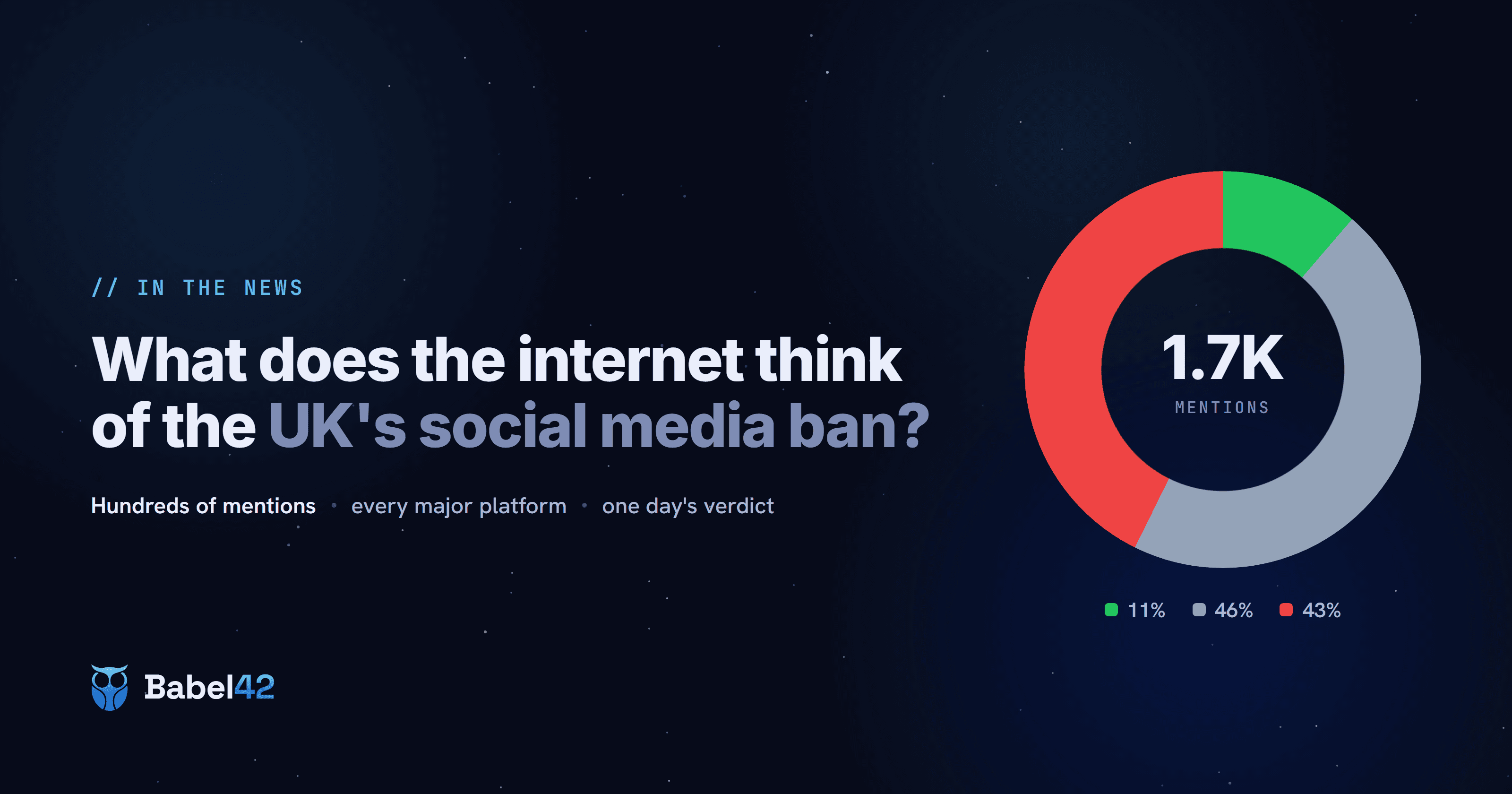
Among the posts that took a side, negative ran ahead of positive by nearly four to one.
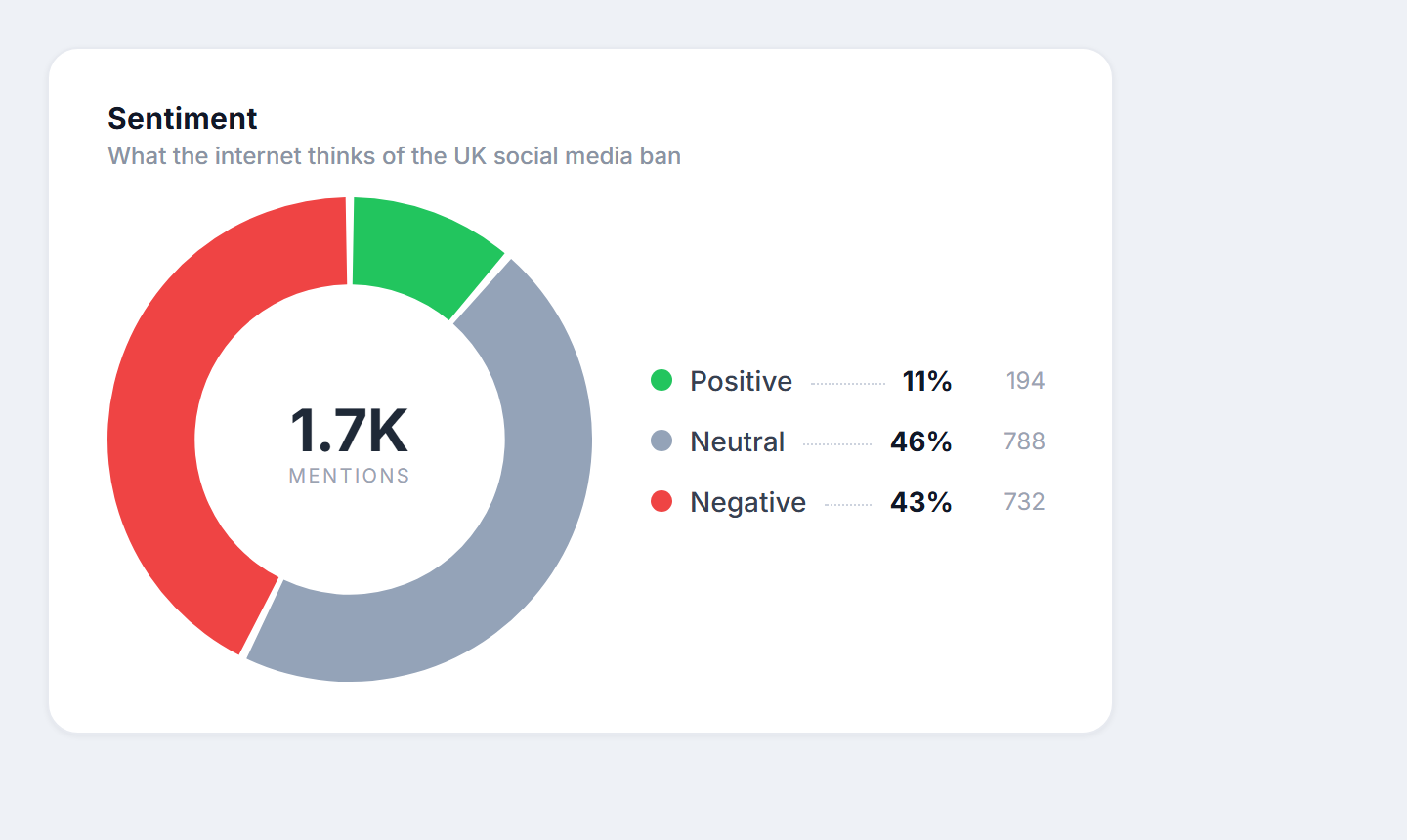
- Negative: 43%
- Positive: 11%
That is the story in two numbers. For every post welcoming the ban, there were close to four attacking it. For a policy the government says nine in ten parents support, "9 in 10 parents backing a social media ban for under-16s" in the words of its own fact sheet, that is a striking gap between the people raising children and the people posting about it, and the explanation, as we will see, is partly about who is doing the posting.
The remaining slice of the conversation was neutral, almost all of it straight news coverage rather than opinion, broadcasters and news brands reporting the announcement without picking a side. We have kept it in the charts for honesty, but the argument is happening in the red and the green.
The same ban, three very different rooms
Split the conversation into X, Bluesky and everywhere else, and that grouping turns out to be the whole story, because the three rooms barely recognise each other's version of events.
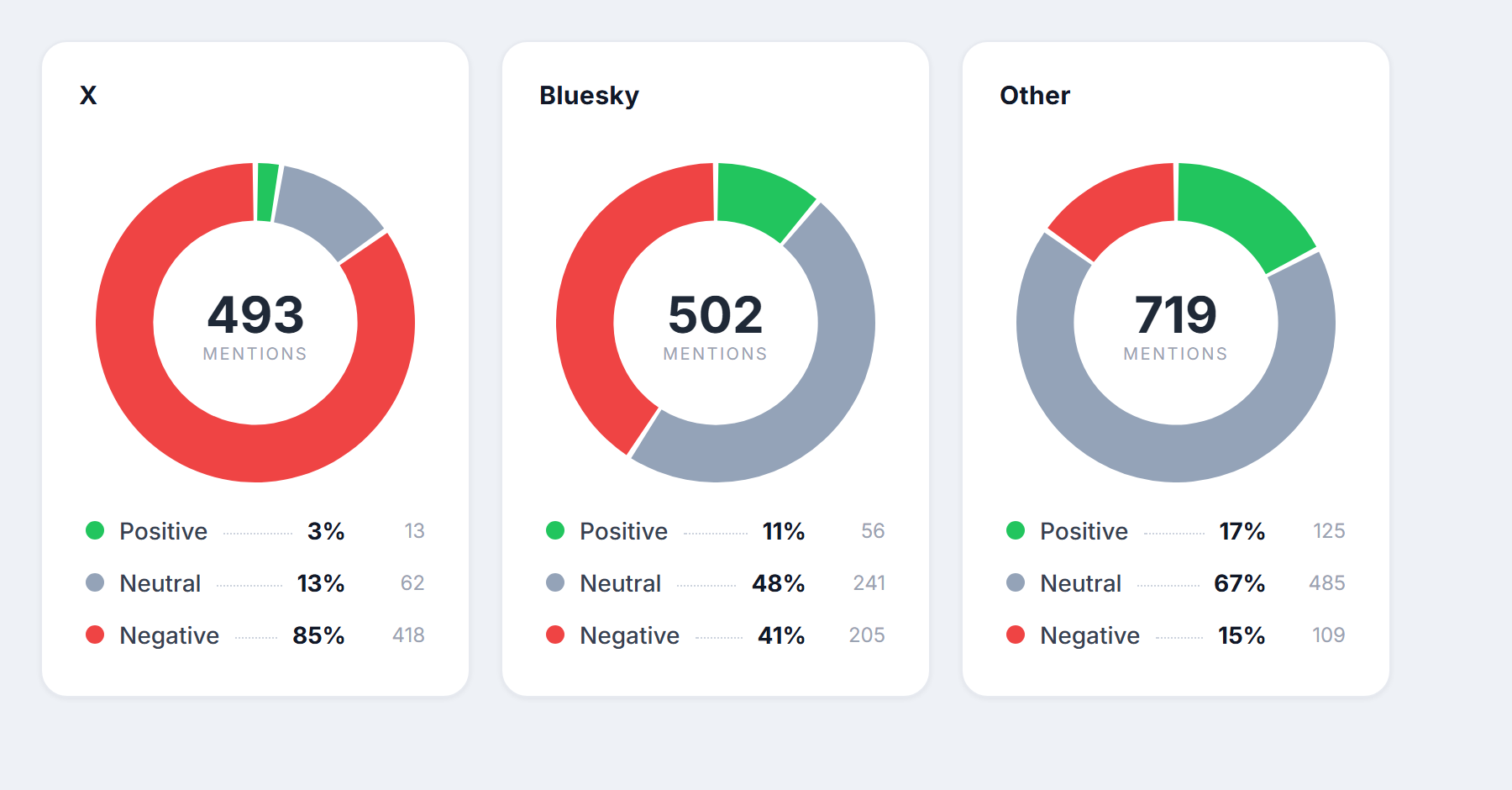
| Platform | Positive | Neutral | Negative | Net sentiment |
|---|---|---|---|---|
| X | 3% | 13% | 85% | −82 |
| Bluesky | 11% | 48% | 41% | −30 |
| Other | 17% | 67% | 15% | +2 |
An 84-point net-sentiment gap separates X from the rest of the internet. Same announcement, same morning, same facts.
X: a wall of opposition
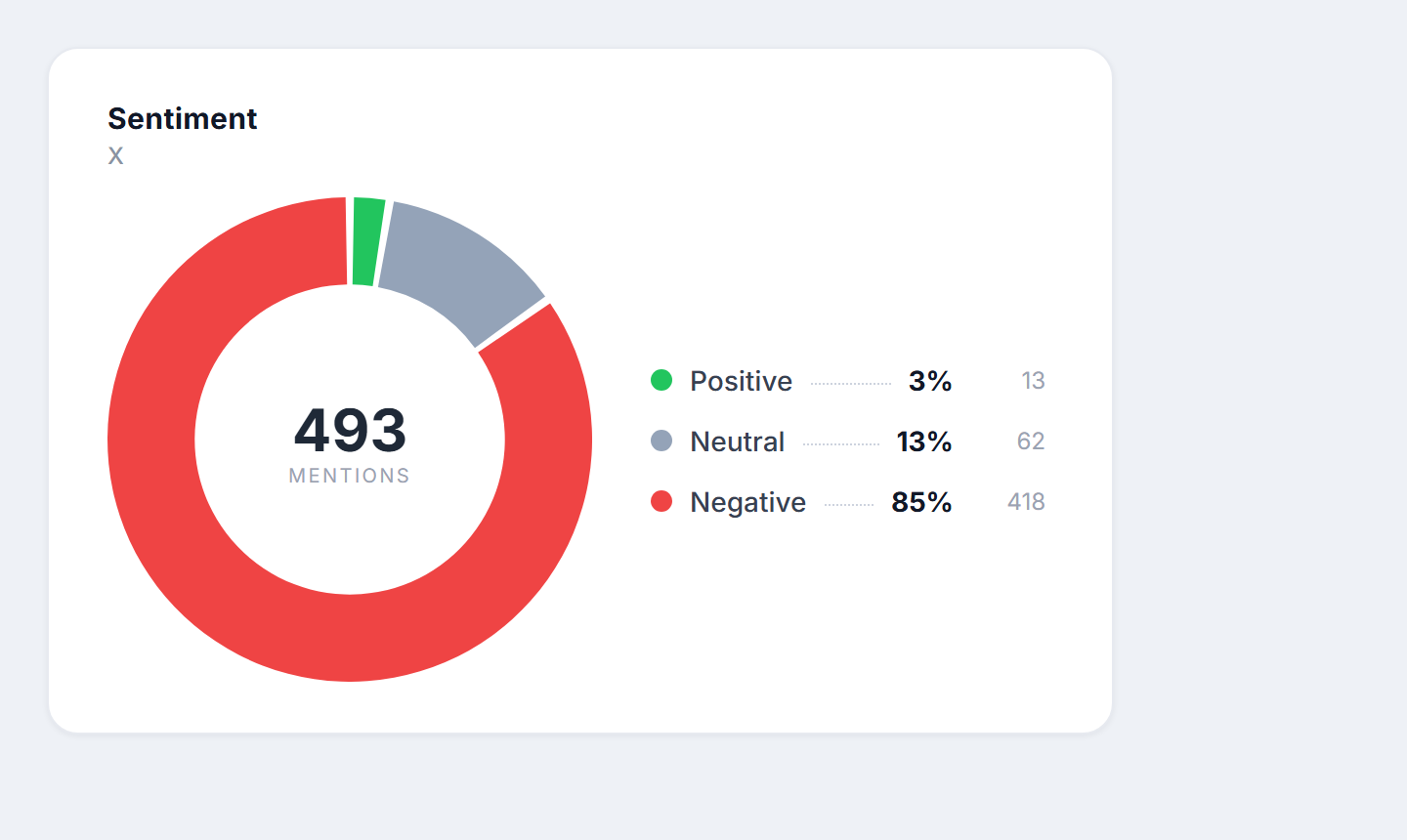
X is not close. More than four in five posts about the ban were negative, and positive sentiment barely registered at 3%. It is the most one-sided platform reading in any analysis we have published.
The reason is structural. The UK's most politically engaged users live on X, and the platform's current centre of gravity is hostile to the government and deeply invested in free-speech and online-privacy arguments. The ban dropped straight into a running conversation about the Online Safety Act, age verification and digital identity, and it was read less as a child-protection measure than as the next step in a surveillance agenda. Elon Musk's reaction, screenshotted everywhere, set the register: he called the UK "a police state" and the policy "a wolf in sheep's clothing", arguing the real goal was to track everyone. On X that was the consensus, not the fringe.
Bluesky: split, and sceptical
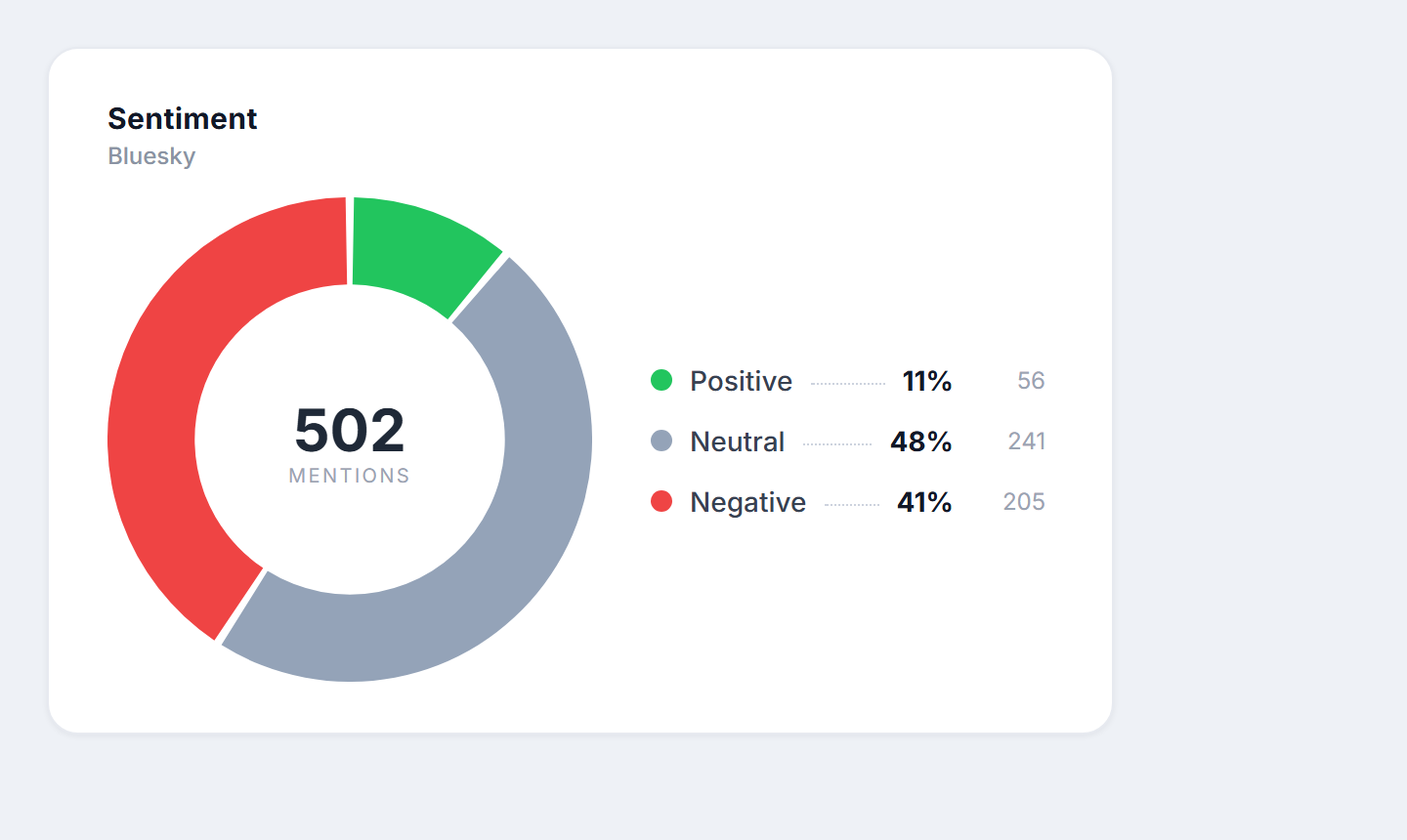
Bluesky is where the journalists, academics and policy-watchers who left X now gather, and its response was more divided: roughly half neutral, four in ten negative, with a small but real positive bloc. The criticism here was different in flavour. Less "the state is coming for your data", more "this is well-meaning, badly thought through, and will not work". Enforcement scepticism dominated, alongside doubts about whether the policy protects children at all. There were defenders too, including teachers and child-safety campaigners, which is why Bluesky's positive share edged ahead of X's.
Everywhere else: mostly the news, quietly reporting
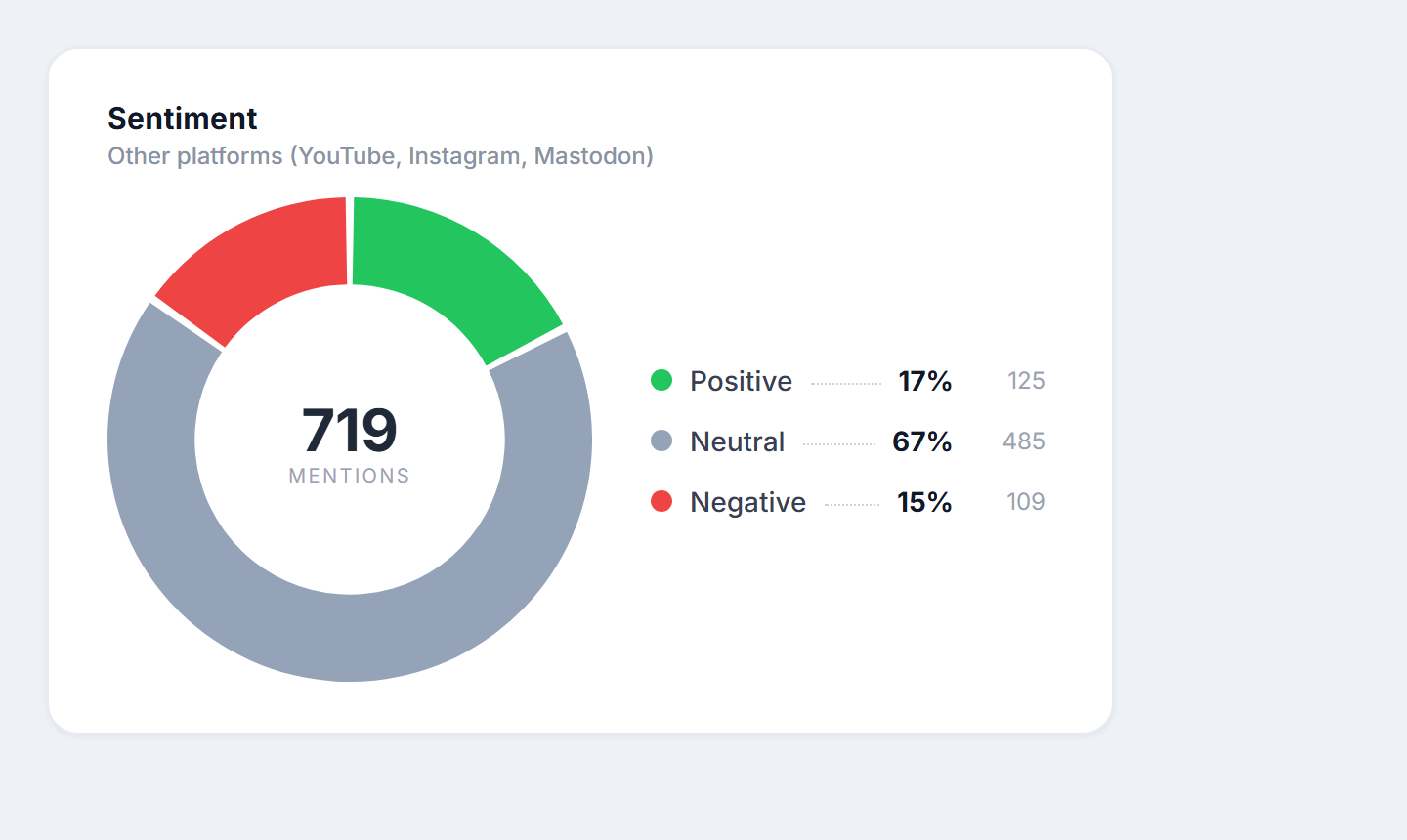
Group YouTube, Instagram and Mastodon together and the mood flips to roughly neutral overall, but that average hides a lot. Two thirds of these posts are straight news coverage, which is why neutral towers over everything else. The opinion that does break through splits by venue. Instagram was the friendliest room of the day, the one platform where positive sentiment clearly beat negative, carried by parents, wellbeing accounts and child-safety campaigners welcoming the move. YouTube leaned slightly negative once you got past the headlines, with political talk shows lining up to call the Prime Minister out. Mastodon, small but vocal, was the most hostile of these three, though nowhere near as one-sided as X.
The practical lesson for anyone doing media monitoring is the one this week illustrates perfectly. Read only X and the ban is a scandal. Read only Instagram and it is a relief. The truth of "what the internet thinks" only appears when you listen across platforms at once.
Why people are against it
Read the negative posts closely and the opposition is not one objection but three, and they matter in this order.
Distrust of the motive was the single biggest theme, and it ruled X. Around a quarter of all negative posts questioned whether the ban is really about children at all. The argument runs like this: to keep under-16s off social media you have to check everyone's age, checking age means proving identity, and proving identity means the end of anonymous accounts. Two of the most shared posts on X put it plainly.
"What's being promoted as a 'social media ban for children' is really an ID check for every adult." Ian Braisby (X)
"Which means if you are over 16, you have to prove that you are over 16 before you can access social media. Which means you have to ID yourself to the government." Glorfindel (X)
This distrust is not confined to one side of politics. On the right of X it reads as digital identity and censorship by the back door. On Bluesky it reads as data harvesting and expanded surveillance powers. The conclusion is the same from both directions: people do not trust the stated reason. One Bluesky post caught the irony that many felt:
"The UK government is banning social media for under-16s to 'protect the children'. Regardless, adults can still access X, which as little as four months ago was able to generate abusive material. Ironically, X is where they put the announcement." Emily Hunt (Bluesky)
The second theme was logistics: a widespread conviction that it simply will not work. A quarter of negative posts focused on enforcement, and this was the dominant complaint on Bluesky. The recurring point is that teenagers are more technically capable than the adults legislating for them, and that a VPN makes the whole thing optional.
"Enforcement will be a nightmare. Teens are already more tech-savvy than most parents." Dr Dean Burnett, neuroscientist (Bluesky)
"Banning social media for teenagers only puts them in greater danger. Teens are forced to switch to VPNs and unlock far worse content. When Russia banned Telegram, 95% of teenagers kept using it. They just moved to VPNs." Watcher (X)
The "it won't work" charge was credible enough that broadcasters tested it directly. LBC ran a segment in which its technology correspondent demonstrated how quickly the new rules could be sidestepped. The government's answer, repeated through the day, was an analogy: we do not scrap alcohol laws just because some teenagers still get served. Whether that convinces the people quoting VPN workarounds is another matter.
The third theme, and the smallest, was a plain dislike of the approach. Roughly one in ten negative posts argued that this is parents' job rather than the state's, that the policy treats a complex problem with a blunt instrument, or that it strips away things teenagers genuinely use. A common, specific objection was the inclusion of YouTube.
"I find it a bit weird that YouTube is part of the social media ban for children. It is a remarkable resource for learning: lectures, tutorials, music lessons, incredible things." Edwin Heathcote (Bluesky)
Some of the heaviest hitters folded all three objections into one verdict. Writing for The Independent, journalist Chris Stokel-Walker called it "a cowardly legacy grab by an outgoing prime minister that will reshape millions of childhoods, and arguably for the worse", before adding, "Oh, and it won't work."
Why people are for it
The positive posts were outnumbered, but they were not quiet, and they clustered tightly around one idea: children's mental health. Six in ten positive posts mentioned wellbeing, screen addiction or simply protecting childhood, and the supporters skewed towards people who deal with the consequences first-hand. Parents, teachers, therapists and campaigners.
"The devil will be in the detail, but the decision to ban social media for under-16s is welcome. The evidence on what social media is doing to young people's mental health is now impossible to ignore." John Caudwell, entrepreneur (Instagram)
"I read about the proposed ban for under-16s, and as a mum of a little boy, I felt an instant huge relief." Anna Durant, parent (Instagram)
Child-safety organisations and education unions, not natural allies of this government, lined up behind it. The National Education Union called it "a turning point in the fight to protect children online". Several Labour MPs pointed to the polling, with one noting that "nine in ten parents have said they would support a social media ban for children under 16". And for a smaller group, the announcement landed personally, including bereaved parents who thanked the Prime Minister directly. The supporters were not arguing the policy is perfect. They were arguing that doing something beats doing nothing.
What we would take away
- The opinionated internet is against this ban, heavily. Once you set aside neutral news coverage, negative posts outnumber positive ones by roughly four to one. That sits oddly next to the nine-in-ten parental support the government cites, which tells you something about who posts and who does not.
- X is a category of its own. At 85% negative it is the most hostile platform, and it is hostile on a different axis: civil liberties and digital identity rather than child welfare. If you monitored only X today, you would badly misread the country.
- The loudest objection is distrust, not dislike. The biggest single driver of negativity is suspicion of the motive, followed by doubts it can be enforced. Outright opposition to the principle of protecting children is the smallest bucket of the three.
- Support is real but lives off the political timeline. It is concentrated on Instagram and among parents, teachers and child-safety groups, the people least likely to win a viral argument on X.
How we did this, and the caveats
We ran Babel42 keyword monitors for the under-16s social media ban as the story broke, sampling public posts from X, Bluesky, YouTube, Instagram and Mastodon. After filtering out off-topic keyword matches, the dataset covered hundreds of mentions on each platform. Follower counts and quotes are as captured at collection time. About a quarter of the posts were reposts, which we kept, because amplification is part of how sentiment travels.
A few honest limits:
- Sentiment is scored by AI, and AI sentiment analysis is not perfect. Sarcasm and irony trip up every system ever built, and a story this politically charged is full of both, so read individual scores as estimates and the aggregates as directional. This is measured, not folklore: in Van Hee et al., "SemEval-2018 Task 3: Irony Detection in English Tweets", the best of dozens of competing systems reached an F1 of 0.71 on the simple yes-or-no question of whether a tweet was ironic at all.
- A sample is a window, not a census. The real conversation is far larger than anything we collected. We analysed a capped sample per platform, so the percentages carry sampling noise and we make no claim about total volume.
- Different platforms, different crowds. X, Bluesky, Instagram and the rest each attract a different audience, so any one platform shows only part of the picture. That is exactly why we read across all of them at once.
Frequently asked questions
What is the UK social media ban? According to today's announcement, the UK government plans to bar under-16s from around ten major social media apps, with limits on gaming and livestreaming, fines for non-compliant platforms, and a start date of spring 2027. The House of Commons Library keeps a running summary of the proposals and their progress in "Proposals to ban social media for children".
What does the public think of the UK social media ban? In our sample, public sentiment leaned negative: 43% of posts were negative, 46% neutral and 11% positive. Among posts that expressed a clear opinion, negative outnumbered positive by roughly four to one.
Which platform is most opposed to the ban? X, by a distance. 85% of X posts about the ban were negative, driven by free-speech, privacy and digital-identity concerns rather than objections to child protection itself.
Why are people against the social media ban? Three reasons, in order: distrust of the government's motive, including fears of mandatory age and identity checks; doubts that the ban can be enforced, given VPNs and tech-savvy teenagers; and a smaller group who see it as the wrong tool or the wrong responsibility.
Who supports the ban? Support is concentrated among parents, teachers, therapists and child-safety campaigners, and was most visible on Instagram. The common theme is children's mental health and online safety.
Run this analysis yourself
Everything above, the sentiment charts, the platform splits, the top-voices ranking and the theme detection, came from Babel42 monitors that took a couple of minutes to set up. Swap "social media ban" for your brand, your competitor, your industry or the next big story, and you will get the same depth on the conversations you care about.
Babel42's free plan includes monitors, AI sentiment analysis and multi-platform coverage, with no credit card and no sales call. Start listening today, for free, and hear what the internet's saying. New to the idea? Start with what social listening is.