// for product & support teams
Customer & product feedback: hear what customers say when you're not asking
Surface complaints, feature requests and praise from across the internet, not just the surveys people bother to fill in.
the brief
Customer & product feedback
Your most honest feedback isn't in a survey. It's in the posts, threads and comments people write when they're not talking to you directly. Babel42 collects that conversation across multiple networks, scores its sentiment and tags the recurring themes, so you can catch a broken release early, spot the feature everyone keeps asking for, and route the unhappy customer to support before they churn.
Catch issues early
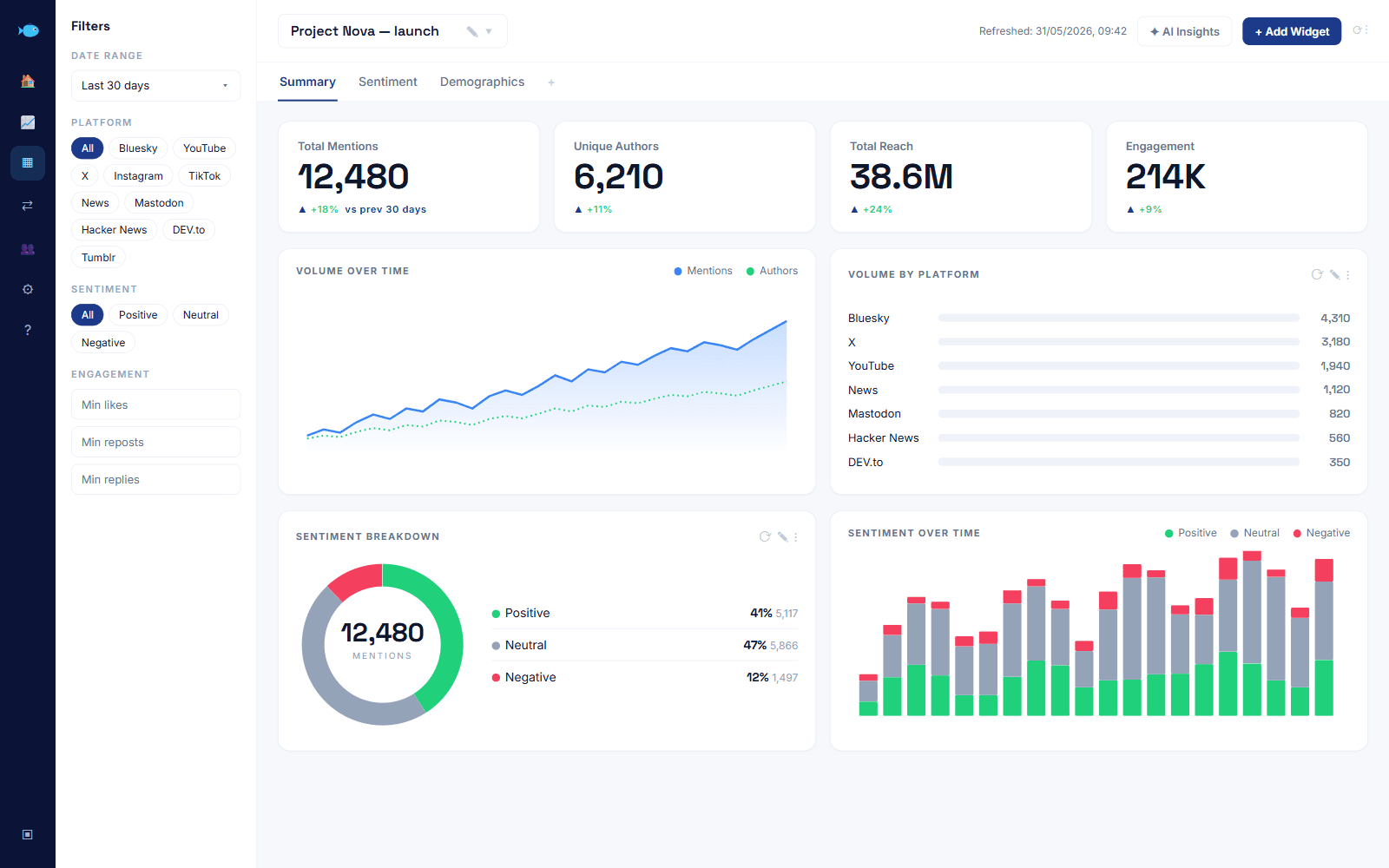
Babel42 scores the sentiment of the mentions it collects and can email you when negative sentiment climbs or a recurring complaint accelerates, which is usually well before it reaches your support inbox. Alerts can be set on volume spikes, sentiment dips or a keyword crossing a count you set, so a broken release announces itself instead of waiting to be noticed.
Find feature requests
Ask Babel42's AI for a read on a feedback monitor and it names the themes it can see across the networks you track, so requests scattered over different sites arrive as a short list instead of a pile. Each one is backed by mentions you can open and read, so a request comes with the customer's own words attached.
Close the loop
Where the network gives Babel42 an author and a link, and most do, an unhappy customer is someone you can go and reply to rather than a number inside a sentiment score. The same applies in the other direction: the praise worth amplifying arrives with the account that wrote it, and you can save those accounts to a list to come back to.
More ways to use Babel42
For founders & brand teams
Brand analysis
ExploreFor journalists & creators
Topic research
ExploreFor marketers & strategists
Competitor analysis
ExploreFor marketers & brand teams
Influencer marketing
ExploreFor developer-tools & DevRel teams
Tech community listening
ExploreFor curious, informed investors
Investment monitoring
ExploreFurther reading
- How feedback gets scored and the sarcastic praise that scores the wrong way.
- Watching the trend rather than the spike sentiment rarely collapses overnight, it drifts.
- What to do when the feedback turns a five-step response for the moment an alert fires.