Someone on your team has started saying "GEO" in meetings. Generative engine optimisation, the practice of getting your brand mentioned favourably when someone asks ChatGPT or Perplexity for a recommendation instead of typing a query into Google. The term is newer than the meetings make it sound: it was coined in a 2023 paper, Aggarwal et al., "GEO: Generative Engine Optimization", later published at KDD 2024. The instinct is to treat it as SEO with a new coat of paint: same playbook, same team, just point it at a different target. That instinct is mostly wrong, and the "mostly" is where the budget gets wasted. So here is GEO vs SEO, stripped of the buzzwords: what changes, and what doesn't.
We wrote what AI search visibility is as the primer. This post is the follow-up question people ask next: fine, but what do I do differently? Below is the practical answer, the parts that change and the parts that don't.
The short version
SEO gets you a ranked position in a list of links. GEO gets you a mention, a characterisation and sometimes a recommendation inside a sentence an AI assistant writes for one specific person. Same underlying goal (be found and chosen by a buyer), completely different mechanism for getting there.
That difference sounds small until you look at what each one optimises.
What changes
The thing you're being measured against isn't a page, it's an answer
A search engine returns ten blue links and lets the user pick. Your job is to be one of the links, ideally near the top. An AI assistant does the picking itself: it reads the query, forms a view, and hands back a paragraph that names a shortlist and often a winner. There's no results page to rank on. There's a single piece of prose, and you're either in it, described well, and named as the answer, or you're not.
This is why "ranking" language doesn't translate cleanly. Position 1 on Google is a well-defined thing. There's no equivalent single number for "how you show up in AI answers", because the answer is regenerated fresh for every conversation, phrased differently each time, and shaped by whatever the buyer said three turns earlier. We wrote about what that actually looks like turn by turn in our breakdown of 59 real AI buying journeys: the same brand appeared in 100% of journeys for one buyer type and 70% for another, in the same week, from the same models.
Your keyword research turns into conversation research
SEO starts from a keyword: search volume, difficulty, intent. GEO starts from a conversation, because that's the unit an AI assistant processes. Real buyers don't type "best social listening tool" into ChatGPT the way they'd type it into Google. They write something closer to "I run a two-person startup, need to track what people say about us on Bluesky and in the tech press, budget is basically zero, what should I use", then follow up on the answer.
That means the research question changes from "what do people search for" to "what does a buyer ask, and what do they ask next". If you only ever optimise for the head-term keyword, you're prepared for turn one of a five-turn conversation and blind to the rest of it.
The content job is answer clarity, not keyword density
Classic SEO rewards content that's comprehensive, well-linked and keyword-relevant, because a crawler and a ranking algorithm are reading it. GEO rewards content that answers a specific, narrow question unambiguously, because an AI model is trying to lift a clean fact or a clear verdict out of it to drop into someone else's sentence.
In practice this means: a page that buries "does this handle IR35 compliance" three paragraphs into a features list is worse GEO material than a page with a heading that says exactly that, followed by a direct yes-or-no and the detail. The model is not rewarding your prose style. It's looking for the sentence it can lift and trust.
The feedback loop is slower and much less legible
With SEO you can check your position most days, run a rank tracker, and see the effect of a change within weeks. With GEO there's no dashboard sitting inside Google that shows you where you rank in ChatGPT's answers, because there's no fixed ranking to show. Google is blunt about this for its own AI answers: "AI features and your website" states that "there are no additional requirements to appear in AI Overviews or AI Mode, nor other special optimizations necessary", and points site owners back at ordinary search guidance. There is no separate lever to pull and no separate position to read off. Models update their training and their live web search on their own schedule, not yours, and two identical questions asked an hour apart can come back with different brands named.
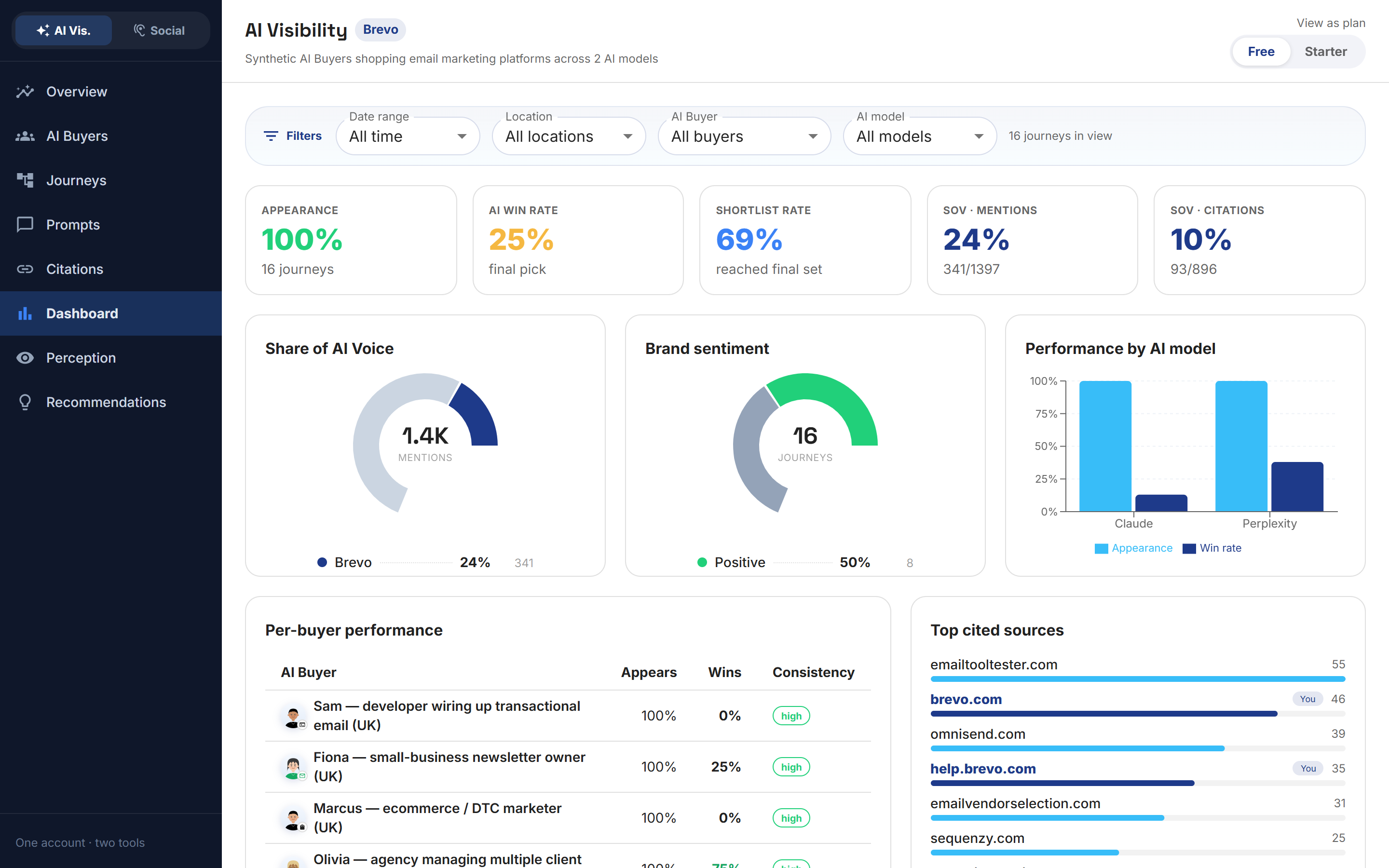
That opacity is precisely why measurement has to be active rather than passive: you can't check a position, so you have to run the conversation yourself, repeatedly, and record what comes back. That's the entire premise behind Babel42's AI Visibility product: send structured AI Buyers through the actual buying conversation, across the models your buyers use, and log who gets named, who gets recommended, and in what words.
Backlinks matter less than being quotable
Domain authority and backlinks are still a real signal in classical SEO ranking. In GEO, the more direct lever is being a source a model trusts enough to cite or draw on: a case study with real numbers, a comparison page that's honest about trade-offs, a mention on a site the model already treats as credible. Volume of links matters less than the model concluding your page said something clear and true.
What doesn't change
It's tempting to treat GEO as an entirely separate discipline requiring an entirely separate team, and that overcorrects. Several things carry straight across:
- Being genuinely good still matters more than any trick. Models draw on real signals about your product, including reviews, forum discussion and case studies. There's no GEO equivalent of a technical hack that makes a mediocre product look better than it is, and if there ever is one, it will be short-lived.
- Clear, factual, well-structured content wins in both worlds. A page that states what your product does, for whom, and at what price, without padding, tends to help both a crawler and a model.
- Third-party credibility still counts. A mention in a publication or forum a model trusts is worth more than one on a low-authority site, exactly as it is for SEO backlinks.
- You still need a measurement discipline. SEO without analytics is guesswork. GEO without running the actual buyer conversations and logging the results is the same problem, just with better branding.
A worked comparison
Take a single buyer question: "what's the best tool for tracking brand mentions on a tight budget." In classical SEO, the target is ranking a page for that phrase (or close variants), built around search volume and competitor gap analysis, then earning the click.
In GEO, the same question, asked of an AI assistant, gets a different treatment entirely. The model doesn't show a page, it writes an answer, and the buyer's next message is usually a constraint you didn't see coming, "I mostly care about Bluesky and YouTube, is there a free tier." The brand that wins isn't necessarily the one with the best-optimised page for the original phrase. It's the one whose pricing and feature pages state its free-tier limits clearly enough that the model can answer the follow-up with confidence. In our own sweep of buyer journeys, the deciding factor was rarely the opening question. It was whether the AI could answer the second and third question about the reader's specific situation, with a fact it could point to.
How to run both at once
You don't need to pick one. A sensible split for a small marketing team:
- Keep your SEO programme as is if it's working: technical health, backlinks, keyword-targeted content. None of that stops mattering.
- Add a GEO content pass on top of it. For your highest-intent pages (pricing, comparison, "how it works"), check that every likely follow-up question has a direct, findable answer. Read the page as if you were the model trying to lift one clean fact from it.
- Measure GEO separately, because it fails silently otherwise. Ask the questions your buyers ask, across two or three AI assistants, and note who gets named and recommended. Do it again next month, because the answer changes without you doing anything.
- Treat the two data sets as complementary, not competing. Google added AI-answer reporting to Search Console itself in June 2026, in "Introducing Search Generative AI performance reports in Search Console", so the two sets of numbers can now sit side by side for Google's own answers at least. A striking-distance keyword in Search Console and a weak AI win rate for the same topic are both telling you the same thing: buyers are asking about this, and you're not winning the answer yet.
Where to start
If your team already runs SEO and is starting to hear "GEO" in the same meetings, the fastest way to find out where you stand is to run the actual buyer conversation and see what comes back. Babel42's AI Visibility product does that: it sends AI Buyers through real, multi-turn shopping journeys across ChatGPT, Claude, Perplexity, Gemini and Grok, probes Google's AI Overviews and AI Mode for appearance and citation, and scores your appearance rate, win rate and how you're described, alongside the social listening data that explains why.
The free plan runs one AI Buyer across any two of those assistants on a weekly cadence, enough to see whether you're in the conversation at all before you invest more anywhere.
If you want to rule out the technical explanation first, our free audit shows you what an AI crawler actually receives from your site, in a few seconds and without an account.