You've probably heard "RAG" in a meeting about AI search, said with the confidence of a term everyone's supposed to already understand. It stands for retrieval-augmented generation, and it sounds like backend plumbing you can safely ignore. It isn't. RAG, or something that works like it, is the mechanism sitting between a customer's question and whichever brand's facts end up quoted in the answer. Understanding the two steps it runs, not the acronym, is what tells you whether your content is even eligible to be picked.
Retrieval-augmented generation, defined
Retrieval-augmented generation is a technique that pairs two systems: a retriever, which searches a set of documents for the passages most relevant to a question, and a generator, a language model that writes an answer using those retrieved passages as its source material, rather than relying only on what it learned during training. The term comes from a specific 2020 paper, "Retrieval-Augmented Generation for Knowledge-Intensive NLP Tasks," by researchers at Facebook AI Research, University College London and New York University, presented at NeurIPS that year (paper listing, NeurIPS proceedings). Their pitch was straightforward: a model that can look things up before answering is more accurate and easier to correct than one that has to recall everything from memory, because you can update or swap the documents it searches without retraining the model itself.
That's the whole idea. What's changed since 2020 isn't the concept, it's the scale of who's using a version of it: a company's own support chatbot, and, in a looser but practically identical sense, the live-search features inside ChatGPT, Perplexity, Copilot and Gemini's grounded answers, all run some form of "search first, then write the answer from what you found."
The retrieval step, unpacked
The generation half is the part people picture, a model writing fluent sentences. The retrieval half is where the selection happens, and it works in three stages that are worth knowing because each one is a place your content can win or lose.
- Chunking. Before anything gets searched, documents are split into smaller passages, a paragraph or a few sentences, rather than kept as whole pages. Retrieval systems fetch chunks, not entire articles.
- Embeddings. Each chunk is converted into a numerical vector, a long list of numbers produced by a language model, that represents the chunk's meaning rather than its exact wording. The query gets the same treatment at the moment someone asks a question.
- Similarity search. The system compares the query's vector against the stored chunk vectors and pulls back whichever chunks are numerically closest, typically using a measure like cosine similarity, and hands only those to the generator to write from (general mechanics, corroborated across IBM's explainer on RAG and vector databases and NVIDIA's overview of RAG).
The detail worth sitting with is the second one: this is matching on meaning, not on exact keywords. A chunk that says "our starter tier includes five monitors" can get retrieved for a question phrased completely differently, "how many brands can I track on the cheaper plan," because the embeddings land close together in meaning even though barely a word overlaps. That's a different game from classic keyword SEO, and it cuts both ways: you don't need to guess the exact phrase a buyer will type, but you also can't win purely by repeating a keyword if the surrounding sentence doesn't actually say anything concrete.
Two versions of this pipeline, and why they matter differently
Companies build RAG deliberately for their own tools: a support bot that searches your help docs before answering, for instance, where you control the whole document set. That's the narrow, original use of the term.
The version marketers should care about more is looser but works the same way underneath: when ChatGPT browses, when Perplexity answers, when Gemini grounds a response in search results, each one is running a retrieve-then-generate loop over the open web instead of a closed set of your own documents. We've written before about how that live-retrieval loop decides which of your pages get crawled and cited, covering the crawling and citation side of that pipeline. This post is one layer underneath that: not whether you get crawled, but what happens, mechanically, at the moment a chunk of your page gets chosen over a competitor's.
What this means for how you write
Three practical consequences follow directly from the mechanics above, and none of them require any special tooling to act on.
- Write in self-contained passages. Because retrieval grabs a chunk, not the whole page, a fact that only makes sense with three paragraphs of prior context is invisible to this process. "As mentioned above, this also applies to our Growth plan" means nothing to a chunk pulled in isolation. Restate the specific fact each time it matters, plan name and number included, rather than pointing back at earlier text.
- Favour semantic clarity over keyword repetition. Since matching runs on meaning, not exact phrasing, the win isn't stuffing a target phrase into every sentence, it's stating the underlying fact plainly enough that its meaning is unambiguous regardless of how someone phrases the question. "Free plan: 500 mentions a month, 2 monitors, 5 networks" carries a clear, liftable meaning. "Generous limits on our starter tier" carries almost none, however many times you repeat the word "generous."
- Structure still helps, even though matching is semantic. A clear H2 that states the actual question, followed immediately by the direct answer, gives the chunking step a clean, self-contained boundary to split on. A wall of text with the answer buried in sentence four of a paragraph makes it more likely the retrieved chunk cuts off before the useful part.
Seeing it land as an actual citation
None of this is theoretical: it's the same mechanism playing out every time an AI assistant answers a question inside one of Babel42's AI Buyer journeys. Below is a real one: the buyer, their opening prompt, and the model's first answer, with the brands it named ready to open up.
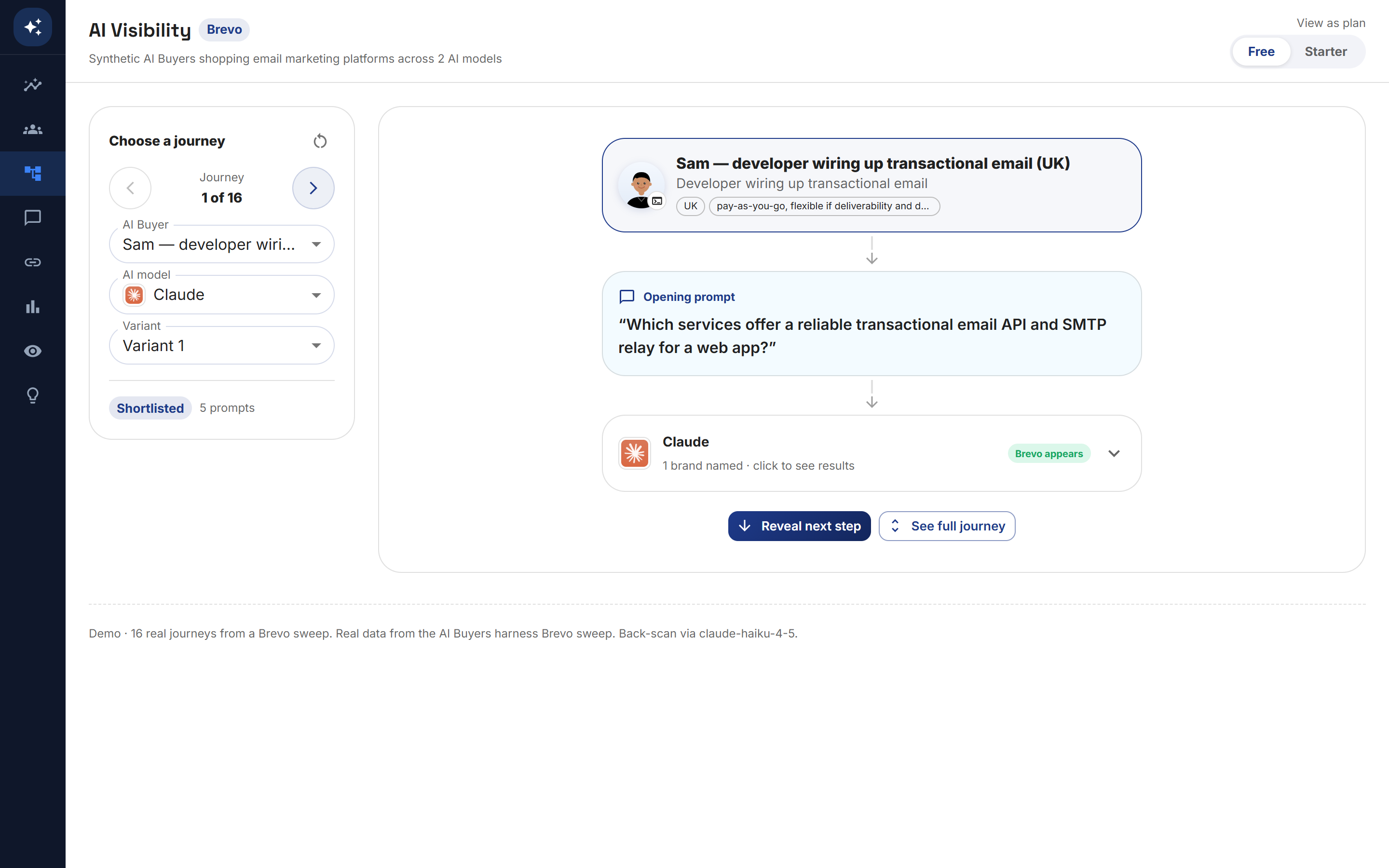
Every one of those citations is a retrieval decision like the ones above playing out on a real query, some chunk of some page got judged the closest semantic match and got quoted, and a different chunk, maybe yours, didn't. What AI search visibility actually measures is, in large part, how often that retrieval decision lands on you rather than a competitor. If you want to see which of your own pages are winning that match and which aren't, that's what Babel42's AI Visibility product tracks, running real AI Buyer journeys across ChatGPT, Perplexity, Claude, Gemini and Grok and showing you the sources each answer cited. The free plan runs one AI Buyer across any two of the seven assistants weekly, no card required, enough to see whether your own facts are the ones getting retrieved.
The short version
RAG is a two-step loop, retrieve the most relevant passages, then generate an answer from them, and the retrieval half runs on chunked, embedded, semantically-matched text rather than whole pages or exact keywords. Understanding that changes what "writing for AI search" actually means: fewer vague sentences that depend on context from three paragraphs back, more self-contained passages that state one fact plainly enough to survive being lifted out on their own. The same discipline applies when an assistant reads one long document you've handed it directly rather than searching for it: see how AI chatbots summarise long content for that side of the mechanism. Retrieval only covers what a model looks up live; for the separate question of what it already knows from training, see how AI models are actually trained.