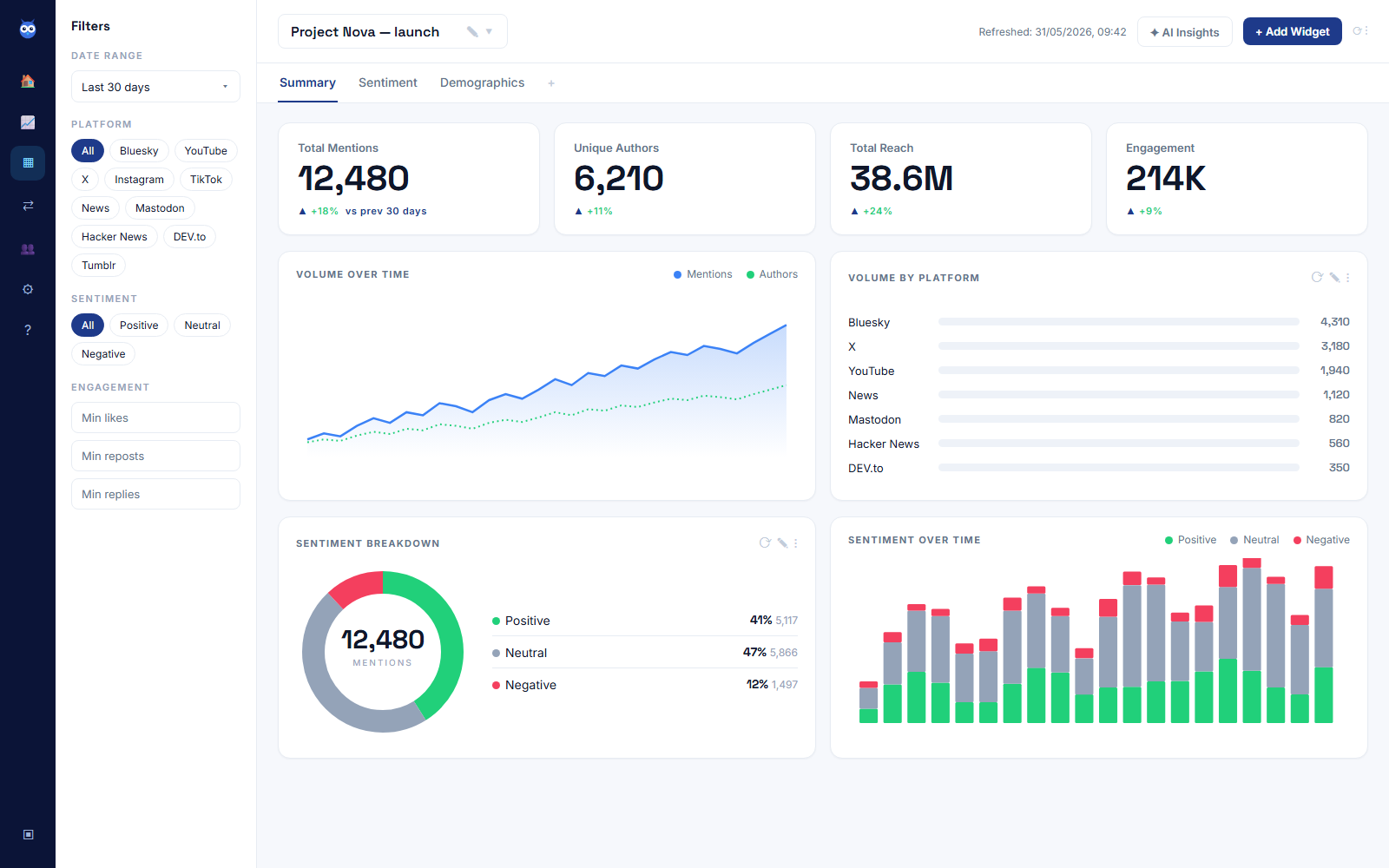
You've probably seen the dashboard before you've seen the machinery behind it: a chart of mentions climbing, a sentiment score sitting at "72% positive," a list of the accounts driving the conversation. It looks tidy. What's less obvious is how do social listening tools work to get from "someone posted something, somewhere" to that clean, confident number, especially when the something is happening across a dozen platforms at once, in volumes no person could read by hand.
This guide walks through the actual pipeline: where the mentions come from, how a flood of raw posts gets cleaned up and de-duplicated, how sentiment gets scored, and why some mentions end up weighted more heavily than others. If you're evaluating tools rather than just using one, this is also the checklist for telling a genuinely capable product from a search box with a nicer coat of paint.
The short answer: four jobs, done continuously
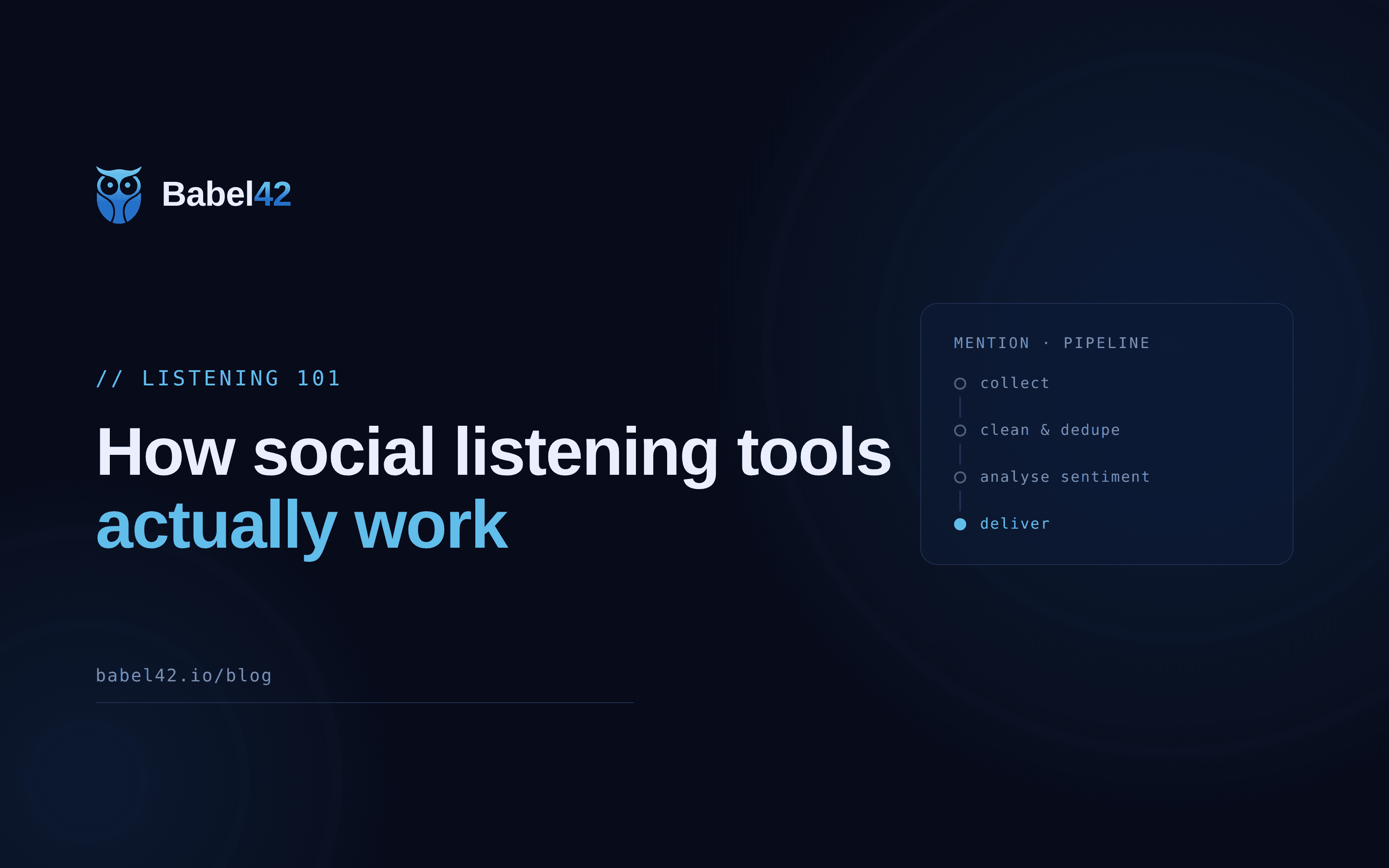
Strip away the branding and every social listening tool, Babel42 included, is doing the same four jobs, in the same order, over and over:
- Collect: pull in every public post that matches your query, from every source the tool covers.
- Clean: strip duplicates and near-duplicates, so one viral story doesn't count as forty mentions.
- Analyse: score sentiment, spot themes, and work out which mentions and which authors matter.
- Deliver: turn all of that into alerts you'll see and dashboards you'd share.
The dashboard is just the visible end of step four. Everything interesting happens in the three steps before it, so that's where we'll spend the rest of this guide.
Where the mentions come from
The collection step depends entirely on what each platform allows. Some networks run an open firehose you can plug into directly, Bluesky publishes one; others require an official, metered API, X bills per request and YouTube runs on a daily quota; a few (Reddit is the classic example) actively work to keep unauthenticated scraping out. That's why "which platforms does it cover" is the first honest question to ask any listening tool, because the honest answer usually has an asterisk on at least one network. Reddit is the clearest case: its Data API Terms require a separate negotiated agreement for "commercial purposes, research in excess of rate limits, or for any use that is not expressly permitted".
Babel42 collects from Bluesky, YouTube, Instagram, Mastodon, Twitch, Tumblr, News, and the developer and Q&A corners of the web (Hacker News, DEV.to, Stack Exchange), plus reviews. X (Twitter) is covered too, through the official X API, but as a paid add-on rather than part of the base plan: X charges per post pulled at the API level, and says so itself, "pay only for what you use", with "credits, deducted per request". So any tool offering "free, unlimited X coverage" is either quietly rationing it or not actually pulling from X's real-time API at all. Worth asking directly if a platform isn't listed: is it not collected, or collected but capped?
Turning a flood of posts into one clean signal
A broad query on a live topic can return thousands of raw hits a day, most of them irrelevant, and a meaningful chunk of them the same story told forty times over. Two things have to happen before that flood is useful:
Query precision. This is the part you control. Boolean operators, AND, OR, NOT, exact phrases and hashtags, are what separate "mentions of your brand" from "mentions of every word in your brand name used separately." Babel42 evaluates these precisely on every platform it covers, so a query like "Babel42" NOT "Tower of Babel" genuinely drops the false positives rather than just downranking them.
De-duplication. A single news story gets picked up by a dozen outlets and reposted by fifty accounts. Without de-duplication, that's one event inflating your mention count fifty times over, and your "share of voice" chart becomes noise. A tool worth using collapses that back down to the underlying story before it ever reaches sentiment scoring, so the number you see reflects how many people are saying it, not how many times it was copied.
How sentiment scoring works
Once the flood is cleaned up, each mention gets scored, usually positive, neutral or negative, and rolled up into a trend line. The hard part isn't assigning a label; it's getting the label right on the posts that don't say what they mean. "Great, another outage" reads positive to a keyword matcher and is obviously the opposite to a human. This is the single most studied weakness in the field: in Van Hee et al., "SemEval-2018 Task 3: Irony Detection in English Tweets", dozens of research teams competed on nothing harder than deciding whether a tweet was ironic, and the winner reached an F1 of 0.71. A launch-day meme, a sarcastic reply, an excited "no words" comment: all of these trip up anything scoring purely on individual words.
Babel42's approach is to have AI read the mention in context rather than scoring keywords in isolation, which is what lets it separate genuine praise from sarcasm dressed up as praise, then roll individual scores up into themes: not just "sentiment is down," but what has changed and why. That distinction, context versus keyword-matching, is worth asking about directly when you're comparing tools, because it's usually the single biggest difference between a sentiment score you can trust and one you have to double-check by hand anyway.
Why some mentions matter more than others
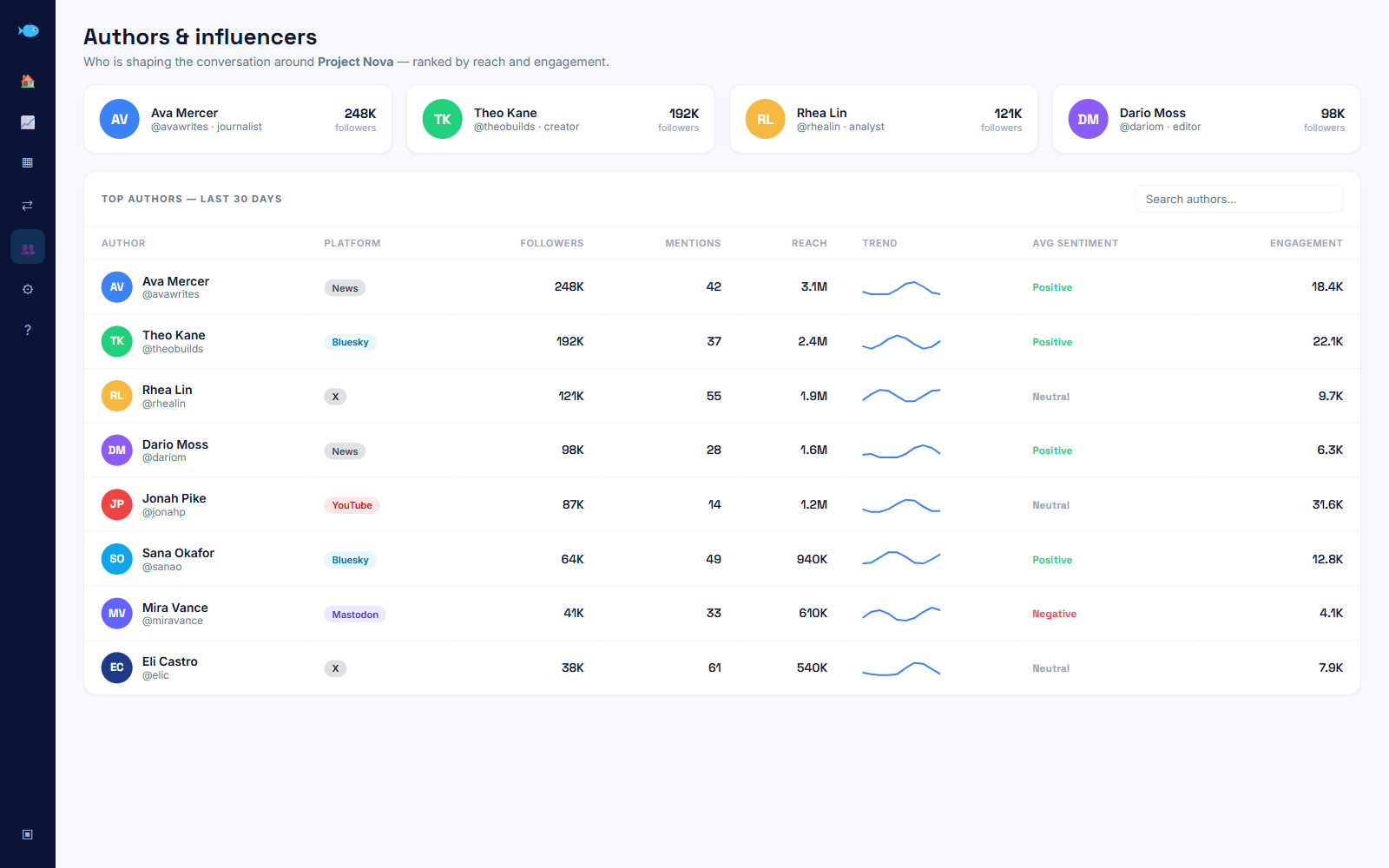
Not every mention carries equal weight, and a tool that treats them as equal will bury the one post that mattered under ninety-nine that didn't. A single post from a journalist with a large, engaged following says more about where a story is heading than a hundred posts from accounts with no reach at all. That's why author and influencer ranking is a core part of the pipeline, not a bonus feature bolted on afterwards: Babel42 ranks the accounts behind a conversation by reach, engagement and sentiment, so the mention worth acting on (the journalist worth pitching, the creator worth a reply) surfaces instead of getting lost in the volume.
From data to decision: alerts and dashboards
The last job is making sure the analysis reaches you at the moment it's useful, not three days later when you happen to check. That means two different outputs, built for two different situations:
- Alerts are for right now: a volume spike, a sentiment dip, or a notable account joining the conversation, pushed to you as it happens rather than waiting to be discovered on your next login.
- Dashboards are for the pattern over time: is sentiment trending up or down across the month, which platform is driving the volume, how does this launch compare with the last one. That needs history, not just a snapshot, which is why retention (how far back a tool keeps your data) is worth checking before you commit to one.
Put together, that's the whole system: collect broadly, clean thoroughly, score in context, weight by who is saying it, then get the result in front of you while it's still actionable.
What this means if you're comparing tools
Knowing the pipeline turns "which social listening tool should we use" from a features checklist into a shorter, sharper set of questions:
- Which platforms are genuinely collected, and which are capped, sampled, or a paid add-on?
- Does sentiment scoring read context, or just match keywords?
- Is duplicate content collapsed before it reaches your mention count?
- Can you rank the people behind the conversation, not just count the posts?
- How far back does history go?
If you want to see the pipeline end to end rather than take our word for it, our plain-English guide to what social listening is walks through every stage with real screenshots, and how to do social listening for free shows what the same pipeline looks like on Babel42's free plan: 500 mentions a month, two monitors, across five networks, with AI sentiment analysis and 90 days of history, no card required. For a closer look at the sentiment step specifically, including the exact ways it gets fooled and how to read a score without getting caught out, see how sentiment analysis works, and where it fails. And once the pipeline's delivered its output, what belongs on a social listening dashboard covers which of those numbers earn a place on the screen you check every day.