You've probably done this: pasted a long report, a product page or your own blog post into ChatGPT or Claude and asked for a summary. Sometimes it's sharp. Sometimes it circles back to the first sentence you wrote, misses the actual point you made three paragraphs down, and confidently states something you never said. If that's felt inconsistent rather than random, there's a reason, and it's not that the model "didn't read carefully enough." It's how these systems summarise long content, and once you know the mechanism, you can write so the important part survives the process.
How do AI chatbots summarise long content?
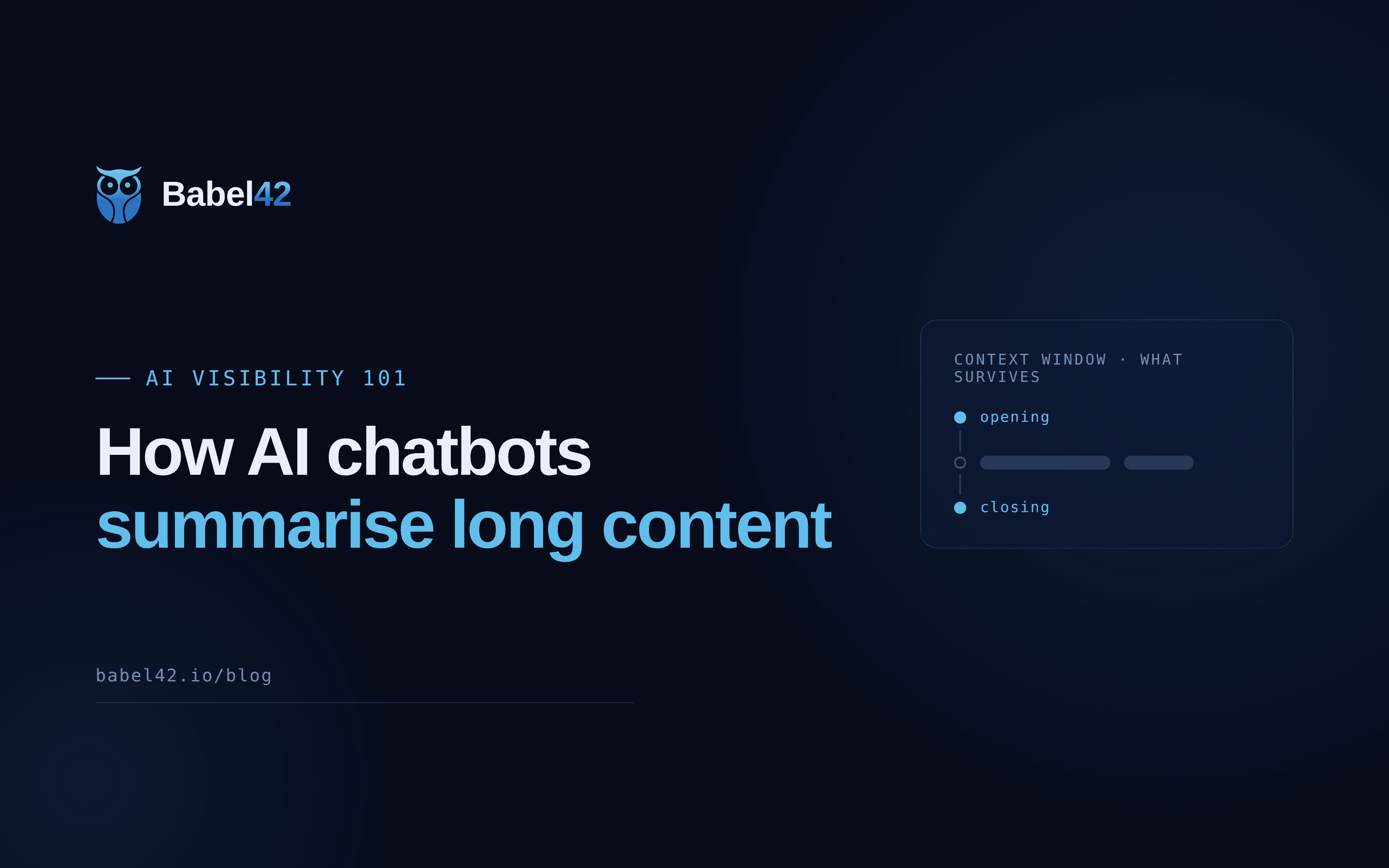
Two things are happening at once, and they're separate problems. First, a model can only see a fixed amount of text at a time, called its context window. Second, even within that window, it doesn't weigh every part of the text equally. Position matters, and the middle loses.
The context window is the working-memory limit: the maximum amount of text a model can hold in view while it reads and writes, measured in tokens rather than words. IBM's explainer on the concept puts it plainly: think of it as the model's short-term memory for a single conversation or document; whatever falls outside that window simply isn't available to draw on, no matter how relevant it might have been (IBM, "What is a context window?"). A very long PDF, or a page with a lot of navigation and boilerplate around the actual content, can burn through that budget before the model even reaches your conclusion.
That explains why extremely long input gets cut short. It doesn't explain why a summary of a page that fits comfortably inside the window still skips the middle. That's the second mechanism, and it's been measured directly.
Why the middle of a long page gets left out
A 2024 paper from researchers at Stanford, UC Berkeley and Samaya AI tested how well language models use everything inside their context window, rather than assuming a bigger window means even attention across it. Their finding: performance is highest when the relevant information sits at the very start or the very end of the input, and it drops noticeably when the model has to find that information buried in the middle, a pattern that held even for models built specifically to handle long context (Liu et al., "Lost in the Middle: How Language Models Use Long Contexts," TACL 2024). The paper's title became the name for the effect: content in the middle gets lost, not because the model can't technically see it, but because it doesn't weigh it as heavily when deciding what to report back.
Translate that to a blog post or a product page. Your headline claim in the first paragraph is well placed. Your call to action or final summary at the bottom is well placed too. The differentiated detail you buried in paragraph six, the specific number that proves your point, sits exactly where a summary is statistically least likely to pick it up.
What Anthropic's own guidance for long documents recommends
This isn't only an academic finding. It shows up in how AI labs tell developers to structure their own long-context prompts. Anthropic's prompt-engineering documentation advises putting long documents near the top of a prompt, ahead of the actual question or instruction, because doing so measurably improves how well the model uses them, particularly on tasks involving more than one document (Anthropic, "Long context prompting tips"). The same guidance recommends wrapping distinct pieces of content in clear structural markers, so the model can tell where one document or section ends and the next begins, and asking the model to quote the specific passage it's relying on before it answers, which anchors the response in the actual text rather than a vague impression of it.
Read as advice for prompting a model, that's about how to structure input you're feeding in. Read as a description of what a model responds well to, it's a fairly direct account of what makes a passage easy to lift out correctly: it's near a natural boundary, clearly marked, and specific enough to quote on its own.
What this means for how you write
None of this requires new tools. It changes where you put things and how self-contained each section is.
- Put your strongest, most specific claim first, and restate it at the end. The primacy-and-recency pattern in the research above means your opening paragraph and your closing section carry more weight in a summary than anything in between. Don't save the actual point for a big reveal in paragraph five; state it up front, then use the middle to support it.
- Make every section stand on its own. A model summarising your page doesn't necessarily process it start to finish the way a person does. A sentence that only makes sense with three paragraphs of context behind it ("as mentioned above, this also applies here") is a weak candidate for being pulled out correctly. State the fact plainly, with the specific number or name attached, everywhere it matters, not just once near the top.
- Use headings that mark real boundaries. Clear, descriptive headings do for a human skimmer and a summarising model the same job Anthropic's own guidance describes for structural markers in a prompt: they show where one idea ends and the next begins. A wall of text with no headings gives the model nothing to anchor a boundary to, which is one more way content in the middle gets treated as filler rather than signal.
This is the same discipline we've written about from the retrieval side: when an AI assistant searches the web before answering, it pulls in self-contained, specific passages over vague ones that depend on surrounding context. Summarisation and retrieval are different mechanisms, one reads a document you handed it directly, the other searches and selects passages from many, but they reward the same kind of writing for the same underlying reason: a specific, self-contained statement survives being lifted out of its original context, and a vague one doesn't.
Seeing what a model reports back
The clearest way to check whether your own writing is landing the way you intend is to watch what an AI assistant actually says when asked a real question in your category, not guess from the outside. Below is a real journey from Babel42's AI Visibility product: the buyer, their opening prompt, and which brand the model named in its first answer.
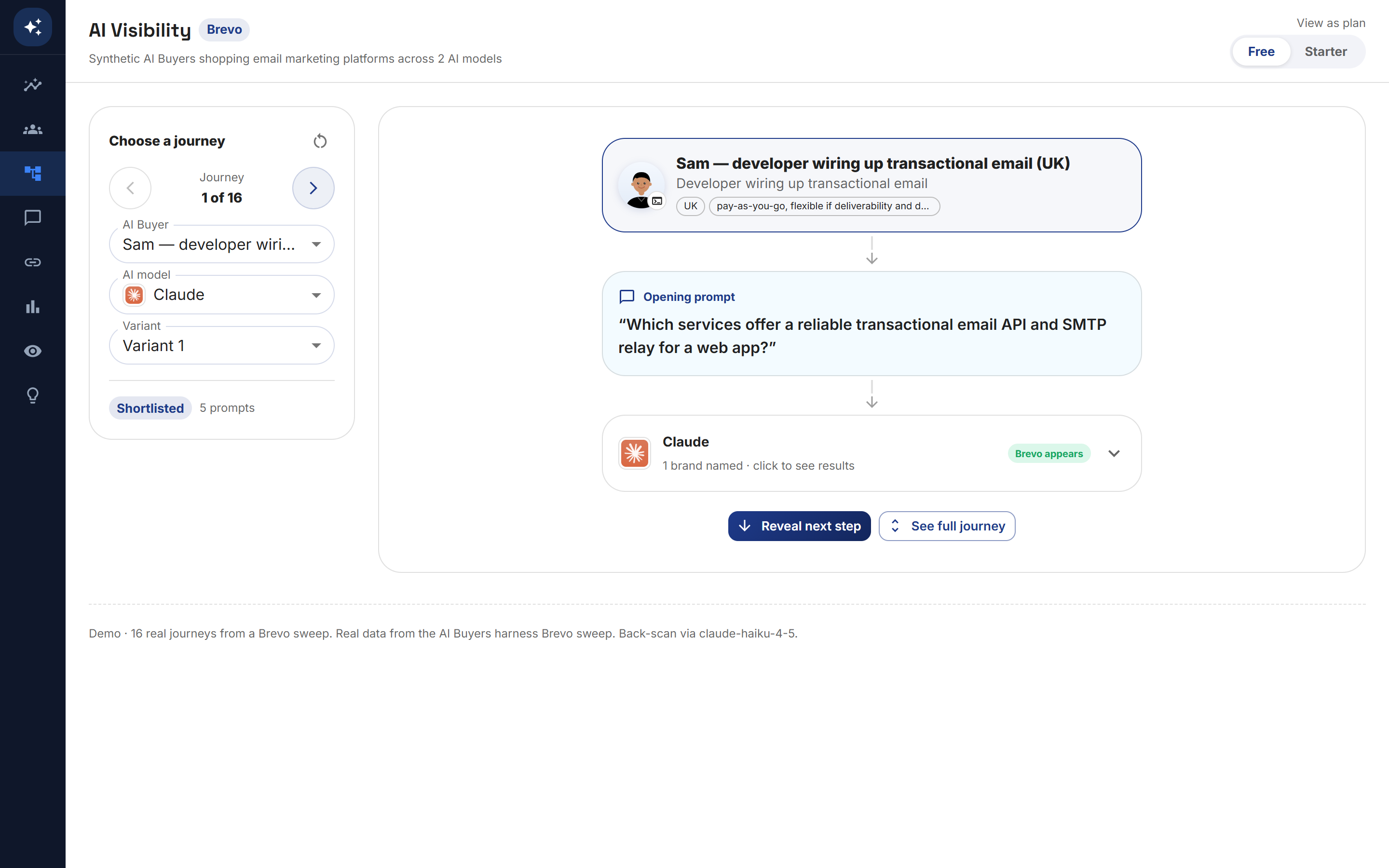
That's Claude answering a buyer built around a specific need ("a reliable transactional email API and SMTP relay for a web app"), with the result showing which brand it named and whether it appeared at all. It's the same underlying behaviour as the summarisation research above, playing out on a live question: the model reads what's available to it and decides, based partly on how clearly a fact is stated and where it sits, what to surface. We covered why some brands get cited over others in more depth previously; this post is about the layer underneath that, why a model that does read your page still might not report the part you most wanted it to.
If you want to see this happening against your own content rather than a demo, that's what the AI Visibility product runs continuously: real buyer journeys across ChatGPT, Claude, Perplexity, Gemini and Grok, with the sources each answer cited. The free plan runs one AI Buyer across any two of the seven AI assistants, no card required, enough to see which of your own facts are getting picked up.
The short version
Two mechanisms decide what survives when an AI chatbot summarises long content: a hard limit on how much text it can hold in view at once (the context window), and, within that window, an uneven weighting that favours information near the start or the end over anything buried in the middle, a pattern confirmed directly by the "Lost in the Middle" research and echoed in how Anthropic itself advises structuring long input. The fix isn't cramming in more keywords or writing more text. It's putting your strongest, most specific claim early and again at the end, keeping each section self-contained enough to be lifted out on its own, and using headings that mark a real boundary rather than a decorative label.