You've run the numbers. Maybe you asked ChatGPT and Perplexity a dozen buyer questions by hand, or you've had an AI Visibility tool tracking it properly for a few weeks. Either way, you now know your appearance rate is patchy, a rival gets recommended more often than you do, and when you do show up, the AI hedges: "good for some use cases, though pricier than alternatives." Fine. Now what?
This is the follow-up question everyone asks once they've measured what AI assistants say about you for the first time, whether through the full method or the quicker visibility audit. Knowing your score is the easy part. Improving it means changing what the internet, and by extension the models trained and retrieving from it, know about you. Here's what makes the biggest difference, in the order we'd tackle it.
Start from the transcript, not a hunch
The single biggest mistake is treating this like SEO and guessing at keywords. AI buyer journeys don't run on keywords, they run on paragraphs: real constraints, budgets, deal-breakers, stated out loud across several turns of conversation. We watched this happen across 59 real AI buying journeys: a buyer states a budget, a compliance requirement, a dealbreaker, and the model filters brands against all of it in one go.
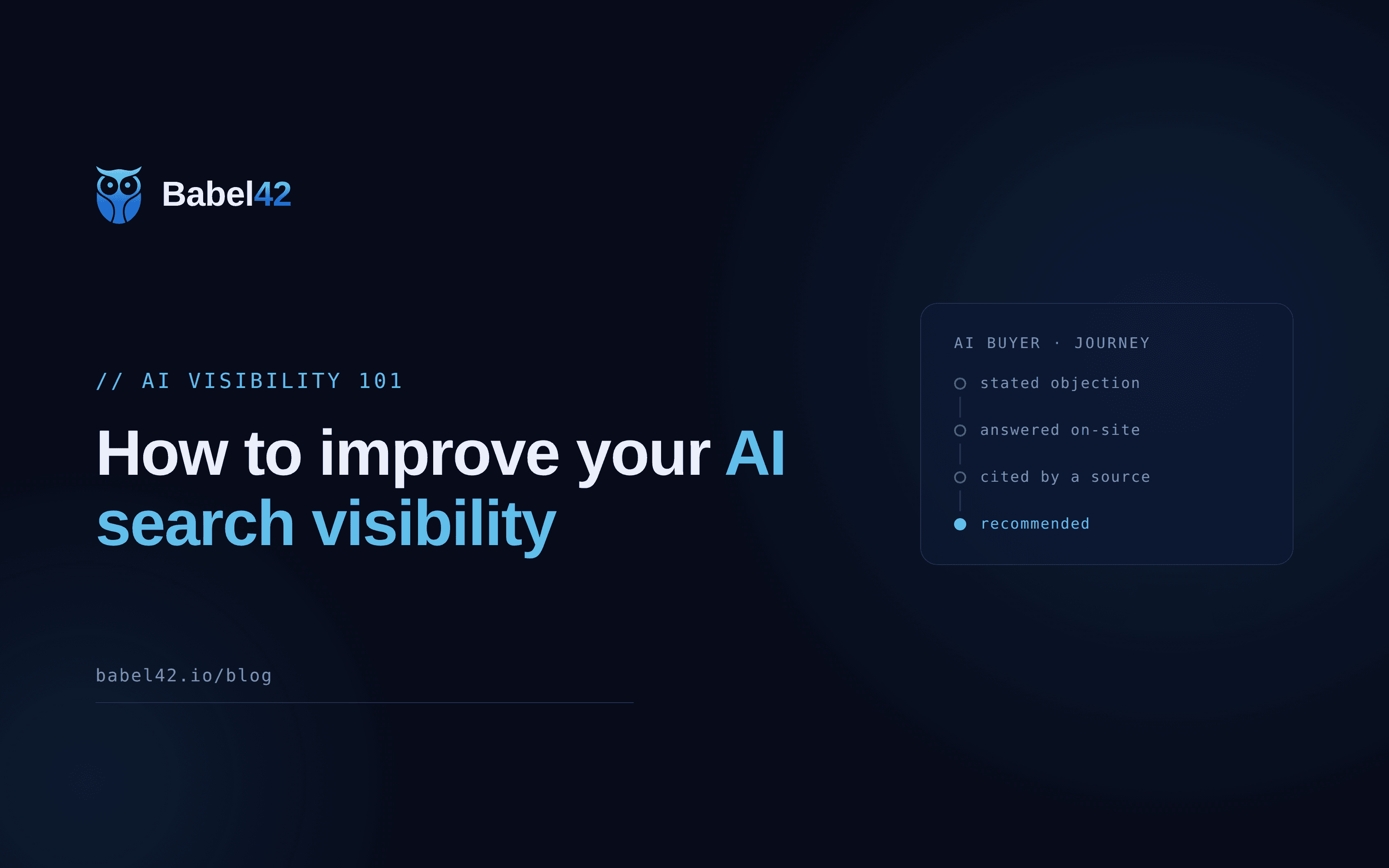
That matters for improvement work because the fix isn't "rank for a phrase", it's "answer the actual question, with the actual caveat, somewhere the model can find it." Before you write a word of new content, read back through your own transcripts (or run a handful of manual prompts across ChatGPT, Claude and Perplexity if you don't have transcripts yet) and write down, verbatim, every objection the AI raised when it didn't pick you. That list is your content brief. Nothing you write speculatively will beat it.
Answer the objection, in public, in plain terms
Once you have that list, the fix is usually mundane: a page that states the answer clearly enough that both a human and a retrieval system can lift it whole. This is also, unhelpfully for anyone hoping for a trick, exactly what Google tells site owners to do for ordinary search, in "Creating helpful, reliable, people-first content". If AI answers keep saying you "don't handle enterprise SSO" and you do, that's a missing or buried page, not a positioning problem. If they say your pricing "can add up", check whether your own pricing page answers the question a buyer would ask, plainly, without requiring a demo call to find out.
A few patterns we'd prioritise, roughly in order of how directly they map to a lost objection:
- A dedicated page or clear section for each recurring objection. Not a blog post that mentions it in passing, a page that states the fact plainly enough to be quoted.
- Numbers over adjectives. "2,000 mentions a month on the Starter plan" survives being lifted into an AI answer. "Generous limits" does not.
- A comparison page that's honest about trade-offs. Models seem to trust pages that admit a limitation more than pages that claim to be best at everything, and it gives the AI something specific to cite when it recommends you with a caveat instead of skipping you.
- FAQ content in your own words, matching how buyers phrase the question (see the transcript work above), not how your product team phrases the feature.
Earn the coverage AI models cite, not just the links that rank
Content on your own site is half of it. The other half is what independent sources say about you, because retrieval-augmented answers lean on pages the model doesn't control: review sites, comparison articles, forum threads, credible press. That mechanism has a name and a paper behind it, Lewis et al., "Retrieval-Augmented Generation for Knowledge-Intensive NLP Tasks", published at NeurIPS 2020: the model fetches documents at answer time and writes from them, so whatever it fetched is what it can say about you. This is the part that overlaps most with classic SEO and PR, and it's also where GEO and SEO genuinely diverge: a backlink that helps your search ranking doesn't automatically help an AI answer, but a clear, factual mention on a site the model trusts enough to retrieve from does.
Practically, that means:
- Pitching genuine comparison and roundup pieces to publications and newsletters in your category, with facts they can quote directly, not just a link.
- Making sure your own product pages state facts (pricing, limits, what's included) unambiguously, so any site that quotes you quotes you accurately.
- Not chasing volume. A handful of accurate, citable mentions on sites the model retrieves from beats a pile of low-quality guest posts.
Track competitors, not just yourself
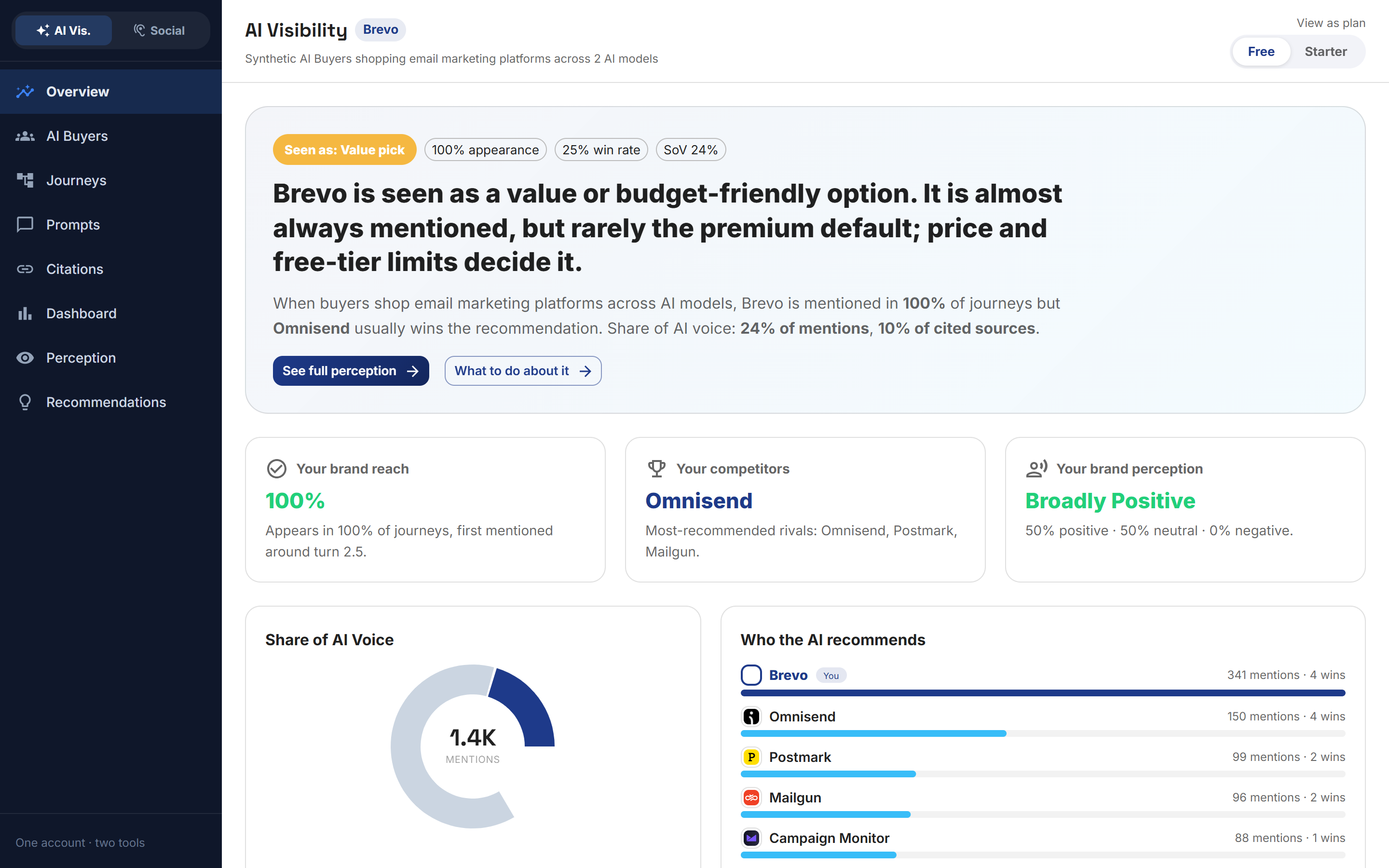
One of the sharper findings from watching real AI buyer journeys is that the same brand can win one buyer segment completely and lose another completely, in the same week, across the same models. If you're only watching your own appearance rate, you'll miss why a competitor is winning a specific buyer type and you aren't. Babel42's share of voice comparison exists for this: track competitors alongside yourself and see which platform, which buyer type and which model is going their way instead of yours, so the content and coverage work above gets pointed at the segment that is leaking, not the one that feels most urgent.
Fix the things that are simply wrong
Sometimes the AI isn't hedging, it's out of date or just incorrect: a discontinued feature it still lists, a price that changed a year ago, a "founded in" date that's wrong. These are the easiest wins because they don't require new content, they require finding and correcting the stale source. Search for your brand name alongside your product category and read what comes back across a few AI assistants; where an answer states something factually wrong, trace it to the source page (yours or a third party's) and get it corrected. This is unglamorous, but a model repeating a wrong fact confidently is worse than a model hedging on a true one. One cause worth ruling out first: if a crawler cannot reach the corrected page, the stale version is all the model has to work from. Our free audit fetches your site the way an AI crawler does and shows you what it receives.
Make it a cadence, not a one-off audit
Model behaviour shifts as vendors update models, retrieval and web search, sometimes within weeks. Google's guidance for its own AI answers, "AI features and your website", says flatly that "there are no additional requirements to appear in AI Overviews or AI Mode, nor other special optimizations necessary", which is another way of saying there is no setting to get right once and leave alone. A one-off round of fixes tells you whether today's problems are solved; it says nothing about next month's. That's the reason to treat this as a standing check rather than a project with an end date: re-run the same buyer questions on a schedule, and treat any newly-appearing objection as a fresh content brief rather than noise.
This is also the practical argument for a tool over spreadsheets and manual prompts. Babel42's AI Visibility product runs AI Buyer personas through multi-turn journeys across ChatGPT, Claude, Perplexity, Gemini and Grok on a recurring cadence, and scores appearance rate, share of AI voice, win rate and perception each time, so a newly-appearing objection or a competitor's gain shows up as a trend rather than something you stumble on months later. The free plan runs one AI Buyer across any two of the seven assistants weekly, which is enough to start building your own objection list without spending anything; paid plans add more buyers, more assistants and a faster cadence as the category gets more competitive around you.
The short version
Improving your AI search visibility isn't a separate discipline from running a good business with clear, honest information available about it. The work is: find the exact objection the AI raises when it doesn't pick you, answer it plainly somewhere retrievable, earn a few accurate third-party mentions, correct what's simply wrong, keep an eye on who's winning the segments you're losing, and check again next week, because the answers will have moved.
See how Babel42 tracks this for you, start with what AI search visibility measures if you haven't yet, or go straight to how to optimise content for AI search engines for the sentence-and-paragraph-level version of this advice.