If you run a brand, build an audience or report the news, you already know the feeling: somewhere out there, people are talking about your topic right now, and you have no idea what they're saying. Social listening is how you fix that.
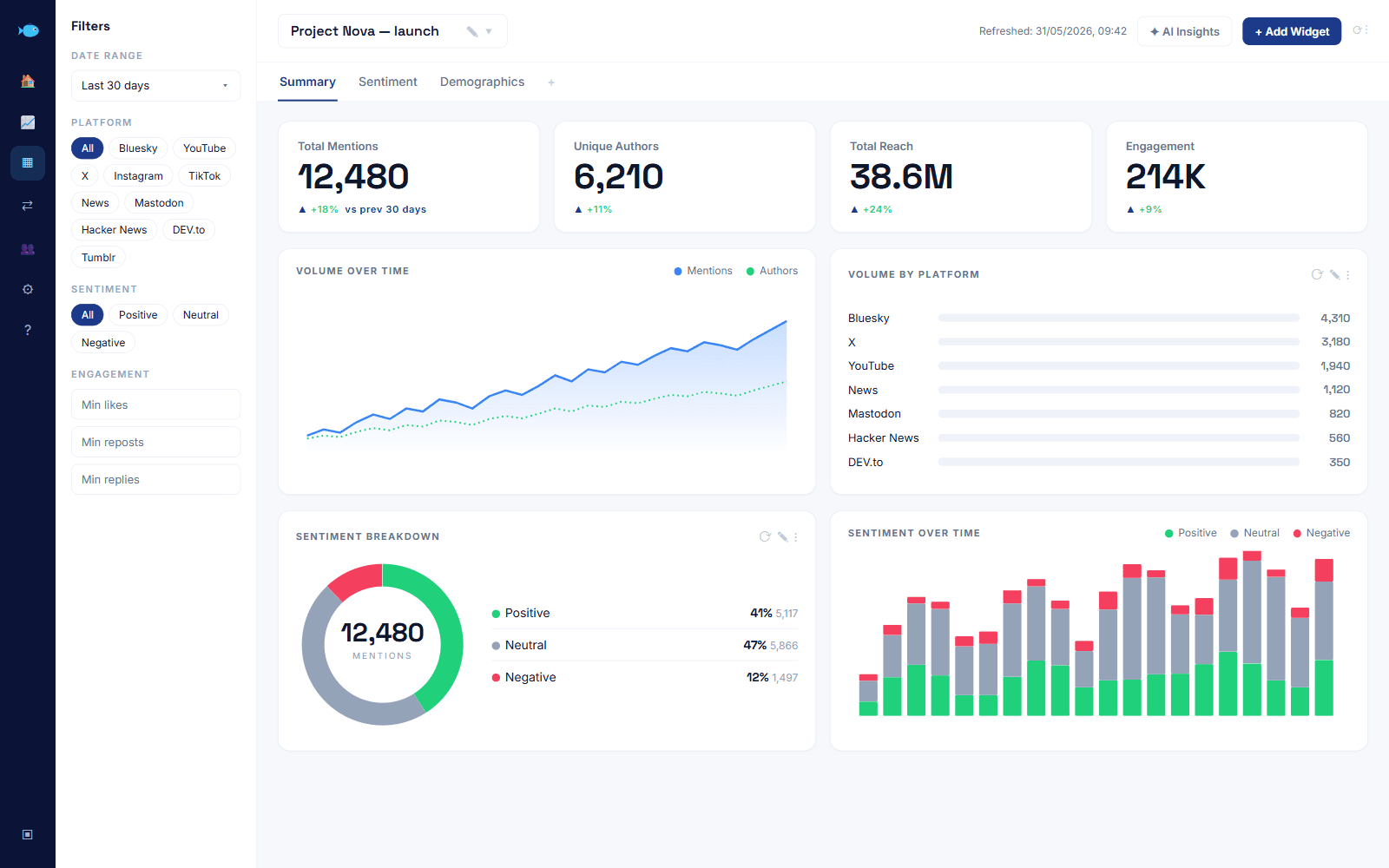
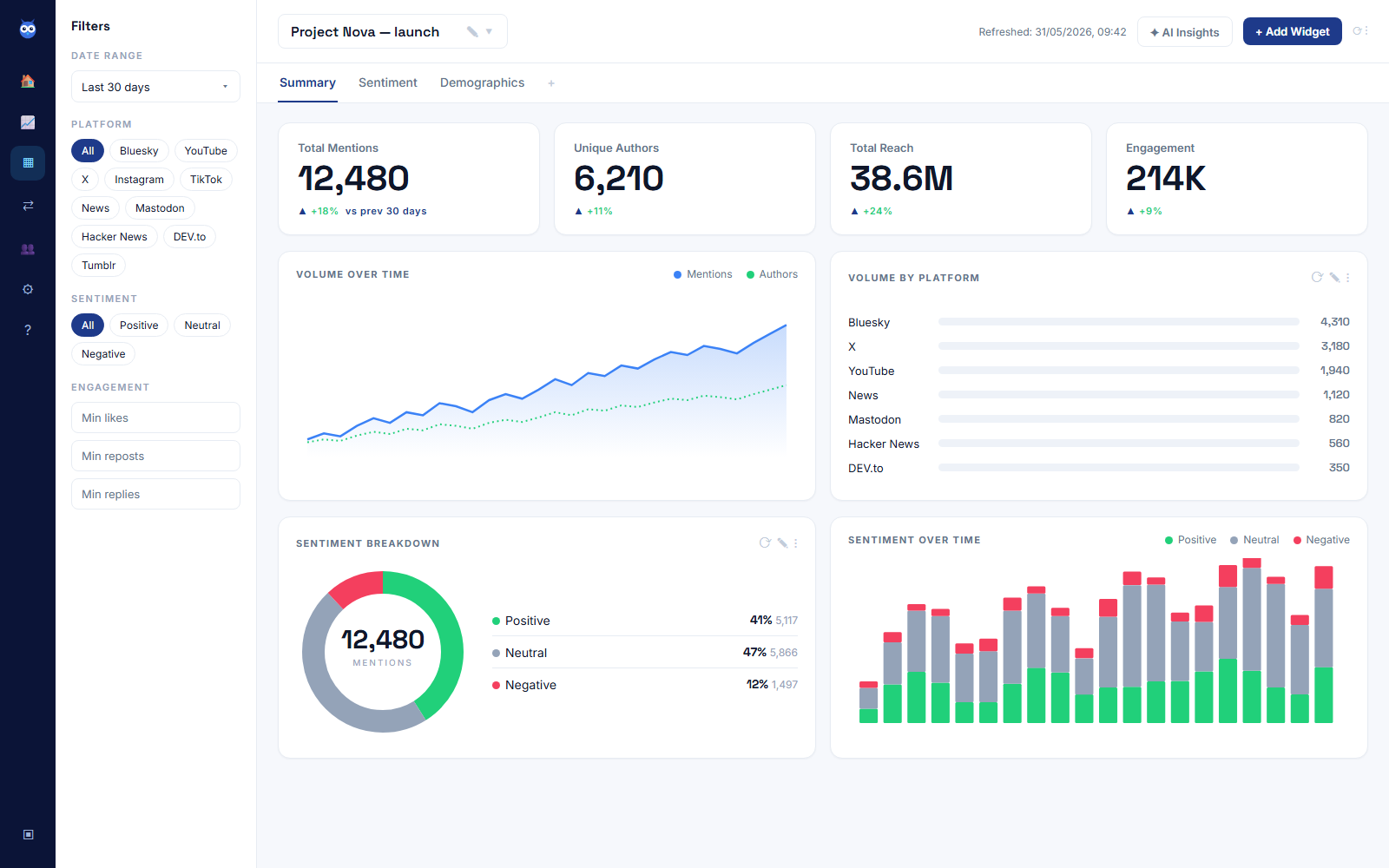
This guide explains what social listening is, how it differs from social monitoring, which platforms it covers, and exactly what a good tool does, with real screenshots from Babel42 along the way. By the end you'll know how to start without an enterprise budget or a data team.
Social listening, defined
Social listening is the practice of collecting public conversations from across the internet (social networks, news, forums and video) and turning them into something you can act on. It rests on three pillars:
- Collection: gathering every public mention of a keyword, brand, person or topic, from every place it might appear.
- Analysis: scoring sentiment, measuring reach, spotting trends, and ranking the people behind the conversation.
- Action: responding, reporting, pitching, planning, or simply knowing before everyone else does.
It's the difference between guessing what people think and knowing. A pile of raw mentions is data; the answer to "is sentiment up or down this week, and who's driving it?" is an insight. Social listening is the bridge between the two.
Listening vs monitoring: what's the difference?
People use the terms interchangeably, but there's a useful distinction:
| Monitoring | Listening | |
|---|---|---|
| Question it answers | "What's being said right now?" | "What does it all mean?" |
| Time horizon | Real-time, reactive | Trends over weeks and months |
| Output | Alerts and individual mentions | Sentiment, share of voice, themes |
| Best for | Catching a problem early | Strategy, reporting, planning |
A good tool does both. You want the alert when a thread blows up and the dashboard that explains the month. Babel42 is built around that pairing: continuous monitoring feeds calm, useful alerts, while everything it collects rolls up into dashboards you can share.
Where the conversation happens
The single biggest mistake in social listening is watching one platform. Your audience doesn't live in one place, so your listening can't either. One query in Babel42 collects from a wide spread of networks:
- Bluesky: full-firehose social coverage, from the open stream of every public post
- X (Twitter): via the official X API, which is billed per request, so it is available as a transparent add-on
- YouTube and Twitch: video and streaming
- Instagram: posts and engagement
- Mastodon and Tumblr: the open and creative social web
- Hacker News, DEV.to and Stack Exchange: developer and technical communities
- Trustpilot and Google reviews: customer reviews with star ratings, once you confirm the business
- News: articles from across the world's media
Reddit restricts the access a listening tool needs, so it stays a manual job: search it by hand alongside your monitors if your audience lives there. That is not a gap we chose. Reddit's own Data API Terms state that anyone wanting the API "for commercial purposes, research in excess of rate limits, or for any use that is not expressly permitted" has to negotiate a separate agreement with Reddit first.
One query fans out across all of them, and the results come back collected and de-duplicated for you, with no tab-juggling, no manual searching, no platform left unwatched.
What a social listening tool does
Collection is only the start. Here's what turns a stream of mentions into something useful. Every one of these is a feature you can use in Babel42 today.
1. Precise queries that keep the noise out
Good listening lives or dies on the query. For narrowing that down, Babel42 supports proper Boolean search (AND, OR, NOT, exact phrases and hashtags), evaluated precisely on every platform. Required and excluded keywords mean you catch "Babel listening" but not "Tower of Babel", so your dashboard stays signal, not noise.
2. Sentiment in plain English and AI that reads the room
Every mention is scored positive, neutral or negative, then rolled up into a sentiment you can act on. The hard part is the posts that don't say what they mean, and it is harder than it looks: in Van Hee et al., "SemEval-2018 Task 3: Irony Detection in English Tweets", the best of dozens of competing systems managed an F1 of 0.71 on the plain question of whether a tweet was ironic. Beyond scoring, Babel42's AI reads the whole conversation and hands you the takeaways (the themes, what's changed and why) so you get answers, not just a pile of mentions to wade through.
3. Rank the voices and build outreach lists
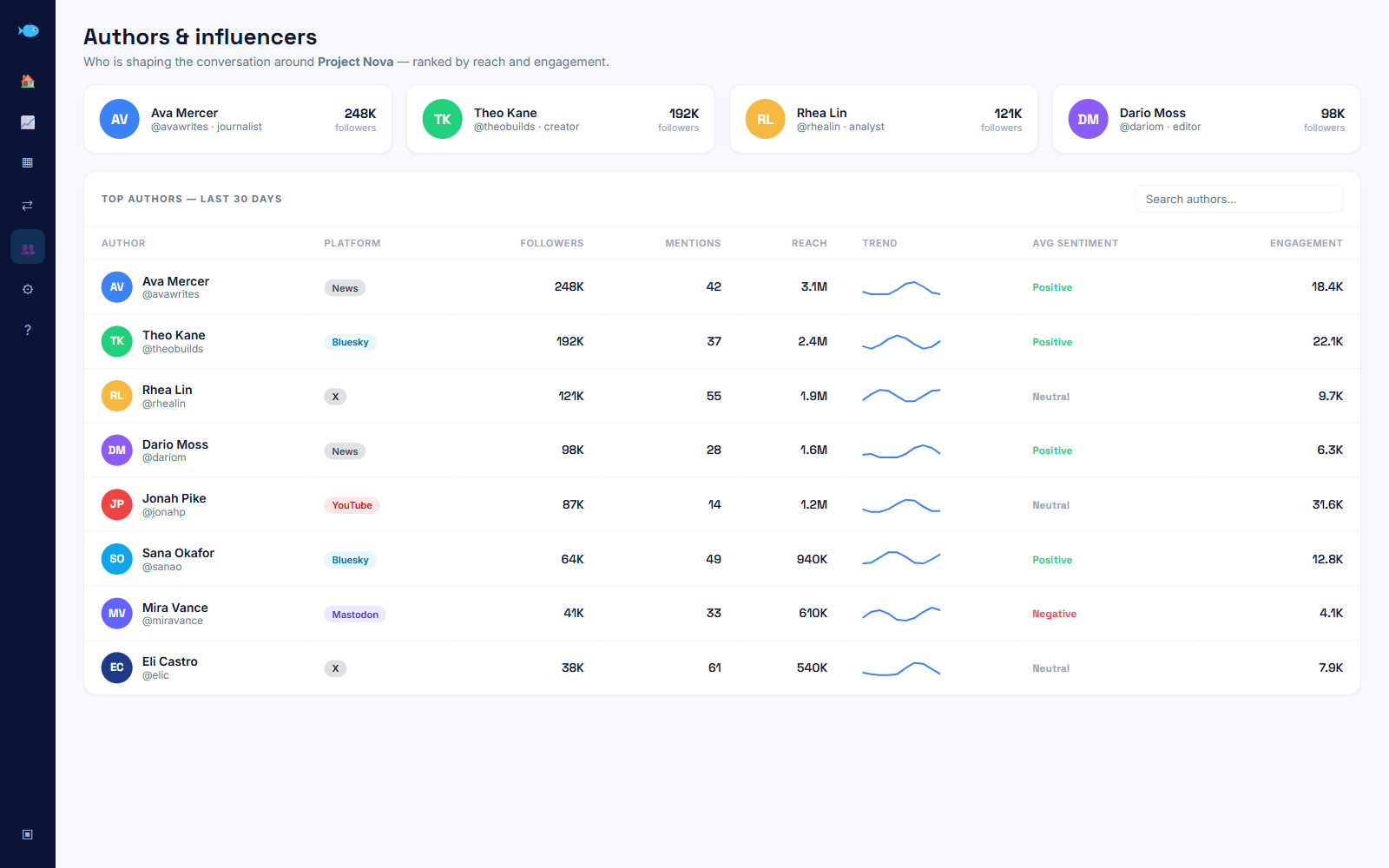
Not every mention carries the same weight. Babel42 ranks the authors, creators, influencers and journalists driving the conversation by reach, engagement and sentiment, so you can find the journalist worth pitching or the creator worth partnering with, then save them to reusable outreach lists in a click.
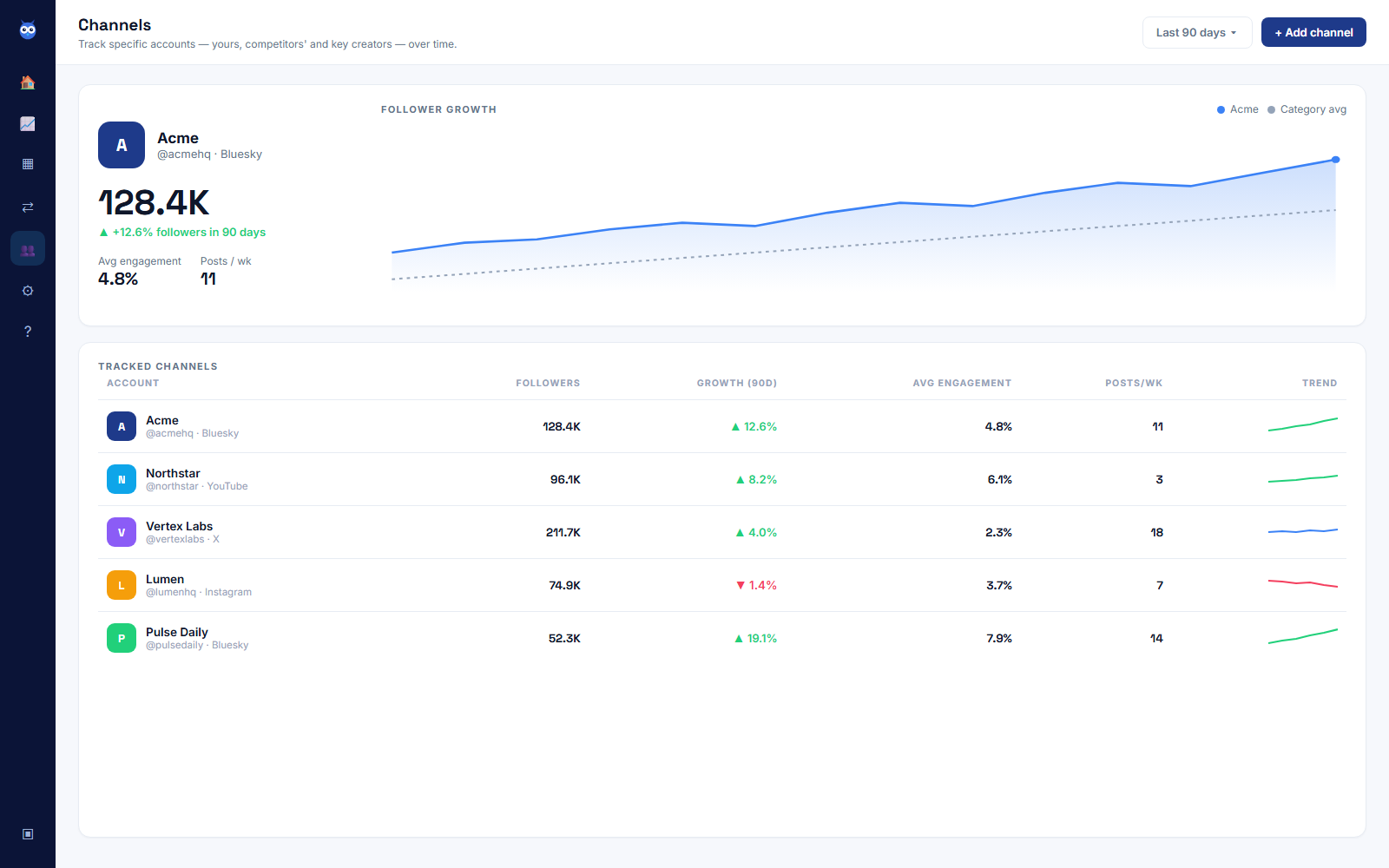
4. Track accounts, not just keywords
Keywords are one way to listen; Channels is the other. Instead of a search query, you follow specific profiles (your own accounts, your competitors', or the creators in your space) and Babel42 tracks their posts, follower growth, engagement and posting cadence over time. It's how you benchmark your profiles against rivals and vet a creator before you partner with them.
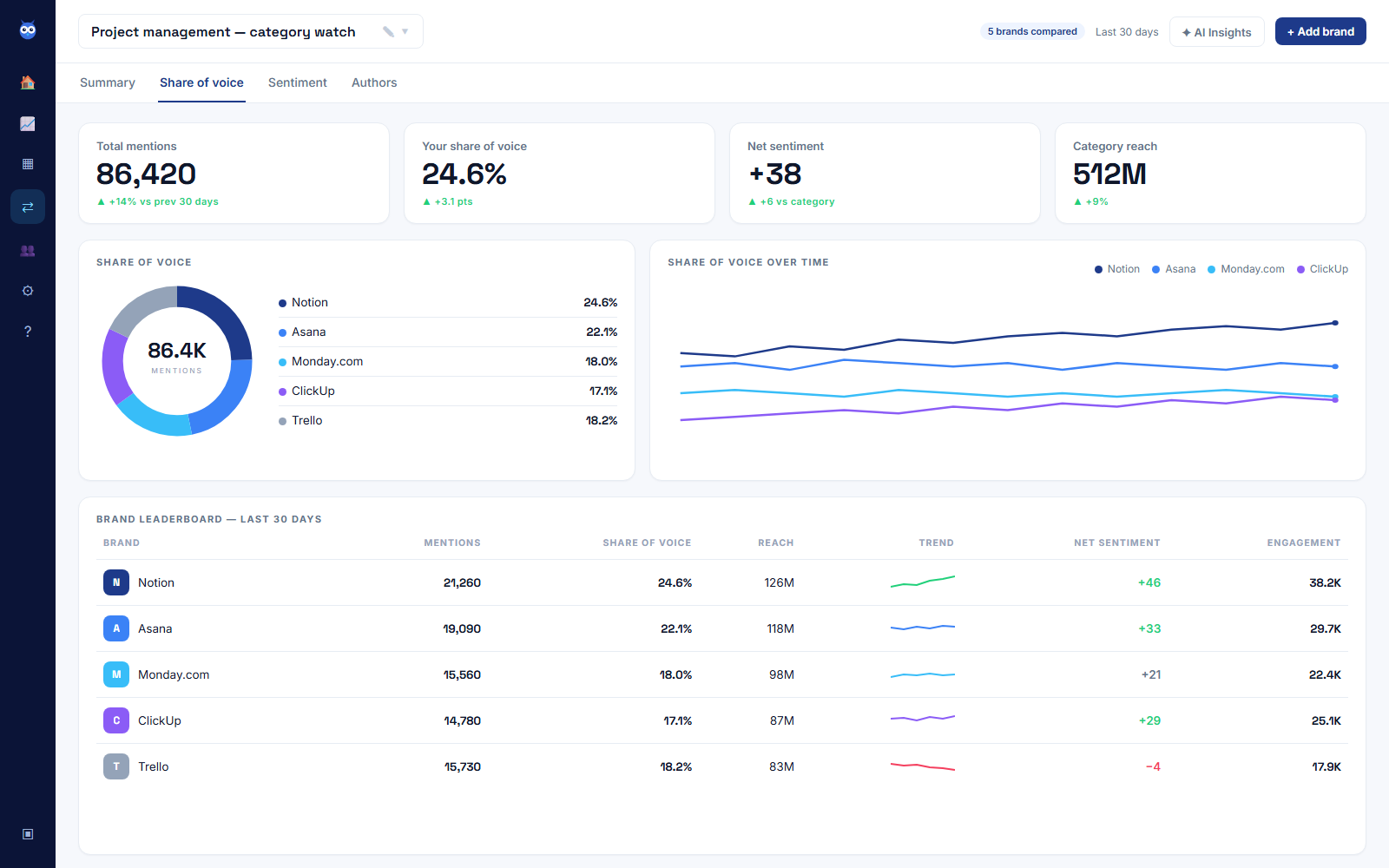
5. Compare share of voice against real competitors
Track competitors alongside your own brand and compare share of voice side by side: who's winning the conversation, on which platform, and how each launch moved the numbers. Net sentiment and trend per brand sit on one comparison view, so the picture is obvious at a glance.
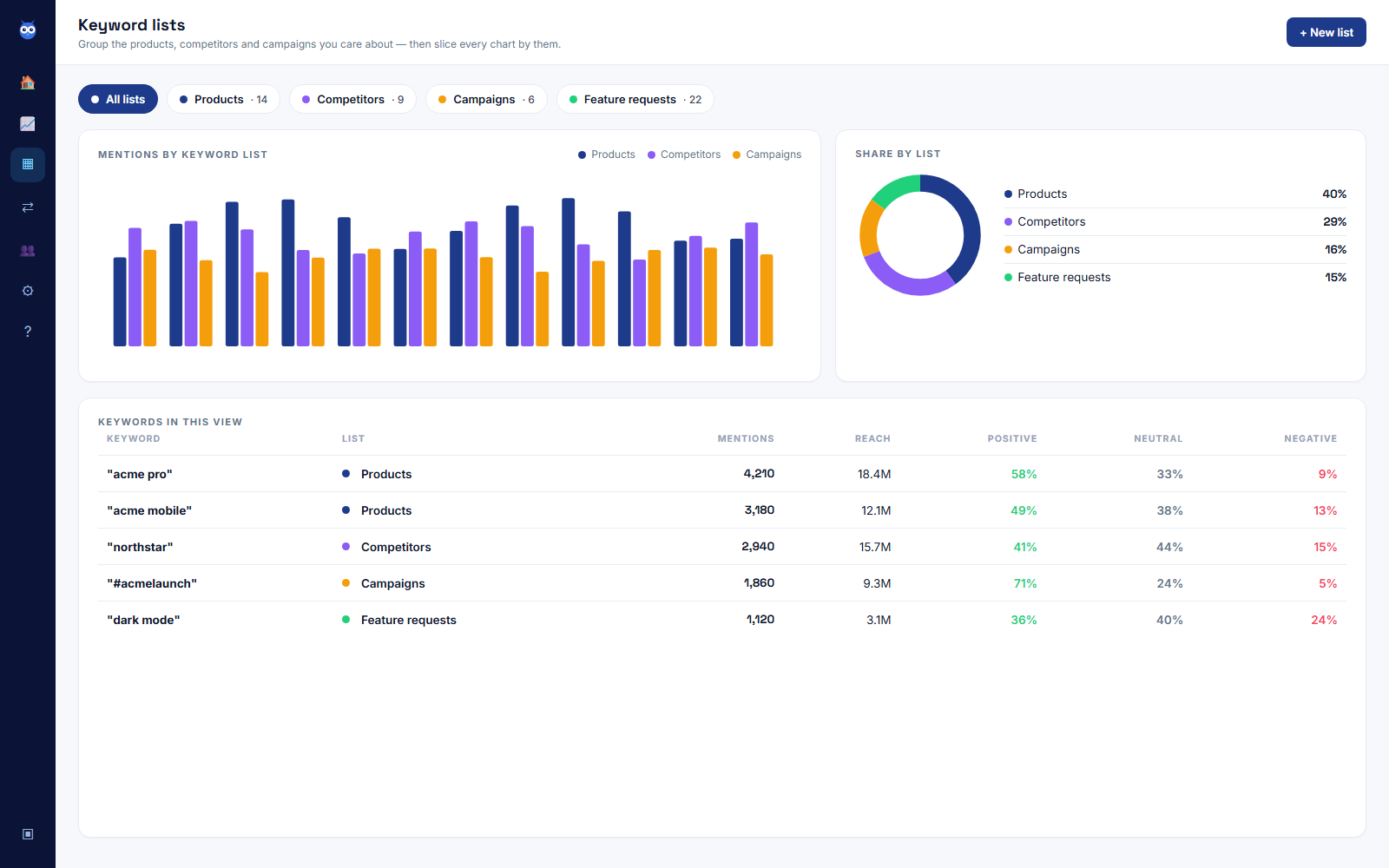
6. Group and slice with keyword lists
Build keyword lists for the products, competitors, campaigns and feature requests you care about, then slice every chart, table and comparison by them. It's how you turn one busy monitor into the exact views your team needs, and compare those lists head-to-head.
7. Calm alerts and a reputation radar
Babel42 watches so you don't have to. Arm an alert and you'll get a nudge when volume surges, sentiment dips, or a big account weighs in, not a firehose, just the moments that genuinely need you. That's your reputation radar: catch the negative thread while it's still a thread, so a crisis never gets a head start.
8. Dashboards worth sharing
Build the view you need with custom charts, comparisons and tables, then send a link that looks like it took a designer a week. Trends, spikes and share-of-voice shifts surface as soon as they're collected, and because Babel42 keeps your history long-term and backfills the long tail when you start a monitor, you can see how a brand or topic moved over months, not just this week.
What can you do with it?
Put those features together and the use cases write themselves:
- Brand analysis: measure awareness and sentiment, and show whether your marketing is changing either.
- Topic research: read the room before you write the article or film the video, and source the real voices shaping it.
- Competitor analysis: benchmark yourself on volume and sentiment, and learn from rivals' launches as they happen.
- Influencer marketing: discover the creators who genuinely move your audience, vet them, and measure the impact.
- Trend-spotting: catch a rising conversation while you can still be early to it.
- Reputation management: get the alert the moment a thread turns, not the morning after.
How to start (for free)
You don't need a six-figure contract to begin. A sensible first week looks like this:
- Pick one thing to track: your brand name, a product, or a topic you care about.
- Write a simple query: the name itself, plus obvious variations and hashtags. Use
ORto catch them all, andNOTto drop the lookalikes. - Watch for a week: let the mentions accumulate, then read the sentiment, the trend and the top authors.
- Decide one action: reply to a critic, pitch a fan, adjust your message, or share the dashboard with your team.
That's it. The hardest part isn't the tooling. It's starting.
Knowing what the whole internet is saying about the things you care about, in plain English. That's the entire job.
Babel42's free plan gives you 500 mentions a month across five networks, AI sentiment and two monitors, enough to answer real questions from day one, with every feature above ready when you grow. Hear what the internet's saying.
Once you're set up, a few practical next reads: how a social listening tool actually works under the hood, what belongs on a social listening dashboard, how sentiment analysis works, and where it fails, a founder's playbook for using it with no budget and no team, finding your first users before you have a brand anyone's searching for, finding partners through social listening, generating leads from what you hear, using it for market research alongside surveys and interviews, watching what your competitors do and say, measuring brand awareness rather than reputation, calculating share of voice properly, and what it misses, handling a reputation wobble and writing a brand crisis management plan before you need one.
For the same tool pointed at real, live conversations rather than a hypothetical, see what it found in the reaction to the SpaceX IPO, the UK's under-16s social media ban, and which AI assistant people are actually talking about.