Many marketing teams assume AI Overviews use the top-ranking pages. Rank well, the thinking goes, and the AI Overview above the results will quote you. Our own data says the two are much less connected than that. Of the sites AI Overviews cited in our study, 45.7% did not rank in Google's top 10 for the same search.
Ranking and being cited are two separate results. A page can hold the #1 spot and be left out of the AI Overview. A site with no page-1 ranking can be the first source the AI Overview lists. This post shows the numbers from our AI Overviews study, explains what fills the gap, and sets out what to check if rank tracking is all you measure today.
How we compared AI Overview citations with organic rankings
We ran 660 US English Google searches in six industries: B2B software, finance, health, local services, online shopping and travel. 600 were generic searches, 100 per industry, picked by a fixed rule from the highest-volume searches. The other 60 were "[brand] reviews" searches.
On day one we recorded the organic top 10, the AI Overview and the AI Mode answer for every search, and measured the pages they pointed to. The 601 searches that showed an AI Overview were then run again every day for 15 days. In short: 660 searches, repeated daily for 15 days, collected 26 September to 12 October 2026.
The sample was high-volume commercial US searches, not a random sample of everything people search. The full method and the raw data, as a downloadable zip of CSV files, are on the study page.
Do AI Overviews cite the top-ranking pages?
AI Overviews often do not cite the top-ranking pages. Of 3,415 sites cited by AI Overviews across 600 searches, 45.7% had no page in Google's organic top 10 for the same search. Only 8.8% were the #1 result. Rankings were recorded on 26 September only, so this comparison uses that one day.
A site counts once per answer here, however many of its pages the AI Overview cites. The table shows where each cited site ranked.
| Organic position of the cited site | Share of cited sites |
|---|---|
| #1 | 8.8% |
| #2 or #3 | 14.3% |
| #4 to #10 | 31.2% |
| Not in the top 10 | 45.7% |
3,415 cited sites from the AI Overviews of 600 searches, 26 September 2026. Source: Babel42 AI Overviews study.
The largest single group is the sites that do not rank on page 1 at all. Sites at #4 to #10 come next, and the #1 result is the smallest group.
In 10% of searches, no cited site ranked on page 1
In 10% of the 600 searches, not one site cited by the AI Overview ranked on page 1 for that search. The whole answer was built from sites outside the top 10.
For those searches, a page-1 ranking gave no share of the AI Overview at all. A brand ranking #1 on one of them could check its rank tracker, see a perfect result, and still be absent from the first answer a searcher reads. Our study found AI Overviews on 90% of these high-volume commercial searches, so this is not a rare layout.
The gap is the same in every industry we tested
The share of cited sites outside the top 10 sits between 42.5% and 47.9% in all six industries. No industry in the study comes close to AI Overviews that simply repeat page 1.
| Industry | Cited sites not in the top 10 |
|---|---|
| Travel | 42.5% |
| Local services | 43.7% |
| Health | 46.0% |
| B2B software | 46.2% |
| Finance | 47.3% |
| Online shopping | 47.9% |
600 searches, 100 per industry, 3,415 cited sites, 26 September 2026.
Travel had the lowest share and online shopping the highest, but the difference is small. A finance brand and a travel brand face much the same gap between ranking and being cited.
Only 32% of page-1 results are cited by the AI Overview
Of 5,316 page-1 results, 32.3% were cited by the AI Overview on the same search. A result counts as cited when the AI Overview cites that same page, not just the same site. The #1 result was cited 48.8% of the time, falling to 21.5% at #10.
| Organic position | Cited by the AI Overview |
|---|---|
| #1 | 48.8% |
| #2 | 44.1% |
| #3 | 41.1% |
| #4 | 32.8% |
| #5 | 30.8% |
| #6 | 28.9% |
| #7 | 28.0% |
| #8 | 24.3% |
| #9 | 22.2% |
| #10 | 21.5% |
5,316 page-1 results from the searches whose AI Overview cited at least one site (89% of the 600), 26 September 2026. Source: Babel42 AI Overviews study.
Two things are true at once. Ranking higher helps, because each step up page 1 raises the chance of a citation. A #1 ranking is still passed over about half the time.
Which sites fill the gap left by page 1
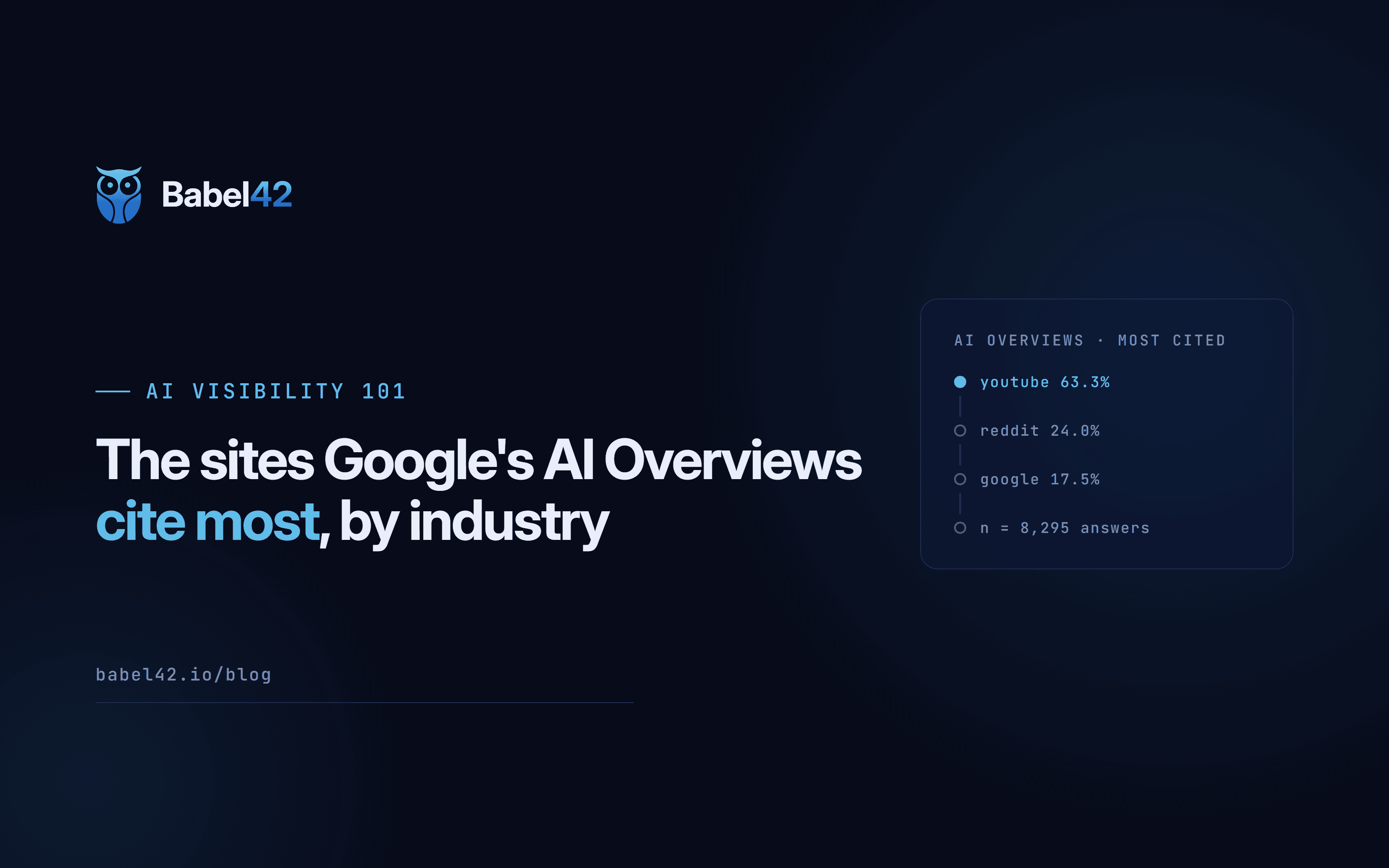
YouTube, Reddit and a small group of specialist sites in each industry are the most-cited sources in the study. Across 8,295 AI Overviews collected over 16 days, YouTube was cited in 63.3% and Reddit in 24.0%. Google's own pages came third at 17.5%, almost all of them shopping product pages and flight searches.
After video and forums, each industry leans on a few trusted specialists. The study names NerdWallet in finance (40.9%), Mayo Clinic in health (35.6%), Zapier in B2B software (29.8%) and Angi in local services (23.2%). The figure is the share of that industry's AI Overviews citing the site.
The practical point is that being cited is not only about your own website. A video review, a forum thread or a specialist guide that names you can carry your brand into an AI Overview even when your own page sits on page 2. A later post in this series looks at the most-cited sites in more depth, and the full list by industry is on the study page.
Why rank tracking alone misses AI Overview citations
Rank tracking measures where your pages sit in the organic results. It does not record which sites the AI Overview cited. In our data those two lists overlap far less than most teams expect.
Three gaps follow from the numbers above:
- A #1 ranking is not a citation. The #1 result was cited 48.8% of the time, so a rank report showing #1 tells you little about the AI Overview.
- Sources outside page 1 are not in the report. 45.7% of cited sites had no page in the top 10, so a top-10 rank report never shows them.
- Competitors can win without ranking. A rival cited through a YouTube video or a Reddit thread does not appear above you in a rank tracker at all.
A team that only watches rankings can see steady positions while the AI Overview on the same search cites someone else. Rankings still matter, because higher positions are cited more often. They just answer a different question.
What to check instead of rankings alone
The useful check is the list of sources the AI Overview cites for your searches, set beside your rankings. Five steps cover it:
- Pick the searches that matter. Use the commercial searches your buyers type, not your brand name.
- Record the cited sites. For each search, write down every site the AI Overview lists as a source, in order.
- Compare them with the top 10. Mark which cited sites also rank on page 1, and which do not.
- Note the third-party sites. List the videos, forums and specialist sites that are cited and check whether they mention you.
- Repeat on more than one day. AI Overview sources change from day to day, so one check is a snapshot, not a result.
Our guide to AI Overview tracking covers how to run this check over time. If your pages rank but are not cited, how to rank in AI Overviews covers what cited pages tend to do differently.
How Babel42 AI Visibility shows which sites AI cites
Babel42 AI Visibility checks whether Google's AI Overviews and AI Mode, ChatGPT, Claude, Perplexity, Gemini and Grok cite and recommend your brand, and lists the sources they used. You see which sites the answers cite for you and for your rivals, side by side.
That turns the steps above into a tracked record instead of a spreadsheet you update by hand. When a rival is cited through a review site or a video you do not appear in, the source list shows it. See how it works on the AI visibility tool page, and read what AI search visibility measures for the wider set of numbers.
The full data behind every figure in this post is free to download from the AI Overviews study, under a Creative Commons Attribution licence.