A local business owner who searches "AI visibility for local business" lands in two different conversations without realising it. One is run by local SEO agencies: get your Google Business Profile and your NAP details consistent, and Google's AI-written local summaries tend to follow. The other is run by tools like ours, and it's about whether ChatGPT or Claude names your brand when someone asks a genuine buyer question. Both are real. They run on different mechanics, and mixing them up means fixing the wrong thing when someone tells you "we're invisible on AI."
Is AI visibility the same as Google's local AI Overview?
No, and the two are worth keeping apart in your head. Google's local AI features, the summaries that can appear on a Maps listing or above local search results, are compiled the way Google has always compiled local results: from your Business Profile, place and review summaries, and content crawled from your own website, according to Google's own support documentation on how it sources local listing information (Google, "How Google sources and uses information in local listings"). It's local SEO with an AI-written summary layered on top. Get your Business Profile hours and categories right, keep your reviews coming in, and you're doing most of what that surface rewards.
A conversational assistant works differently. Ask ChatGPT or Claude "who's a good plumber in Leeds" and it isn't reading your Business Profile at all. It's drawing on what it learned during training and, when it decides to search, on whatever it finds live on the web, the same mechanism we've written about for AI search visibility generally. Being well set up on Google Business Profile does nothing for that second surface on its own, because the assistant most likely never looks at it. Perplexity and Gemini sit somewhere in between, leaning more on live search by default, but the underlying split still holds.
How many customers are even asking a chatbot this?
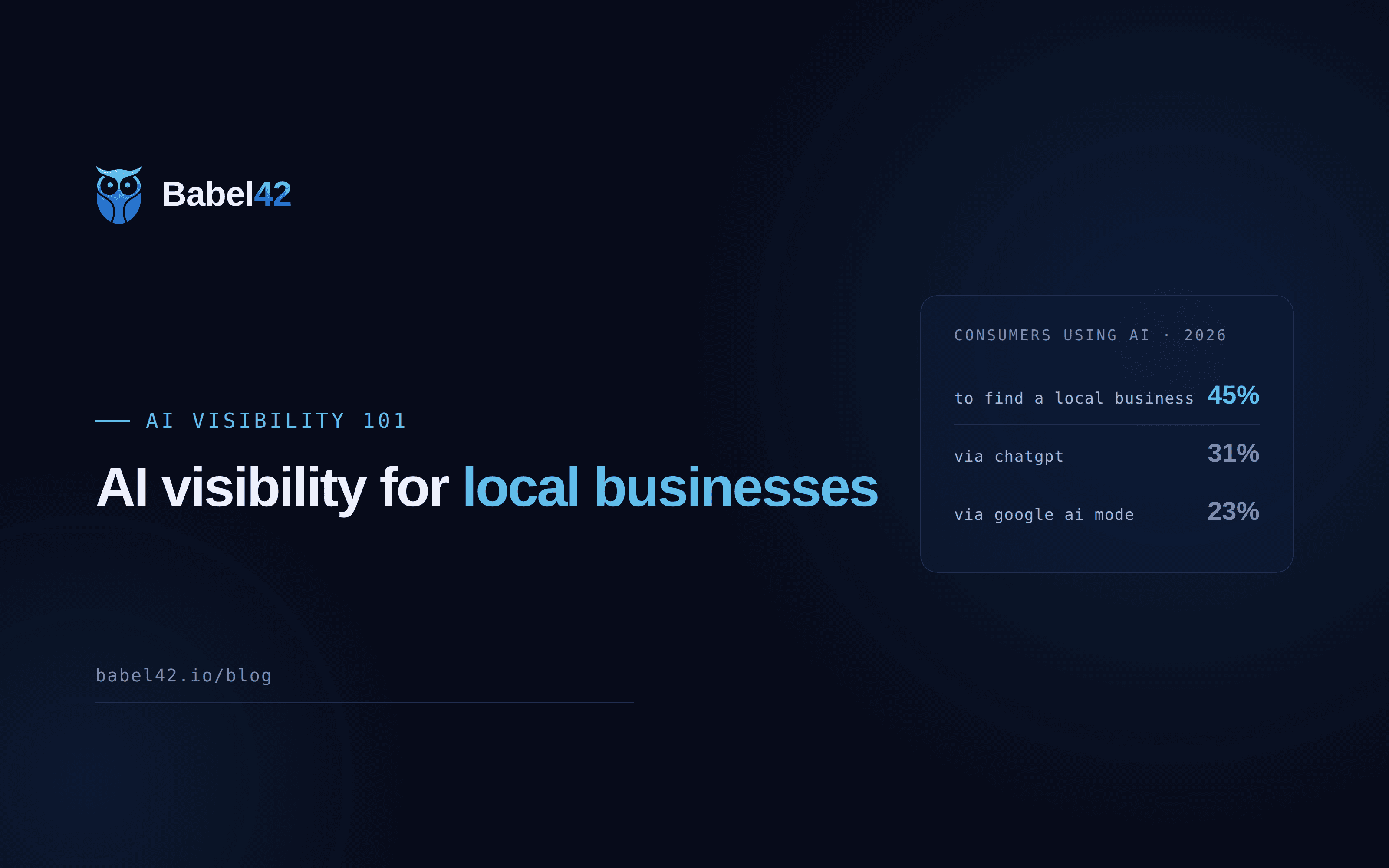
More than you'd probably guess. According to BrightLocal's Local Consumer Review Survey, run on a panel of 1,002 US adults and published February 2026, the share of consumers using AI tools to find local business recommendations jumped from 6% the year before to 45% (BrightLocal, "Half of consumers are asking AI for business recommendations"). ChatGPT led that group at 31%, ahead of Google's AI Mode at 23%. The same survey ranks AI as the third most-used source for local recommendations behind Google and Facebook, ahead of Yelp and TripAdvisor. This isn't a niche channel any more.
What gets a local business recommended by a chatbot
The same evidence that applies to AI visibility generally applies here, just with local proof points doing the work. According to Ahrefs' analysis of roughly 75,000 brands, branded mentions on sites you don't control correlate with AI visibility at 0.66 to 0.71, against 0.22 to 0.27 for backlinks (Ahrefs, "Top Brand Visibility Factors in ChatGPT, AI Mode, and AI Overviews").
For a local business, those third-party mentions tend to take a few familiar shapes: a review on Google or Trustpilot, a write-up in a local paper or community blog, a listing on an industry directory, a client naming you in their own case study. None of that sits on your own website. That's exactly why it carries more weight with a model trying to judge whether a claim about you is trustworthy than anything you write about yourself.
What you do control still matters, for a narrower reason: it gives an assistant something concrete to lift if it lands on your page anyway. Write the plain fact rather than the adjective. "Licensed and insured, serving Leeds and the surrounding 15 miles since 2014" beats "trusted local experts" every time, because a model can quote the first sentence and has nothing to do with the second. Keep your name, address and phone number identical everywhere. A model quoting your suburb wrong because two of your listings disagree is the same consistency problem NAP audits have flagged for a decade, just read by a new kind of reader.
Where Babel42 fits for a local business
Babel42's AI Visibility product shows you what AI assistants say when someone asks for a recommendation in your category. It runs a synthetic AI Buyer persona through a real, multi-turn shopping journey on a category question, then reports which brands ChatGPT, Claude, Perplexity, Gemini and Grok recommend by name. That answers a question your Google Business Profile leaves open: when a customer asks an assistant who to use, is your name the one that comes back?
It fits best the moment your business competes on a category question rather than a single map pin: a firm with several branches, a professional-services practice serving a whole region, a franchise brand, or any local business whose category comes up in genuine AI buyer research ("who should I hire for X") rather than only "near me" searches. That's the kind of journey the screenshot below is from.
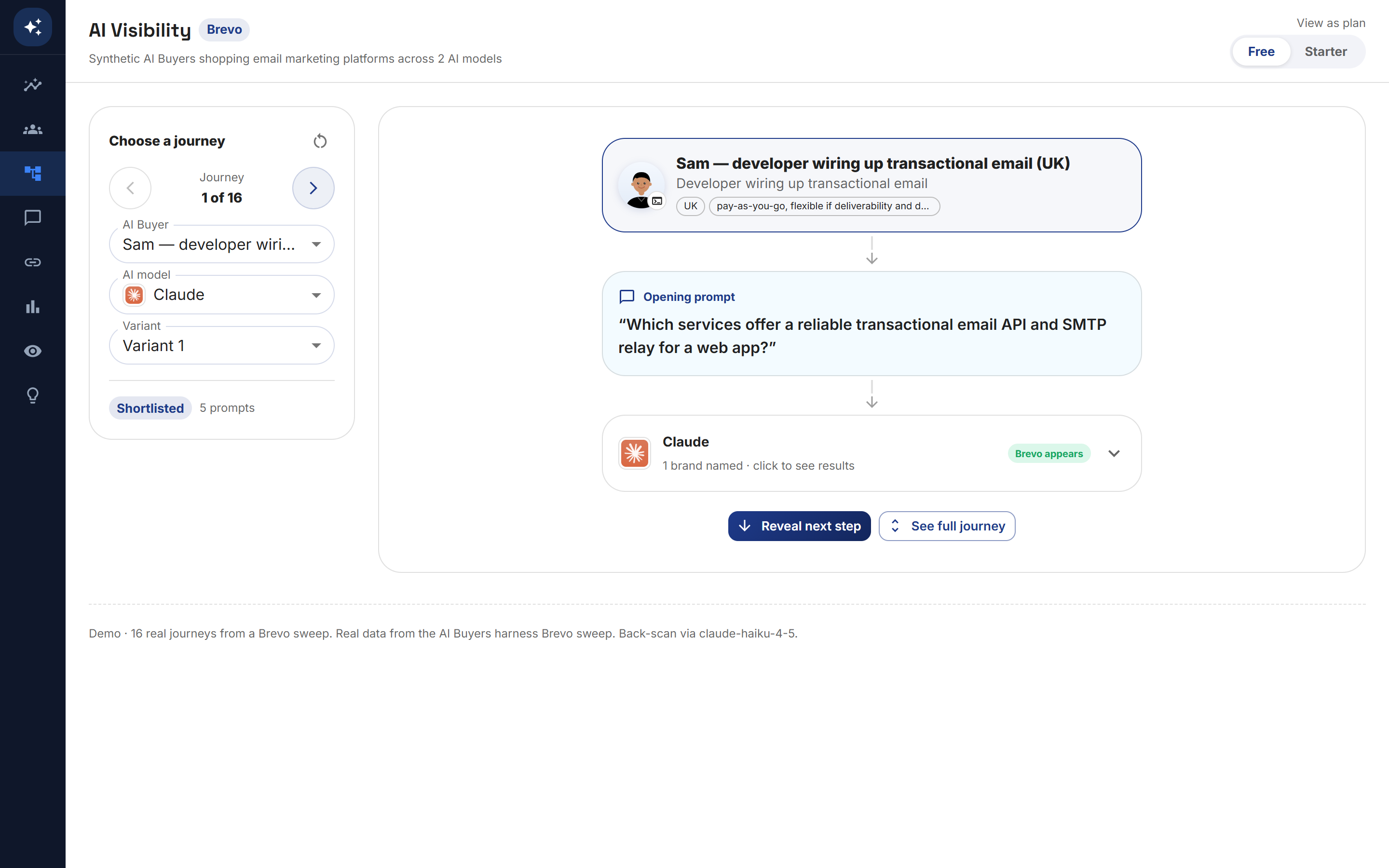
This journey, a UK developer shopping for a transactional email API, shows the mechanism a local firm is checked against too: a real question, run across several assistants, with the outcome read straight off the dashboard rather than guessed at. In our own data from this workspace, the AI Buyer's win rate across five assistants sat at 32%, against a 100% appearance rate: named everywhere, actually recommended less than a third of the time. That gap between being known and being picked is what AI search visibility measures, whichever kind of business is asking.
What to check this week
Two things you can do without any tool at all. First, open ChatGPT and Claude in separate tabs and ask each one the actual category question a customer would type, not your business name, and read past the headline sentence to see who gets named and why. Second, pull up your Google Business Profile next to your own website and check that the address, phone number and core service description say exactly the same thing in both places; a mismatch there is a cheap, common reason a model quotes the wrong detail or skips you rather than risk it.
If what you find on the conversational side is worth tracking properly rather than checking by hand every few weeks, the free plan runs one AI Buyer across any two of the seven assistants Babel42 tracks, weekly, no card required, enough to see whether your category recommends you before deciding whether to go further.