Ask five people what drives AI search visibility and you'll get five different lists: write FAQ schema, get more backlinks, publish more often, fix your llms.txt, be on Reddit. Some of that is useful. Some of it is a guess dressed up as a rule. The problem with most AI search visibility factors content is that it reads like a checklist with no ordering, as if fixing your robots.txt and chasing backlinks were equally urgent. They aren't, and the difference matters if you only have a few hours a month to spend on this.
This is our attempt at an honest ordering: what we can point to real evidence for, what's a reasonable working theory, and what to fix first.
What determines whether an AI assistant cites your brand?
Three things have to be true at once: the AI has to be able to reach your content, what it finds has to answer the question clearly enough to quote, and your brand has to read as a specific, trustworthy entity rather than a vague mention. Miss any one of the three and the others don't save you. A perfectly crawlable page that never states a clear answer won't get quoted. A brilliant answer nobody can reach won't either. We'll take each one in turn, roughly in the order we'd spend an afternoon on them.
Can the AI even reach your content?
This is the one factor that's a binary gate rather than a matter of degree, and it's the cheapest to check. AI providers each run their own crawler, GPTBot, ClaudeBot, PerplexityBot, Google-Extended and the rest, and most respect robots.txt. If one of them is blocked, accidentally or on purpose, nothing else on this list matters for that provider: no crawl, no citation, full stop. We've written the full version of this check, including what llms.txt is and why it helps, in how AI crawlers find and cite your brand. It takes about ten minutes to open your robots.txt and confirm you're not blocking the crawlers you'd want visiting, and our free audit checks this automatically, sorting the crawlers by what blocking each one costs you rather than treating them as one group. The per-crawler breakdown is the reference behind that sorting.
The second, less obvious part of reachability: is the fact you want quoted actually in crawlable text? A price, a limit or a feature buried in a JavaScript-rendered widget or hidden behind a form is invisible to a crawler even on a page it's fully allowed to read. State the number in plain text somewhere a bot can parse it.
Being crawled is not the same as being cited
This is the gap that trips people up most. A brand can be crawled constantly, mentioned in plenty of AI answers, and still lose almost every recommendation to a competitor. Appearing and winning are different measurements, and conflating them is why a "we're mentioned everywhere" report can sit next to falling sales.
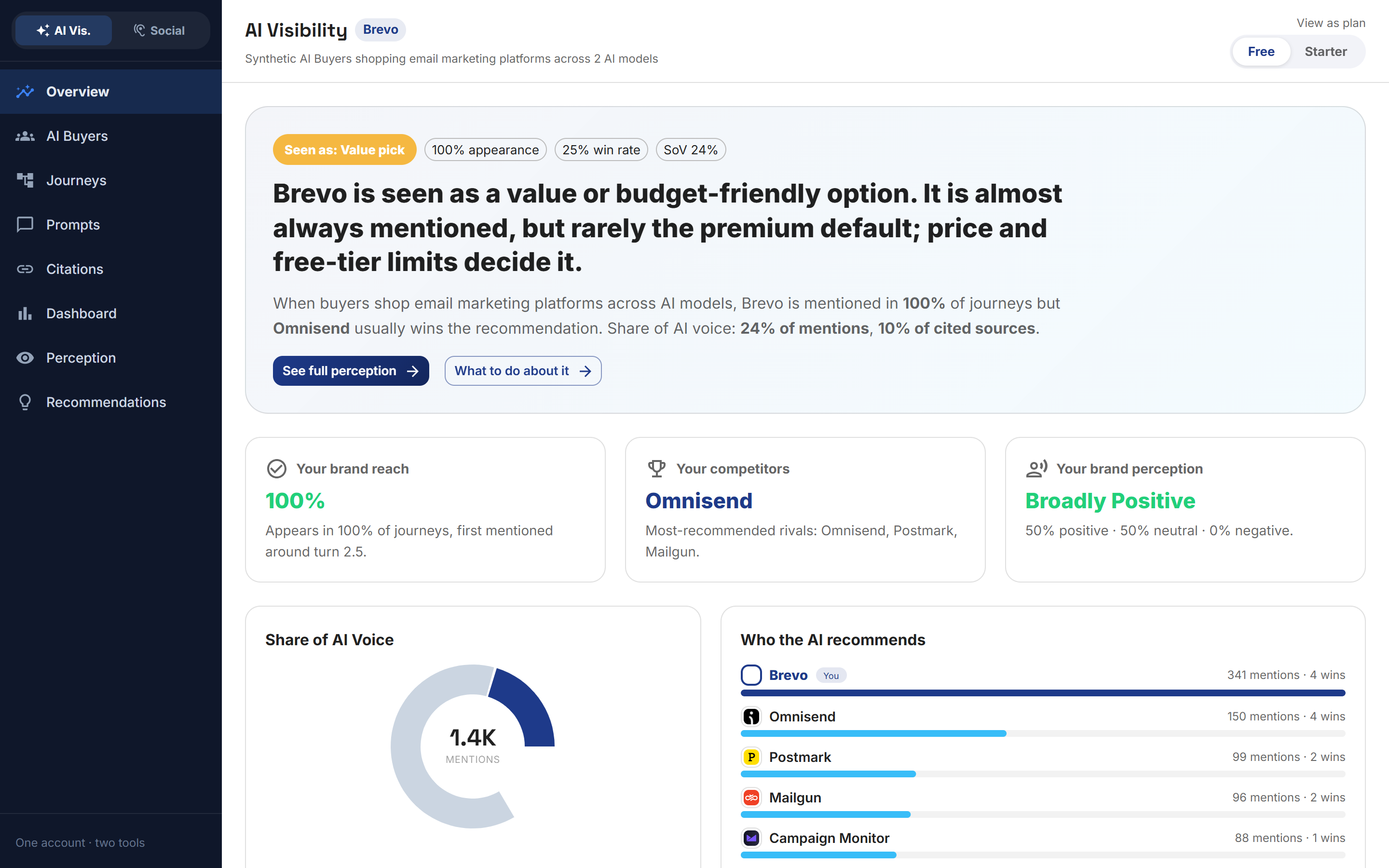
The screenshot above is a demo account in Babel42's own AI Visibility dashboard, and it makes the gap concrete: our own data shows this brand named in 100% of buyer journeys, with a 24% share of AI voice, but it only wins the actual recommendation 25% of the time. Being reachable and being mentioned got it into the conversation. Something else decided who won it, which is the next factor.
Does a clearer answer get quoted more often?
Our working theory, based on how these systems generate summaries and quotes, is yes: an AI assistant generating an answer is pulling together sources and lifting the sentence that most directly answers the question, so a page that states its claim plainly in one place is easier to lift than one that makes a reader piece the answer together from three paragraphs. We can't point to a controlled study proving this causes more citations rather than merely correlating with them, so treat it as a strong hypothesis, not a settled fact. It's also the reasoning behind writing at least one heading in a post as a direct question, which is why you'll see that pattern across our own posts.
What we can say with more confidence is structural: a page that states a specific number (a price, a limit, a named feature) rather than a vague adjective gives a summarising model something concrete to lift. "Affordable" is not quotable. "$29 a month" is.
Why third-party mentions outweigh backlinks
This is the one factor with a real study behind it rather than a working theory. Ahrefs' analysis of roughly 75,000 brands found that branded web mentions, how consistently your name shows up as a named entity across sites you don't control, correlated with AI visibility at somewhere between 0.66 and 0.71. Backlinks, by comparison, correlated at only 0.22 to 0.27, and raw branded search volume at 0.35 (Ahrefs, "Top Brand Visibility Factors in ChatGPT, AI Mode, and AI Overviews"). In plain terms: being talked about, by name, on sites you don't own, tracks AI visibility more closely than being linked to. That's also why a platform licensing its review data directly into an AI assistant, as Yelp recently did with ChatGPT, is worth watching: it turns one more site you don't control into a named input.
That's a different priority order than classic SEO, where a backlink has long been treated as the strongest external signal. It doesn't mean backlinks are worthless, but it does mean a mention on a review site, a comparison post or a forum thread, even without a link attached, is worth chasing on its own terms. We've written more about the mechanics of getting your name to read clearly as an entity in does your brand name affect AI search visibility.
Freshness: easy to fix, easy to forget
The last factor is mundane and gets skipped for exactly that reason. Live retrieval, the route Perplexity, browsing-enabled ChatGPT and Gemini's grounded answers use most, pulls pages at the moment someone asks a question, so a page with a stale price or an outdated feature list gets quoted with the wrong facts, or not quoted at all if the model judges it unreliable. We keep this current on our own posts by setting an updated date whenever a fact or the structure changes materially, not on every typo fix, so a reader and a crawler alike can tell a page was actually revisited rather than just republished.
AI search visibility factors, in the order we'd fix them
If you're doing one thing this month, check crawlability first. It's the only factor on this list that's a hard gate rather than a matter of degree, and it's a ten-minute check. After that:
- Confirm the AI crawlers you care about aren't blocked, and that key facts are in plain, crawlable text.
- State one clear answer per important page, in a sentence a summariser could lift on its own.
- Chase branded mentions on sites you don't control, not just backlinks.
- Keep facts current, and mark pages as updated when they materially change.
None of this replaces measuring where you actually stand first. If you're new to the topic, what AI search visibility actually measures is the place to start; if you already know that and want the method, our piece on measuring AI search visibility covers it, and running a full audit turns these factors into a repeatable scorecard rather than a one-off check. Doing the check by hand across a handful of questions and models works, but it's manual and easy to let slide; Babel42's AI Visibility product runs the buyer-journey side of this continuously; the free plan covers one AI Buyer across any two of the seven assistants it tracks, weekly, which is enough to see your own version of the appearance-versus-win gap above without spending anything. These factors apply whether you're a national brand or a single-location shop, though AI visibility works differently for local businesses, with its own mix of proof points. If you want to know how your own pages measure up on the evidence factor specifically, we scored 164 sites on exactly this and found most have almost nothing an assistant can quote. Chasing branded mentions matters even more as consumers get more sceptical of AI answers generally; see why trust in AI search is falling even as usage rises for the 2026 survey data behind that shift. Selling a physical product rather than software changes which inputs matter most; see what actually changes for GEO in ecommerce. Getting cited once is not the end of the story either; the same assistant names a different winner most of the time it's asked twice, which is why a single check is worth so little on its own. And "Google" isn't one surface to check either; Gemini, AI Overviews and AI Mode read almost entirely different parts of the web, so a factor that fixes one doesn't necessarily touch the other two.