Most teams track brand mentions with one tool and assume it covers the whole picture. It does not. A mention in a public post and a mention inside an AI assistant's answer are found by different methods, logged as different data, and answer different questions. Being mentioned in one does not mean you are mentioned in the other.
What counts as a brand mention?
A brand mention is any instance where your brand's name appears in something someone else wrote or said. That covers two very different sources. The first is public conversation: a post, a review, a forum thread, a news article. The second is a generated answer: the sentence an AI assistant writes when a buyer asks it for a recommendation.
The two sources need different tools because they are built differently. Public conversation already exists before anyone looks for it, so a monitor finds mentions that are already there. An AI answer does not exist until someone asks the question, so checking it means asking the question yourself and reading what comes back.
Are social mentions and AI mentions the same thing?
No. A social mention is evidence that someone talked about you. An AI mention is evidence that a model, asked for a recommendation, chose to name you. The first tells you whether you came up. The second tells you whether you were put forward as an option, which is a stronger and rarer thing for your brand name to do.
A customer complaining about your checkout flow on a forum is a mention. ChatGPT naming you alongside two rivals when a buyer asks "what's a good tool for this" is also a mention, but it carries more weight, because an assistant only has room to name a handful of brands before it has to stop.
How to track brand mentions across social, video, news and forums
A keyword monitor is a saved search that runs on a schedule and brings matching posts back to one dashboard. Babel42's own monitors take Boolean queries, AND, OR and NOT, plus quoted phrases and hashtags, evaluated the same way across every network rather than falling back to each platform's own search box. A monitor for a product brand might read: "Babel42" OR "#Babel42" NOT "job" NOT "hiring", which excludes the recruitment posts a bare name search usually pulls in.
Babel42's social listening tool collects mentions across Bluesky, X, YouTube, Instagram, Mastodon, Tumblr, Twitch, Hacker News, DEV.to, Stack Exchange, Trustpilot and news, on a schedule set by your plan rather than instantly: every 12 hours on the free tier, down to every 30 minutes on the top paid tier. The free plan covers 500 mentions a month across five networks and two monitors, with 90 days of history, no card required.
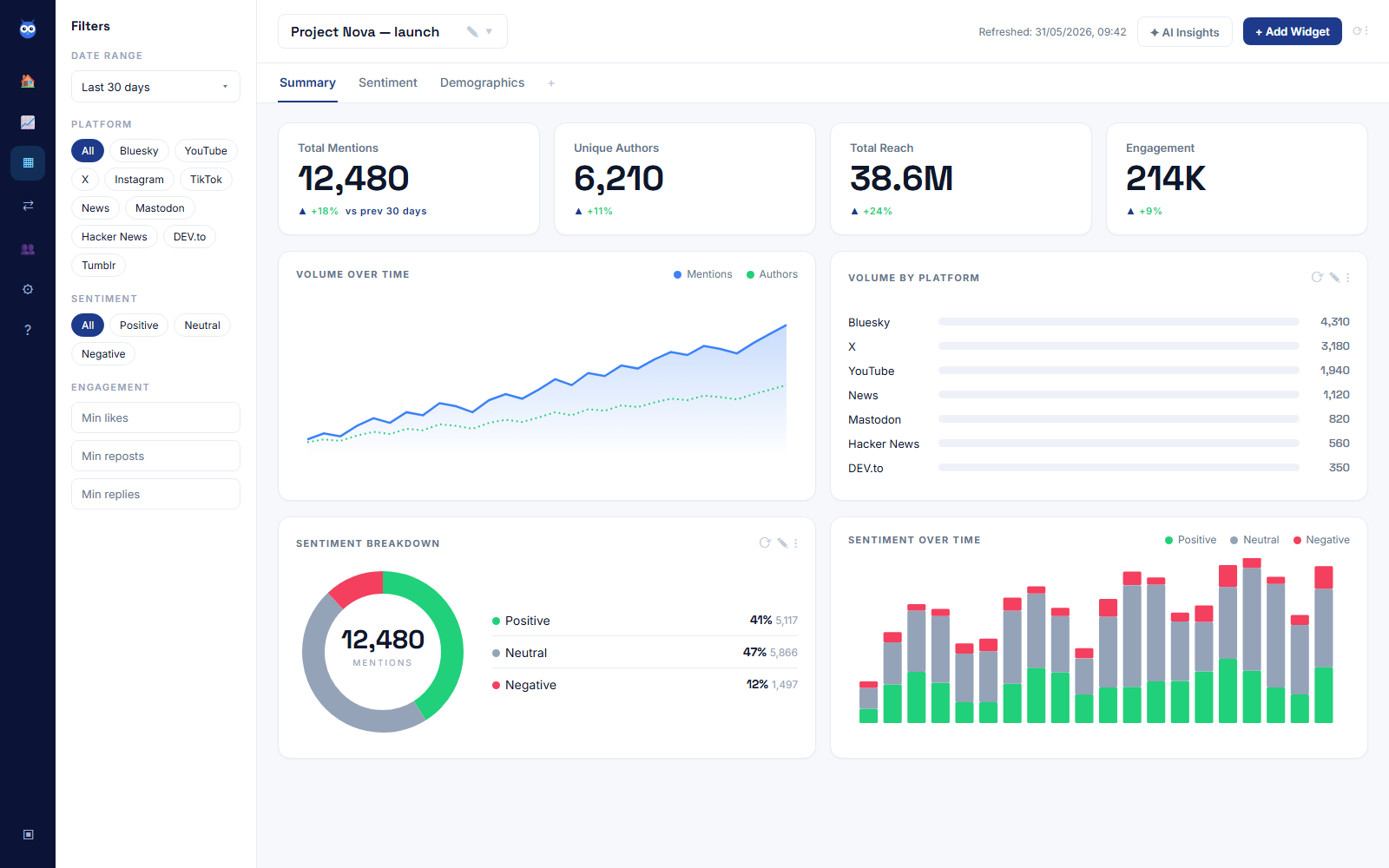
The screenshot above is a demo workspace tracking a product launch. According to its platform breakdown, Bluesky and X led the 12,480 mentions in the period, ahead of YouTube and news. Its sentiment donut, read straight off the same dashboard, splits them 41% positive, 47% neutral and 12% negative.
None of that volume says anything about what an AI assistant would tell a buyer asking about the same category. That is a separate question, answered by a different check.
How to track brand mentions inside an AI assistant's answer
An AI mention has to be asked for, because the answer does not exist until someone poses the question. Tracking it means running the same buyer question repeatedly, reading whether your brand is named, and logging the result as data rather than a one-off glance at a chat window.
Babel42's AI visibility tool runs this as a structured check: a synthetic AI Buyer persona asks a real category question, the assistant's answer is read, and the result is logged as a brand named or not. The free plan runs one AI Buyer across any two of seven assistants, ChatGPT, Claude, Perplexity, Gemini, Grok, Google AI Overviews and Google AI Mode, on a weekly cadence, no card required.
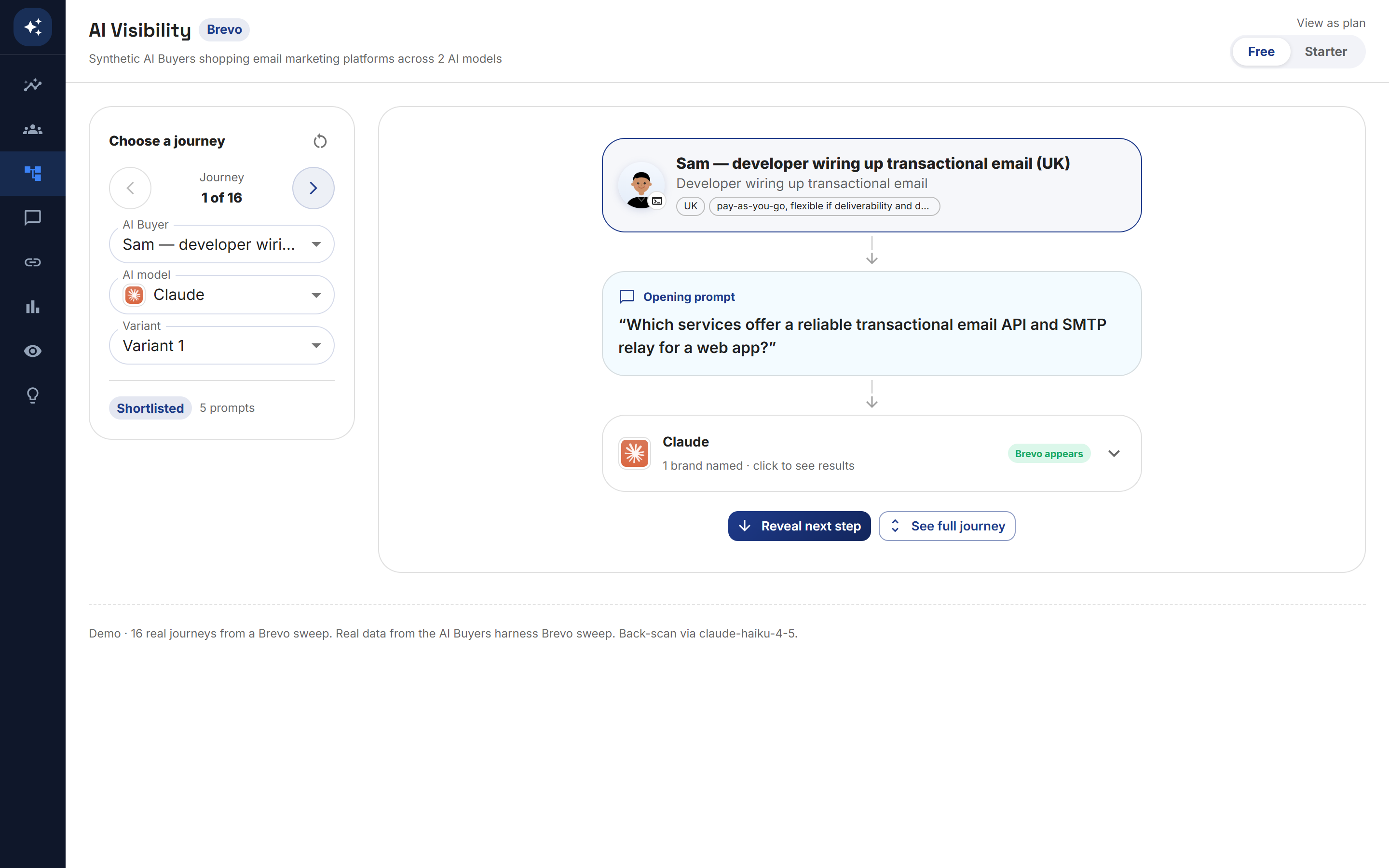
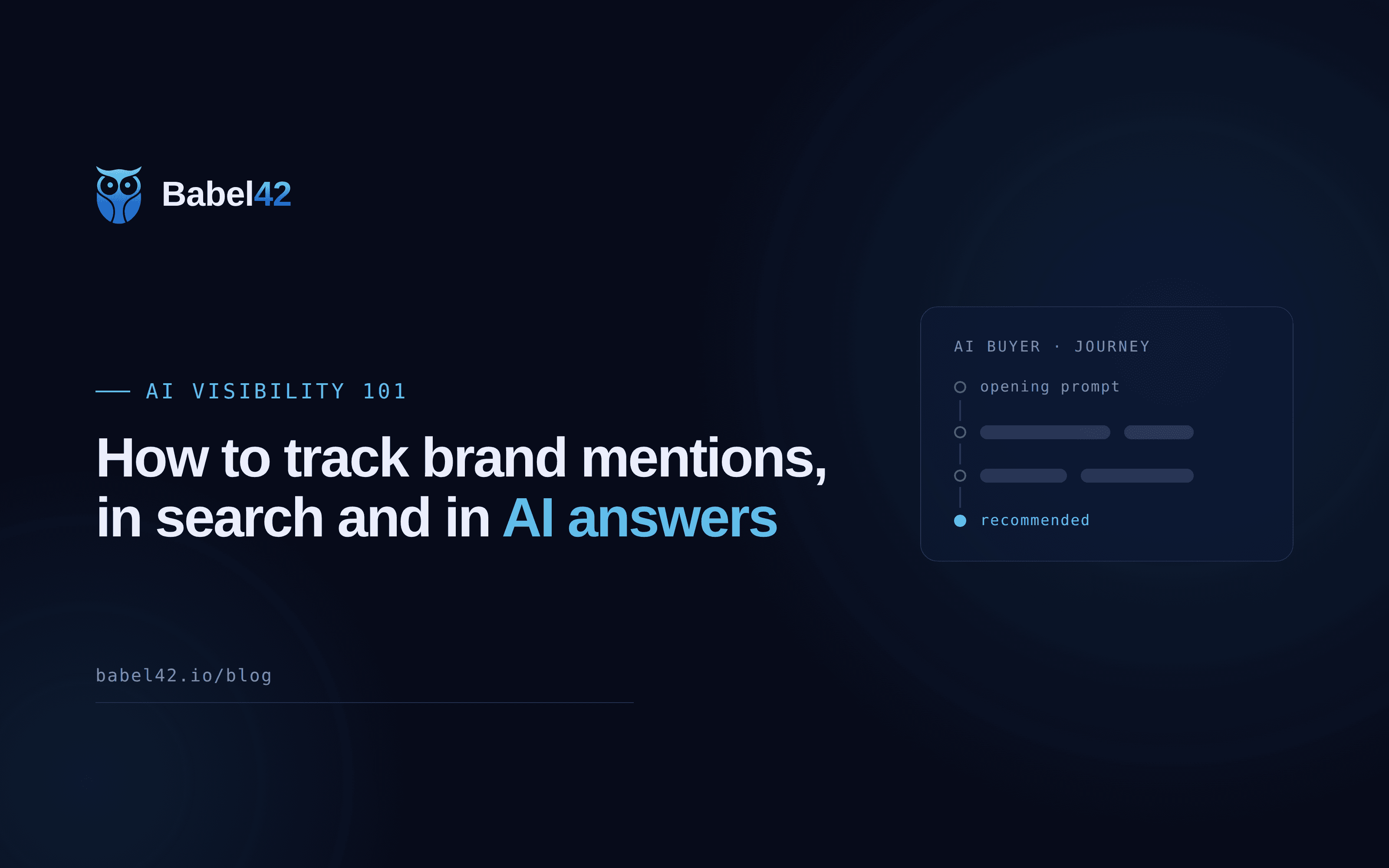
The journey above shows the unit this measurement actually runs on: one buyer persona, one opening question, one assistant's answer, read and tagged the moment it comes back. Run sixteen journeys like it and the tagged results become appearance rate, the share of journeys where the brand is named at all.
Two trackers, two different numbers
| Social mentions | AI mentions | |
|---|---|---|
| Where it looks | Bluesky, X, YouTube, Instagram, Mastodon, Tumblr, Twitch, Hacker News, DEV.to, Stack Exchange, Trustpilot, news | ChatGPT, Claude, Perplexity, Gemini, Grok, Google AI Overviews, Google AI Mode |
| How it finds a mention | A saved keyword query runs on a schedule | A buyer question is asked and the answer is read |
| Free-plan cadence | Every 12 hours | Weekly |
| What a hit tells you | Someone talked about you | An assistant chose to name you over the competition |
Neither number substitutes for the other.
A brand can be mentioned often on social media and still be left out of every AI answer in its category. The two run on different inputs: one reads what people already wrote, the other reads what a model generates fresh each time it is asked, drawing on a different set of sources than the conversation you are reading.
What should you do once you have found a mention?
Act on the two kinds of mention differently, because they call for different responses. A social mention, especially a negative one, usually wants a reply: respond, correct, or escalate while the conversation is still live. An AI mention cannot be replied to. The assistant has already answered, so the only lever is changing what it reads next time, by publishing the page or earning the citation that gets you named in the next answer.
That is also why the two trackers feed different parts of a marketing team. Social monitoring is a daily watch: a spike, a complaint, a journalist asking a question. AI visibility is a slower read on whether your content and reputation are shaping up to look like the recommended option, tracked weekly rather than checked in real time.
Put the two side by side and a pattern worth acting on is a brand that scores well on social mentions but poorly on AI mentions. That usually means people already talk about the brand, but the pages an assistant reads when it answers a category question do not make the case as strongly as the conversation does: a missing comparison, a thin review page, a pricing page that is not clear.
The fix sits on the content side, not the listening side. Publish the page that states the comparison plainly, then use the next AI Buyer run to check whether it moved the appearance rate at all.
Track both, because they answer different questions
A brand that only watches social media knows what people are saying. A brand that only watches AI answers knows what one kind of buyer hears when they ask for a recommendation. Neither view is wrong, they are just answering different questions, and a team that tracks only one is blind to the other.
If you are new to the AI side of this, what AI search visibility measures is the place to start. If social listening is the unfamiliar half, what social listening is covers the same ground for public conversation. Both products run on a free plan, so the cheapest way to see your own gap between the two is to check them both yourself.