Five assistants, five different answers
Babel42 puts a realistic buying question to several AI assistants at once and records which brand each one ends up recommending. Same buyer, same wording, same moment. The dataset held 113 comparisons across ChatGPT, Claude, Gemini, Perplexity and Grok where two or more assistants were present in the same run; 61 of those were decidable, meaning every assistant in the room named a single winner, so we checked how often that winner was the same brand.
On this evidence, 60 of the 61 decidable comparisons ended with at least one assistant naming a different brand from the rest. That's 98%. All the present assistants agreed on a single brand in exactly 1 of the 61.
The comparison only works because the question is genuinely identical. Every assistant in a comparison received the same opening question, written once and sent to all of them together, so nothing in the wording can explain the split. What is left is the assistants themselves.
That single number changes what "doing well in AI search" can even mean. A brand is not visible to AI. A brand is visible to one assistant, in one category, on one kind of question, and that tells you very little about the other four.
No two assistants agree with each other
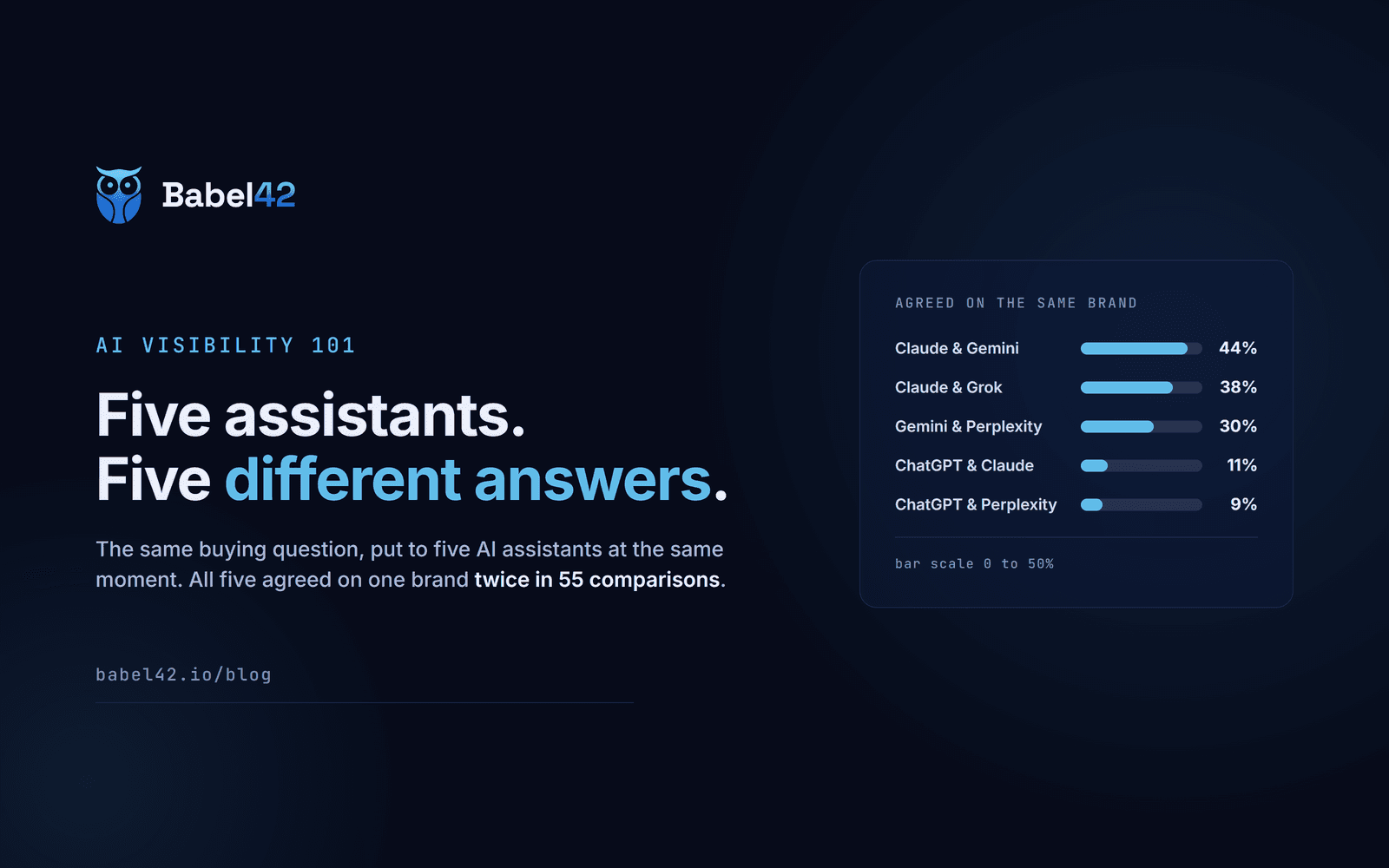
The headline figure counts a comparison as a disagreement if any one assistant breaks from the rest, which is a low bar with several of them in the room. So we also measured every pair on its own: out of the comparisons where both members of a pair named a brand, how often was it the same brand? Grok's paired cells were too few across this corpus to report a rate, so it's excluded from the table below rather than counted as a zero.
| Pair | Agreed | Rate |
|---|---|---|
| Gemini and Perplexity | 3 of 23 | 13% |
| Claude and Gemini | 2 of 21 | 10% |
| ChatGPT and Gemini | 1 of 21 | 5% |
| Claude and Perplexity | 1 of 43 | 2% |
| ChatGPT and Perplexity | 0 of 23 | 0% |
| ChatGPT and Claude | 0 of 15 | 0% |
On this evidence, the friendliest pair on the board still agrees only 13% of the time, and four of the six reported pairs agree 5% of the time or less.
Most teams check their brand in whichever assistant they personally use. On this evidence, that check tells you almost nothing about the rest. ChatGPT and Claude never named the same brand together in this corpus, and neither did ChatGPT and Perplexity.
They are reading different webs
The reason shows up in the sources. Babel42 records which websites each assistant leaned on while it was making its recommendation, so we tallied the most-cited website for each one across every answer we captured.
| Assistant | Most-cited source | Then |
|---|---|---|
| Perplexity | LinkedIn, Yelp | |
| ChatGPT | Wikipedia, TechRadar, Forbes | |
| Google AI Mode | google.com, Instagram | |
| Google AI Overviews | YouTube | Facebook, Reddit |
| Gemini | vendor websites | Capterra |
The five are not ranking the same web in a different order. They are reading different webs. Two of them are built mostly on what people say to each other on Reddit. One is built on LinkedIn profiles. One leans on video. One leans on vendors describing themselves.
Once you see the sources, the disagreement stops looking like a fault and starts looking like the obvious result. Two assistants reading two different halves of the internet were never going to arrive at the same shortlist.
What this means for getting recommended
Published research already tells us a good deal about what makes a page quotable. The 2024 KDD paper GEO: Generative Engine Optimization tested nine edits to real pages and found that adding statistics, quotations and cited sources were among the strongest ways to lift visibility in a generated answer. We measured the same thing across 164 sites and found most have almost nothing an assistant can quote.
What this comparison adds is the second half of the job. Being quotable decides whether a page can be used. Being present in the right sources decides whether the assistant ever reaches your page at all, and the right sources are different for each one.
In practice that means three things:
- A well-argued Reddit thread can carry weight with ChatGPT and Perplexity, the two that cited Reddit above everything else, and do nothing at all for Google AI Mode.
- A strong LinkedIn presence can carry weight with AI Mode, which cited LinkedIn above everything else, and very little with Perplexity.
- Gemini was the only one of the five whose most-cited sources were vendor websites. For the other four the top source was somewhere you do not own, so your own site being excellent is necessary but not sufficient.
The practical order of work is to find which assistants your buyers actually use, find what those specific assistants read, and go and earn a place in those sources. Spreading the same effort evenly across all of them wastes most of it.
The limits of this measurement
Every number above comes from 113 comparisons where two or more assistants were present, and we would rather state the limits than have them pointed out.
The sample is small, but it is paired. Each comparison is its own control: same buyer, same question, same moment, so the only variable is the assistant. That is why a 98% split is meaningful at this size, on this evidence. It is not a market survey and we would not present it as one.
A further 52 comparisons were set aside because at least one assistant in them did not settle on a single brand. Some assistants readily name one recommendation and others prefer to give a list. If every one of those 52 had quietly agreed, the disagreement rate would still be 53%, the honest floor for this finding.
Google AI Overviews and AI Mode are excluded from the agreement figures. Both answer in one pass rather than working through a decision, so they have no single recommendation to agree or disagree with. They appear in the source table only. The source table itself covers five of the seven.
The categories are whatever our customers happen to sell in, so nothing here supports a claim about any particular industry. It is a finding about assistants, not about markets. Brands and categories are not named, because they are real companies' competitive sets.
Where your own brand stands
The figures above describe assistants in general. The number that matters to you is your own, and it will differ by assistant in the same way.
Babel42 runs this comparison for your brand: the same buying question put to seven AI assistants, repeated on a schedule, with the winning brand and the sources behind each answer recorded every time. You see which assistants recommend you, which ones recommend a rival, and what each of them was reading when it decided.
See how AI assistants answer for your brand, or run the free audit to check whether your website gives them anything worth quoting in the first place.
Assistants disagreeing with each other is only half of it; the same assistant asked the same question twice agrees with itself just 22% of the time. How the seven assistants differ is the short reference behind both findings.