Why a lack of evidence could cost you a mention
In 2024 a team from Princeton, IIT Delhi, Georgia Tech and the Allen Institute for AI published GEO: Generative Engine Optimization at KDD, the first large study of what actually changes whether an AI-powered search engine cites you. They tested nine different edits to real pages across thousands of queries and measured which ones moved visibility in the generated answer.
Three of the strongest performers were adding statistics, adding quotations, and citing sources. The paper reports visibility gains of up to 40% from this kind of optimisation, one of several concrete levers behind what actually earns a brand an AI citation.
How AI assistants fetch your content
When an AI assistant is asked a question it sends a crawler to your website. Amongst the things it is looking for, is exactly what we mentioned above, evidence. Clean evidence on a website that it can quote back without the need to assume. The site that provides clear evidence, numbers that can be quoted will be looked upon favourably and that can be the difference between you and your competitors getting cited.
With AI search on the rise, there may come a time AI assistants spend more time reading our websites than actual users, hence why companies are starting to take an AI first approach, building sites that are AI assistant friendly. We wanted to focus on evidence, see how many websites are actually setup to serve good enough evidence that would merit a mention.
Our method of scoring the evidence on a website
We ran our AI SEO audit tool across a sample of 164 websites. The check reads up to ten pages per site, splits each page into sections under its headings, and scores four things. One of those four is what we call evidence.
Evidence is the share of a site's written sections that contain at least one of three things: a number, a quoted phrase, or a link out to another website. That is the whole test. It does not judge whether the number is impressive or the source is any good. It asks whether there is anything in the section that an assistant could lift and attribute.
Of the 164 sites, 149 had enough readable writing on them to score. Those 149 are what the figures below describe.
Most companies are failing to include quoteable information
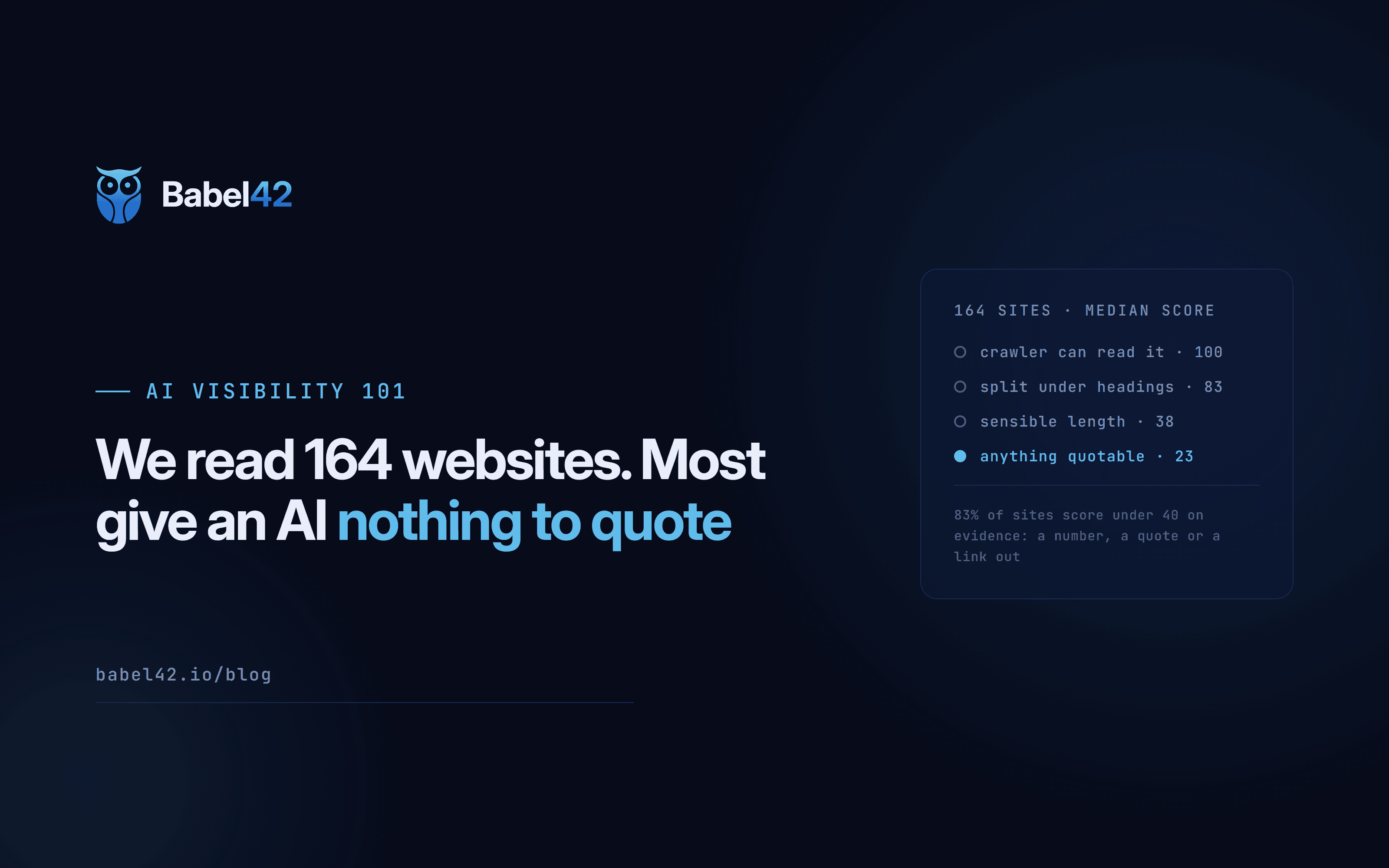
Across those 149 sites, the median evidence score is 23. Just under a quarter of the average site's sections contain a number, a quote, or an outward link.
83% of the sites scored under 40. Fewer than four sections in ten carry anything quotable.
For comparison, here is how the other three measures came out on the same 149 sites:
| What we measured | Median | Share of sites scoring under 40 |
|---|---|---|
| Can a crawler read the page at all | 100 | 0% |
| Are sections split cleanly under headings | 83 | 4% |
| Are sections a sensible length | 38 | 53% |
| Is there anything quotable in them | 23 | 83% |
Sites are broadly fine at being read and broadly fine at being structured. Where they fall down is having something in the structure.
Those three edits are precisely what our evidence score counts. The research says adding a number, a quote, or a citation is among the most reliable ways to get picked up. Our measurement says 83% of sites have not done it on most of their pages.
What an empty section looks like
Some real readings from the set, with the names left out.
A villa rental platform scored 100 for structure and 2 for evidence. Every section sat cleanly under its own heading, correctly sized, easy for a crawler to parse. Almost none of them contained a figure, a quotation or an outward link. It is a well-built house with nothing in the rooms.
A safari operator scored 1 for evidence. Another scored 3. A third, a tour company with a strong reputation and decades of trading behind it, scored 7.
These are not neglected websites. They are professionally built, well designed, and written by people who know their subject. What they say tends to sound like this:
Our expert guides know the region intimately, and our carefully designed itineraries offer an unforgettable journey through some of the most breathtaking landscapes on earth.
Nothing there can be lifted. There is no number, nobody is quoted, nothing is sourced. An assistant asked to recommend a safari operator cannot do anything with that sentence except ignore it. Compare it with the same claim carrying something to hold on to:
Our guides average eleven years in the region. On our 2025 departures, 94% of travellers rated their guide five out of five, and our lion tracking data is published each season with the Kenya Wildlife Trust.
Same claim. One version is quotable and checkable, the other is decoration.
The sites that write best are not the sites that write quotably
We grouped the 149 sites by sector. The pattern that came out was not the one we expected.
| Sector | Sites | Structure | Length | Evidence |
|---|---|---|---|---|
| Travel | 30 | 91 | 48 | 24 |
| B2B software | 37 | 80 | 33 | 26 |
| Financial services | 28 | 77 | 24 | 24 |
| Everything else | 47 | 89 | 44 | 22 |
Travel sites are the best writers in the set. They have the cleanest section structure of any sector we measured, and their sections are the closest to a sensible length by a wide margin. Financial services sites score half as well on length, writing in short fragments that stop before they have answered anything.
And on evidence, travel scores 24. Statistically level with everybody else.
Travel companies write longer, better organised, more readable pages than any other sector here, and still put almost nothing quotable in them. Fluency and citability are separate skills, and the industry that has clearly invested in the first has not noticed the second exists.
There is a reason for that, and it is not laziness. Travel copy is written to create a feeling. Numbers and citations get edited out precisely because they interrupt the mood. That instinct was correct when the reader was a human browsing for inspiration. It works against you when the reader is a model deciding whether your page is worth quoting to somebody who asked which operator to book.
What to change
The fix is boring and cheap, which is the best kind.
Put one checkable thing in every section. Not every paragraph, every section under a heading. A figure, a named source, a quote from a customer or a member of staff, or a link to something outside your own site. One is enough to move a section from unquotable to quotable.
Use numbers you already have. Years your team has been doing this, customers served last year, response time, group size, the share of people who come back. Most companies have these figures already and keep them in a sales deck rather than on the website.
Quote real people by name. A sentence from a guide, an engineer or a customer, attributed to a person, gives an assistant something to attribute in turn.
Link out. Pointing at a source you rely on is treated as a signal of a page that is grounded in something. It costs you a click and it is one of the three edits the research found most effective.
Leave the rest alone. Most sites in our set are already readable and already well structured. Those measures came out at 100 and 83. The gap is not technical and it is not your site build. It is what the writing contains.
If you want to see how your own site scores on this, our free AI readability check reads up to ten pages and reports the same four measures we used here. It is one piece of the wider discipline of tracking your AI search visibility: what a page contains is what an assistant has to work with when it decides whether to quote you. Evidence is one of four dials that check measures; access is another, and it turns out robots.txt rarely tells you the whole story there either.