Ask an AI assistant where to buy running shoes, or which project-management tool fits a five-person team. It names two or three options, not twenty. Somewhere between the question and the answer, a long list of candidate pages got cut down to the handful that earned a mention. This is how an AI assistant decides which sites to recommend: a two-step process, and a cut that usually rewards clarity over general reputation.
Not every question runs this process at all
An assistant answers some questions purely from memory. There is no retrieval step, and usually no citation. It runs a live search for others, and only that second route picks sources at all. OpenAI's own help centre states it plainly: ChatGPT "can search the web and cite sources when it needs current information." A person can also trigger that search directly with the web-search icon or the "/Search" shortcut (OpenAI help centre).
Memory-only answers come from training data, a snapshot of the web collected up to some cutoff date. If a fact changed after that date, the model does not know it, however well the page is written. What retrieval-augmented generation actually does covers that split in full. This post picks up where that one leaves off: what happens once retrieval runs, and a real pool of candidate pages exists to choose from.
How does an AI assistant decide which sites to recommend?
Once retrieval runs, the assistant ranks the pages it pulled back against the question. It keeps the strongest matches and writes an answer using only those. Everything else is discarded before a reader sees anything. Google describes its own AI Overviews this way: the feature is tied to its "core web ranking systems" and built to "only show information that is backed up by top web results" (Google, AI Overviews update).
That ranking step is the one that matters for a marketer, more than the crawl itself. A page can be fully crawlable and still lose here. Losing at this stage is a relevance and trust judgement, not an access problem. We've covered the access half separately: getting a crawler to your page at all. This is the judgement that runs after access stops being the question, given that the model can read your page, whether it trusts the page enough to quote it.
Does the assistant read my whole page, or just part of it?
Retrieval works on passages, not whole pages. The retriever breaks a page into chunks, usually a paragraph or a short section, and scores each chunk against the question separately, a design that goes back to the original retrieval-augmented generation paper from Facebook AI Research, University College London and New York University, presented at NeurIPS in 2020 (paper listing, NeurIPS proceedings). One chunk of your pricing page can win a citation while a chunk three paragraphs later, on the same page, never gets read at all.
That changes what "well-written" means for this purpose. A page can open with a strong, specific paragraph and still lose on a question that lands on its weaker middle section, because the assistant never sees the strong part and the weak part in context together. Every section of a page is competing on its own, not riding on the page's best paragraph.
This is also why a page that reads well to a person can still read badly to this step. A human scans the whole page and fills gaps from context further up. An assistant retrieves one chunk at a time, so a pricing section that says "contact us for details" offers nothing, even if the actual number sits in a table two sections above it.
Does a bigger brand automatically win this cut?
No single factor we have seen decides the cut on its own, and general brand size is not the one doing the deciding at this step. The ranking judges the retrieved chunk against the question in front of it, not the domain's overall reputation.
That is why a specific, well-stated answer from a small site can out-rank a vague paragraph on a page with far more traffic. It is also the opening a younger brand has here. The cut rewards how clearly a fact is stated on the page the model is reading, not how long the brand has existed.
The signals that separate a citation from a candidate
Three patterns come up repeatedly when we watch real AI Buyer journeys land on an answer, each judged on the page itself, not the domain's general reputation.
| Signal | What it decides |
|---|---|
| A plain, quotable fact | Whether the model can lift a sentence whole, rather than paraphrase vaguely or skip the page |
| Whether the fact reads without extra steps | A number gated behind a login, or rendered only in client-side JavaScript, is effectively invisible here, even where a human visitor would find it fine |
| How recently the page changed | Live retrieval leans on recency as a relevance signal; training data does not update until the next snapshot, however old the page gets |
No provider publishes this as a formula, and we would not claim one exists. It is a pattern we and others have watched repeat across real answers, not a documented rule. We flag it as observation rather than fact for that reason.
The same question can return a different citation twice
The ranking above is not a fixed, deterministic function. Our own read of five assistants asked the same question found they rarely agree on sources for it. A separate check on ChatGPT alone found it does not always agree with itself, run twice minutes apart. Retrieval timing, the live state of the index and small prompt variation can all shift which candidates make the final cut. A single answer checked once is a snapshot, not a verdict on whether your page wins this cut in general.
A real decision, inside one AI Buyer journey
Here is what that cut looks like end to end, inside a demo journey from Babel42's AI Visibility product.
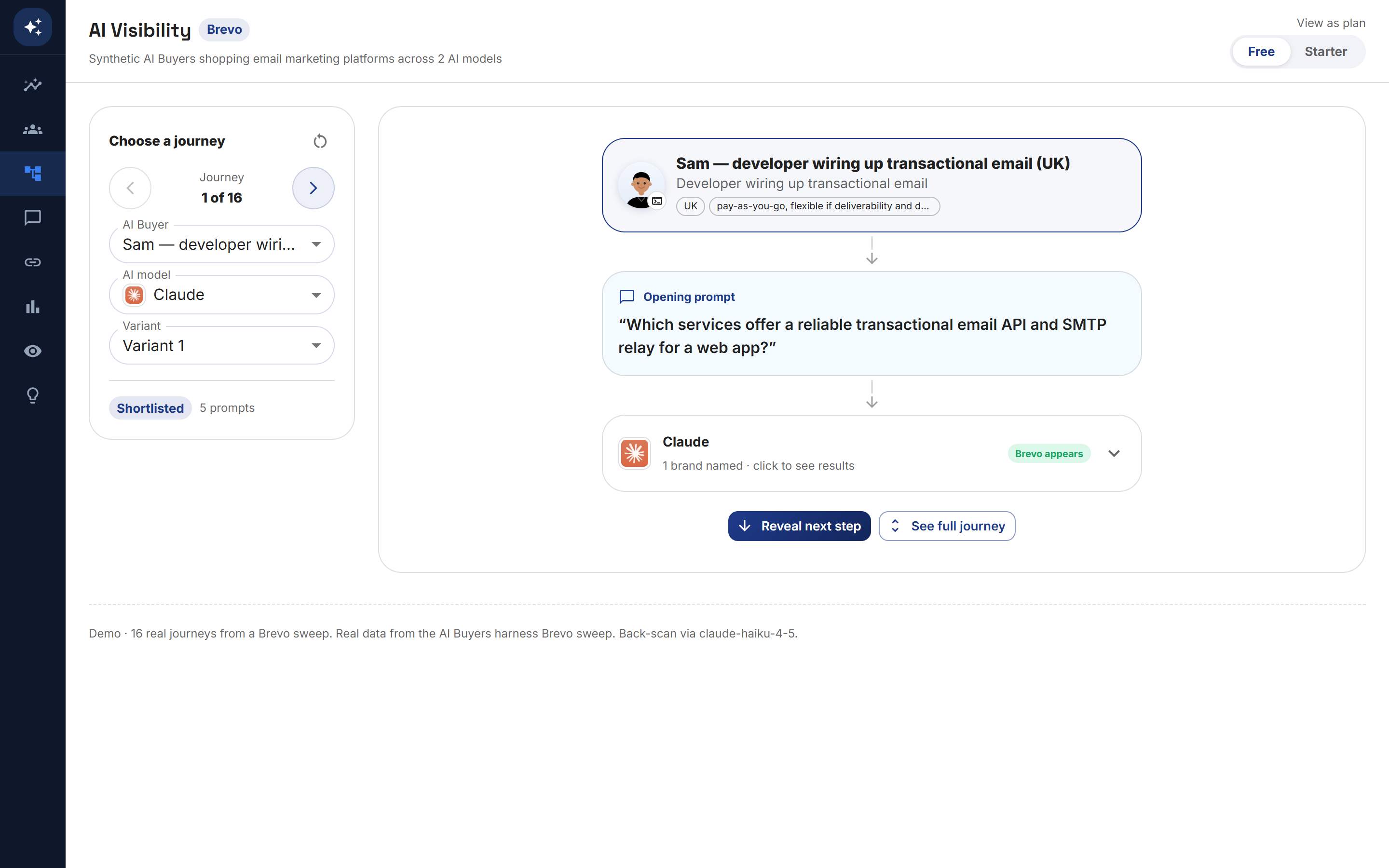
A synthetic buyer built around a developer wiring up transactional email in the UK opens with one question: which services offer a reliable transactional email API and SMTP relay for a web app. Claude's answer named one brand. Every other page it retrieved and ranked below that one is invisible in the final answer. That is the cut this post describes, just not visible from outside the assistant.
What this means for what you publish
The cut happens before the assistant writes a word. The fix belongs on the page, not in how you phrase a prompt to go and test it. Write the number, not the adjective: state pricing, limits and specifics in plain text the page already renders, not behind a login or a "book a demo" form.
Keep the fact current, too. A live-search assistant weighs recency, and a page untouched in a year is a weaker candidate than one with a visible recent update. Check the weaker sections of a page as well, not only the opening paragraph, since the assistant can retrieve either one on its own, as the chunk-level split above explains.
Checking whether your own pages are winning this cut beats guessing. Babel42's AI visibility tool runs the same kind of buyer journey against your own category and shows which of your pages got cited and which got dropped. The free plan checks any two of the seven assistants it covers, no card required.
If this is your first stop on the subject, what AI search visibility actually measures is the wider page this one sits under, and it is the score this whole cut adds up to over many questions, not just one.