Somebody asked us this week whether social listening is "one of those things you need a big budget for." It isn't. You can start today, for nothing, and get a useful read on what people are saying about your brand, your product or your topic. This guide walks through how to do social listening for free: the manual methods that cost nothing but your time, where they quietly fall apart, and how a free tool tier fixes the parts that manual searching never will.
Start with the searches you already know
Before any tool, there's the search box. Every major platform has one, and most people use it worse than they could.
- X and Bluesky: both support proper search operators. Use quotes for an exact phrase,
ORto catch variants ("Babel42" OR "Babel 42"), and a minus sign to drop noise (-giveaway). Filter by "Latest" rather than "Top" if you want to catch a thread while it's still small. - Reddit: its native search is patchy, and no listening tool can fill the gap for you, because Reddit's Data API Terms require a separate negotiated agreement for any commercial use. So route around it: search
site:reddit.com "your brand"in Google instead, and check the two or three subreddits where your buyers actually hang out directly. A subreddit's own search bar, scoped to that community, beats the sitewide one every time. - YouTube: search your brand or topic, then don't stop at the video titles. The comments underneath are often the real conversation: praise, complaints and comparisons to competitors, all in one place.
- Google, plain and simple:
"your brand name" -site:yourdomain.comfinds news coverage, forum threads and blog mentions you'd otherwise never see, because they don't ping you and you don't know to look. Google documents the operators it actually honours in "Refine web searches", which is worth a read, because a good half of the operators passed around online were quietly retired years ago.
None of this needs a login you don't already have. It's also exactly how most people's "social listening" starts and, for a lot of small brands, where it stops.
Add Google Alerts for the mentions you can't watch for
Manual search only works if you remember to do it. Google Alerts closes that gap for free: set one up for your brand name, your product, and maybe your own name if you're the public face of the company, and new web and news mentions land in your inbox as they're indexed. It's not real-time and it misses social platforms entirely, but for press coverage and blog mentions it's a useful, zero-cost trip wire. Ten minutes at alerts.google.com and you've got a standing watch on the open web.
Where the manual approach quietly falls apart
Manual searching gets you started, but it breaks down in predictable ways once you're relying on it week after week:
- It doesn't scale across platforms. Your audience is on X, Bluesky, Reddit, YouTube and probably a few forums you haven't thought to check. Manually searching all of them, every day, is a part-time job you didn't sign up for.
- There's no memory. Search results show you now. They don't show you whether sentiment is better or worse than last month, or whether volume is climbing or falling, because nothing's being kept.
- Nobody's telling you the mood. You can read ten posts and get a feel for the tone, but at fifty or a hundred a week, "reading the vibe" stops being reliable, and it's the first thing that slips when you're busy.
- You only catch what you go looking for. A thread can build for hours before you happen to check, and by the time you search for it, the moment to respond well has often passed.
- Nothing is de-duplicated. The same story gets picked up by three outlets and reposted by a dozen accounts, and manually you'll count it, and recount it, over and over.
None of that is a knock on doing it by hand. It's the honest reason tools exist at all: not to replace searching, but to keep watching after you've stopped.
Where a free social listening tool changes the maths
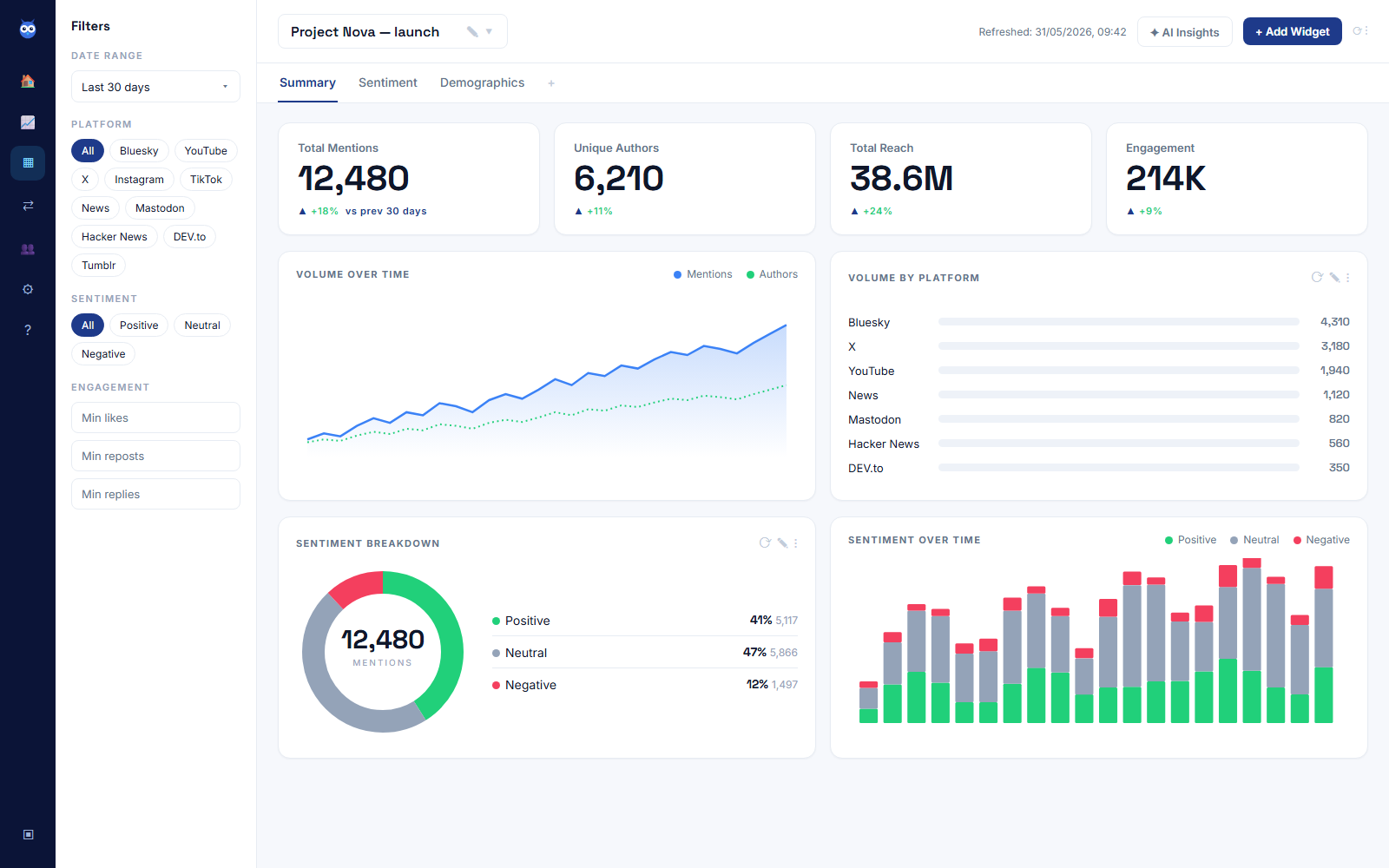
This is the part most guides skip, because most listening tools don't have a real free tier. Babel42 does: 500 mentions a month, two monitors, one channel, across five networks (Bluesky, YouTube, News, Hacker News and DEV.to), with AI sentiment analysis and 90 days of history, no card required. That's not a seven-day trial that nags you to pay. It's the actual product, sized for someone starting out.
What changes once a monitor is doing the watching instead of you:
- One query, five networks. Instead of five separate searches in five tabs, you write the query once, with the same Boolean precision (
AND,OR,NOT, exact phrases) you'd use on any single platform, and Babel42 fans it out across all of them and brings the results back collected in one place. - Sentiment, scored, not guessed. Every mention comes back positive, neutral or negative, so "is this going well?" has an actual answer instead of a hunch.
- A record you can look back on. Ninety days of history means you can compare this week to last month, not just stare at a snapshot.
- It's still watching when you're not. The monitor keeps collecting in the background, so the thread that started building at midnight is sitting there waiting for you, instead of lost.
A free-week workflow you can keep up
Put the manual searches and the free tool together and you get a routine that costs nothing and takes about twenty minutes a week to run:
- Set up one monitor for your brand name (variations and obvious misspellings included) as one of your two free monitors, and a second for your main product or category.
- Set a Google Alert for the same brand name, to catch the press and blog coverage the monitor's five networks don't reach.
- Once a week, spend fifteen minutes in the dashboard. Read the sentiment trend, skim the top mentions, and note anything that needs a reply.
- Once a week, spend five minutes searching X, Instagram and Reddit by hand, using the search tricks above, so the rest of the conversation is in front of you too.
- Act on one thing. Reply to a critic, thank a fan, or jot down a recurring complaint for the product backlog. A monitor nobody acts on is just a hobby.
That's a complete, low-effort listening habit, and every part of it is free.
What the free plan gives you, and where a paid plan adds
Know the shape of the free tier before you build a habit on it. X runs through the official X API, which is billed as "credits, deducted per request" in X's own words, so it's a paid add-on on any paid plan, and Instagram, when you do have it, is sampled coverage rather than every single post. You get one channel for tracking a specific account rather than a query, and two monitors, enough for a brand and a category. History runs to 90 days, so year-over-year comparisons come with a paid plan. None of that stops you from starting; it tells you what to expect when you outgrow it.
Start this week
You don't need a strategy meeting to begin, and you don't need a budget. Pick the one thing you most want to know what people are saying about, run a Google Alert and a Babel42 monitor against it, and give it a week. The picture that builds up, sentiment, volume, the actual words people use, is usually worth more than the guessing it replaces.
Once you've got the basics running, two useful next reads: our full guide to what social listening is and, when you're ready to put the conversation to work for growth, how to grow your organic marketing with social listening. For a sense of what a week of free-tier monitoring can surface on a genuinely large story, see what social media actually said about the SpaceX IPO.