Someone in a meeting says "we need an AEO strategy" and three people nod, each picturing something different. One means featured snippets. Another means showing up when someone asks ChatGPT a question. A third isn't sure there's a difference between that and GEO, and isn't going to ask. That confusion is reasonable: AEO is an older term than most people assume, and it has been quietly repurposed for the AI-assistant era without anyone agreeing on a new definition. Here is what it means, where it came from, and what it means specifically if you sell to other businesses rather than consumers.
AEO, defined
Answer engine optimisation (AEO) is the practice of structuring content so it can be lifted directly into a machine-generated answer, rather than found via a list of links. That's the constant part of the definition. What's changed is which machine, and which answer.
Where AEO came from, and why it now means two things
AEO predates ChatGPT by years. It started life describing a narrower, older problem: winning the direct-answer slots search engines had already been building for a decade before generative AI existed, Google's featured snippets, the "People Also Ask" boxes, and the single spoken sentence a voice assistant like Siri or Alexa reads out when you ask "how many teaspoons in a tablespoon." None of that involves a large language model. It's pattern matching against structured, well-marked-up content, usually with schema markup and a clean, literal question-and-answer format, competing to be the one snippet an algorithm decides to surface.
That older AEO is still a real discipline, and it hasn't gone away. But once ChatGPT, Perplexity and their peers started answering questions in full paragraphs instead of a single lifted sentence, marketers reached for the same three letters to describe the new problem, because the shape of the goal looked similar: don't just rank, be the answer. The term stuck to both jobs, which is why it now means two things depending on who's saying it.
AEO, GEO and SEO: not the same job
We've written before about what changes between GEO and SEO in practice, and AEO sits in an odd spot next to both. Here's the clearest way we've found to separate the three:
- SEO gets you a ranked position among a list of links on a results page. The user does the choosing.
- AEO, in its original and still-narrower sense, gets your content chosen as the single direct answer to a specific, literal question, a featured snippet, a "People Also Ask" entry, a voice assistant's spoken line. There's one slot, one fact, one winner.
- GEO is broader again, and it is a younger term than either of the others: it comes from a 2023 paper, Aggarwal et al., "GEO: Generative Engine Optimization", later published at KDD 2024. It means being named, described and recommended inside a generated, multi-sentence answer that an AI assistant writes for a specific person, often across several turns of a conversation, not just one factual lookup.
The practical overlap is real, though: an AI assistant answering "does this tool support SSO" in one clean sentence is doing something close to classic AEO, a single fact, cleanly lifted, even though the underlying model and pipeline are the same ones people mean when they say GEO. The line between "answer engine" and "generative engine" blurs exactly at the point where a question has one factual answer rather than a comparison to make. Most of what we cover on this blog is closer to the GEO end, because most of what a B2B buyer asks an AI assistant isn't a single fact, it's a comparison with a decision at the end. But AEO's original, narrower skill, stating a fact so cleanly it can be lifted whole, is a real part of winning that comparison too, just not the whole of it.
Why the distinction matters more for B2B than it looks
For a B2B audience specifically, this isn't just semantics, because the two versions of AEO reward different things.
Classic, single-fact AEO rewards structured markup and a literal question-and-answer format: FAQ schema, a clean H2 that states the question verbatim, a one-sentence answer directly underneath it. That's worth doing, and it's cheap to do. It's also not sufficient on its own, because most of the B2B buying questions that actually decide a deal aren't single-fact lookups. "Does this handle SSO" is a single-fact AEO question. "Should I use this or a competitor for a 40-person marketing team on a tight budget, and what am I giving up either way" is not, it's the kind of question we watched play out across 59 real AI buying journeys, where a buyer states a constraint, gets a shortlist, adds another constraint, and the shortlist changes again.
A B2B team that only does the narrow version of AEO, tidy FAQ pages with schema markup, will pick up the easy single-fact wins (a clean answer to "what integrations does X have") and still lose the comparison questions, which is where most competitive deals are decided. The narrow version is a floor, not a strategy.
What works for both, in practice
The good news is that the technique underneath classic AEO, state one fact plainly enough that it can be lifted whole, is also exactly what helps in the broader, comparison-driven answers that decide B2B deals. We've written about this from the technical side in how AI crawlers find and cite your brand: a model can only quote what it can read as an unambiguous, specific claim. "2,000 mentions a month on the Starter plan" gets lifted into an answer, whether that answer is a single spoken fact or a five-paragraph comparison. "Generous limits" gets lifted into neither. None of it helps on a page that never gets fetched, so it is worth confirming that part first: our free AI SEO audit checks whether assistants can reach and read your pages before you spend time on the wording.
A short, practical checklist that covers both versions of AEO at once:
- Write the question as your buyer actually asks it, as a heading, followed immediately by a direct answer. Not three paragraphs of context first, the answer first, the context after. This is the part classic AEO always got right, and it still matters.
- State every fact that would answer a follow-up question, not just the opening one. A buyer asking an AI assistant rarely stops at question one; if your page only answers the first question a comparison shortlist raises, you win the snippet and lose the deal two turns later.
- Use FAQ schema where your CMS supports it, for the genuinely single-fact questions (pricing, integrations, compliance certifications). It's low effort and it's the one part of this that's a pure technical checkbox. Be clear about what it buys you, though. Google restricted the FAQ rich result in September 2023 and its own FAQPage documentation now says the feature "is only shown for well-known, authoritative government and health websites". The markup still states the question and its answer unambiguously to anything reading the page, which is the part that matters here.
- Don't stop at your own pages. A model forming a comparative answer draws on independent sources too, review sites, forum threads, comparison articles, so the same plain-fact discipline matters wherever your product gets discussed, not only on your own site.
Seeing the difference in an actual answer
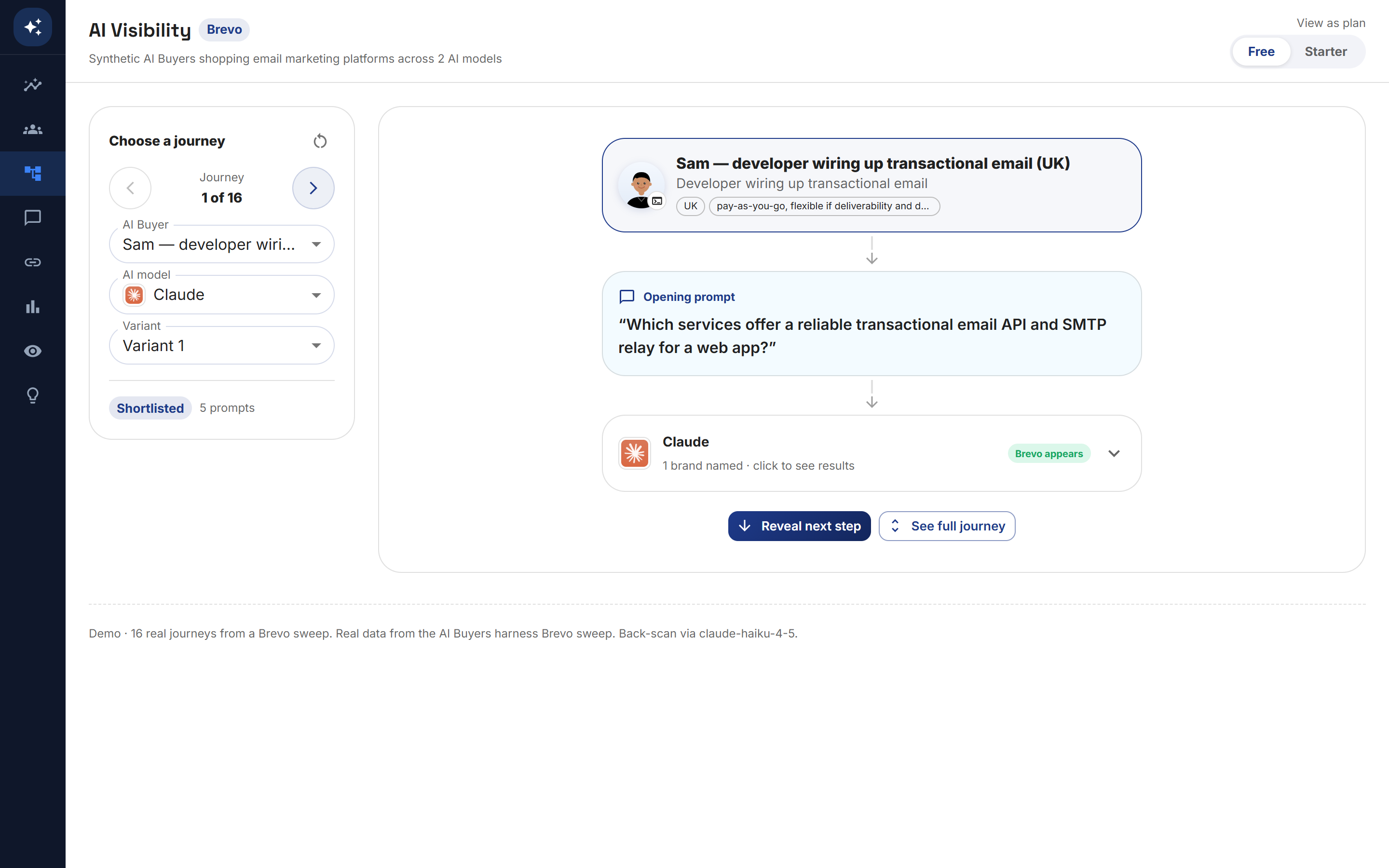
Below is a real journey from Babel42's AI Visibility product: a developer opens with a narrow, factual question about transactional email APIs, and the model names a brand in response. That opening question is close to classic AEO, one fact, cleanly answered, but the four turns that follow it are where the comparison gets decided, and the same plain-answer discipline is what gets a brand named at either end.
Where AEO fits if you're measuring this properly
If you're already tracking AI search visibility, you don't need a separate AEO programme bolted on the side. The four metrics that matter, appearance rate, share of AI voice, recommendation rate and sentiment, apply just as well to a single-fact answer as they do to a five-turn comparison; the difference is only in how narrow the question is. Babel42's AI Visibility product runs AI Buyer journeys and tracks both kinds of answer as they happen, rather than treating single-fact AEO and multi-turn GEO as two separate tools to buy. The free plan runs one AI Buyer across any two of the seven assistants it covers on a weekly cadence, enough to see, concretely, whether your plainest facts are getting picked up; paid plans add more buyers, more assistants and a faster cadence as the questions worth tracking multiply.
The short version
AEO is an older term than the current AI hype cycle, borrowed from a narrower job, winning a single direct-answer slot, and now used loosely for a broader one too, being named favourably inside an AI assistant's generated answer. For a B2B audience, the narrow version is worth doing and cheap to do, but it only covers the opening question of a buying conversation. The comparison questions that close deals need the same plain, factual, quotable writing, just applied further into the conversation than a single FAQ answer usually goes.
For the direct, side-by-side comparison, including which to prioritise first, see AEO vs GEO: what's actually different. Our answer engine optimisation reference keeps the ranked factor list in one place if you would rather work from that than from prose. If a vendor or a colleague uses "LLM SEO" instead, it's the same discipline under a third name, and our AI SEO pillar covers the whole of it end to end.