You don't have a marketing team yet. You have a product, a handful of users, and every hour split between building, selling and putting out fires. Social listening sounds like something you'll get to once there's a marketing hire to own it.
We'd argue the opposite: social listening for founders pays off earliest, precisely because nobody else in the company is watching the conversation for you. A marketing team eventually builds a dashboard and a process around this. A founder just needs to know, quickly and without a research budget, what people are actually saying about the problem you solve, the launch you just shipped and the competitors you're up against. That's a smaller job than "run a listening programme," and it's one a single monitor can do from week one.
Why this is different for founders than for a marketing team
A marketing team listens to prove a campaign worked. A founder listens to make decisions that haven't been made yet: what to build next, who to talk to, whether the thing you shipped on Tuesday actually landed.
Catching it as it happens matters more than it sounds, because asking later gets you a worse answer. According to Fallesen et al., "Long-Term Recall Error in Retrospective Family Surveys", which matched what people remembered against the register record, recall quality slips "by 0.5 to 0.6% points per year on average over a 20-year period". The stakes are also more personal. If a marketing team misses a bad thread, a report gets delayed. If a founder misses one, it can be the thing an early customer remembers about you.
The good news is that founder-stage listening doesn't need to be sophisticated. You're not trying to prove ROI to a board yet. You're trying to answer five specific questions, cheaply and quickly enough to act on them.
Five things worth watching from day one
1. Whether your category has a pulse before you sell into it
Before you've spent a penny on marketing, the people who'll eventually buy from you are already complaining about the problem you solve, somewhere. A monitor on the problem itself (not your brand, which nobody's mentioning yet) tells you whether that pain is real, how people describe it in their own words, and who else is trying to solve it. Those exact phrases are worth stealing for your landing page, because they're proof the words resonate; we've seen the same pattern in how founders discover partners through the conversation already happening in their niche, and the logic for validating demand is identical. It's also the same monitor that does double duty as a way to find your first users before anyone's searching for your brand by name, and as a lightweight market-research tool in its own right once you want more than a gut check on whether the pain is real.
2. What happens in the hours after you launch
Show HN, a Product Hunt launch, a first press mention: these moments generate more signal in a few hours than most weeks of ordinary conversation, and they happen exactly when you're least able to sit refreshing five tabs. Hacker News at least makes itself easy to watch, publishing a read-only API anyone can call with no key and no quota. A monitor catches the mentions you'd otherwise only find by luck, so you can reply to the comment that's shaping opinion while it's still shaping it, not the next morning when the thread has already decided what it thinks.
3. Who your first real partners and champions are
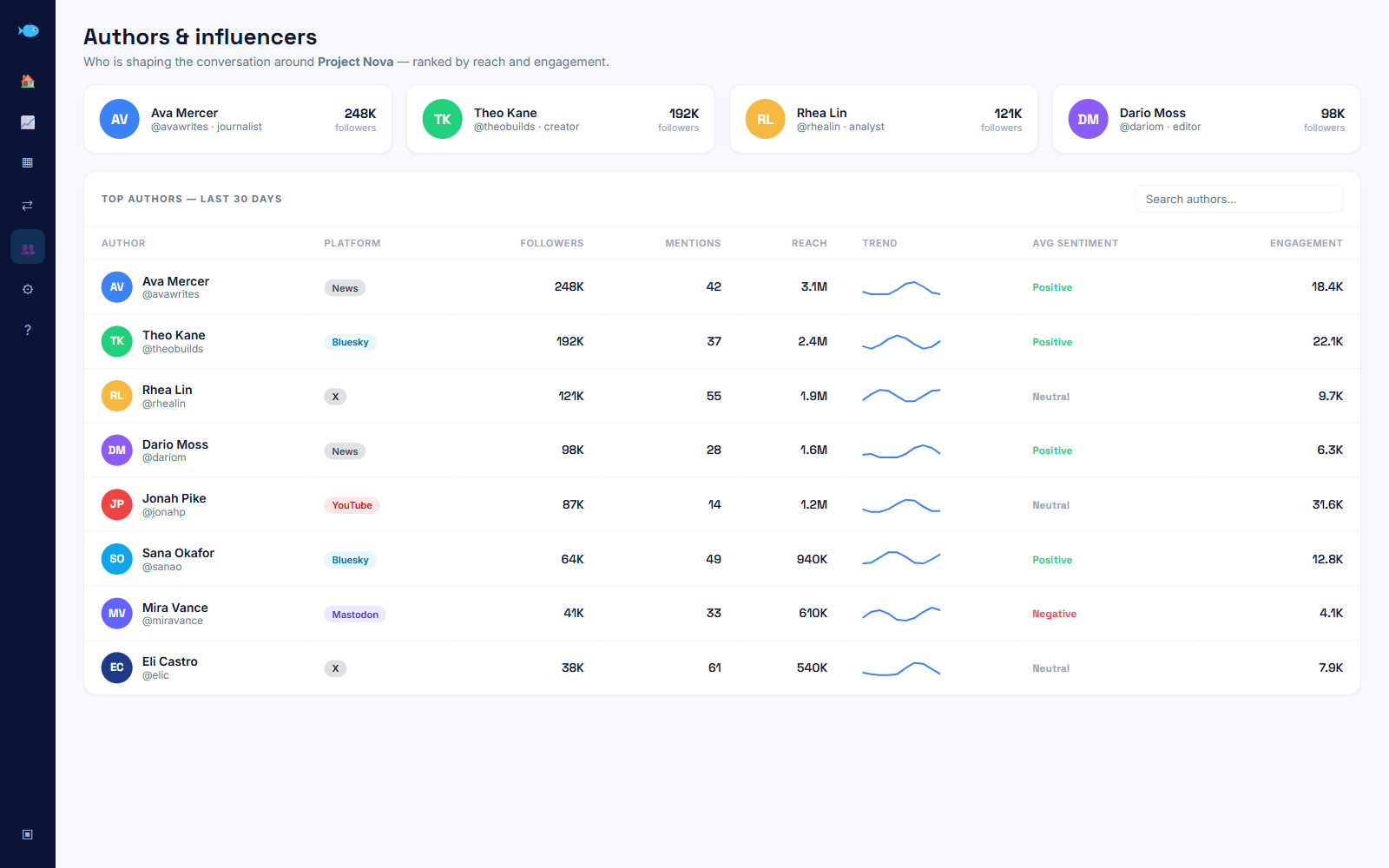
Your first ten meaningful partnerships rarely come from cold outreach. They come from people already talking about your space, who you find by watching who shows up, how often, and with how much reach. Expect a handful of names to dominate. According to Pew Research Center's "Contending with the 80/20 rule when studying online behavior", "the most active 10% of Twitter users produce 80% of all tweets from U.S. adults", which is a nuisance when you are counting mentions and a gift when you are looking for the people worth knowing. Our full playbook for finding partners through social listening covers the process in detail: set up a niche monitor, rank the people behind the mentions, and vet them before you reach out. For a founder with no BD team, this is often the single most productive thing a listening tool does, full stop.
4. What competitors are shipping and how it's landing
You don't need a paid competitive-intelligence subscription to know when a rival launches a feature, changes their pricing, or takes a public beating in their own replies. Track their name and their product alongside your own category monitor, and their launches, and the reaction to them, show up in the same place your own mentions do. It's the cheapest form of competitive research that actually stays current, because it updates itself.
5. The moment a wobble starts, not the moment it's a crisis
A frustrated early user with a following, a bug that hit at the worst time, a post that reads worse out of context than it meant to: every founder gets a version of this eventually. What separates a bad hour from a bad quarter is almost always how early you knew. We wrote a five-step playbook for handling a reputation wobble that starts with exactly this: a monitor with a sentiment alert, so you have time to respond while the conversation is still small enough to steer.
What this looks like without a team
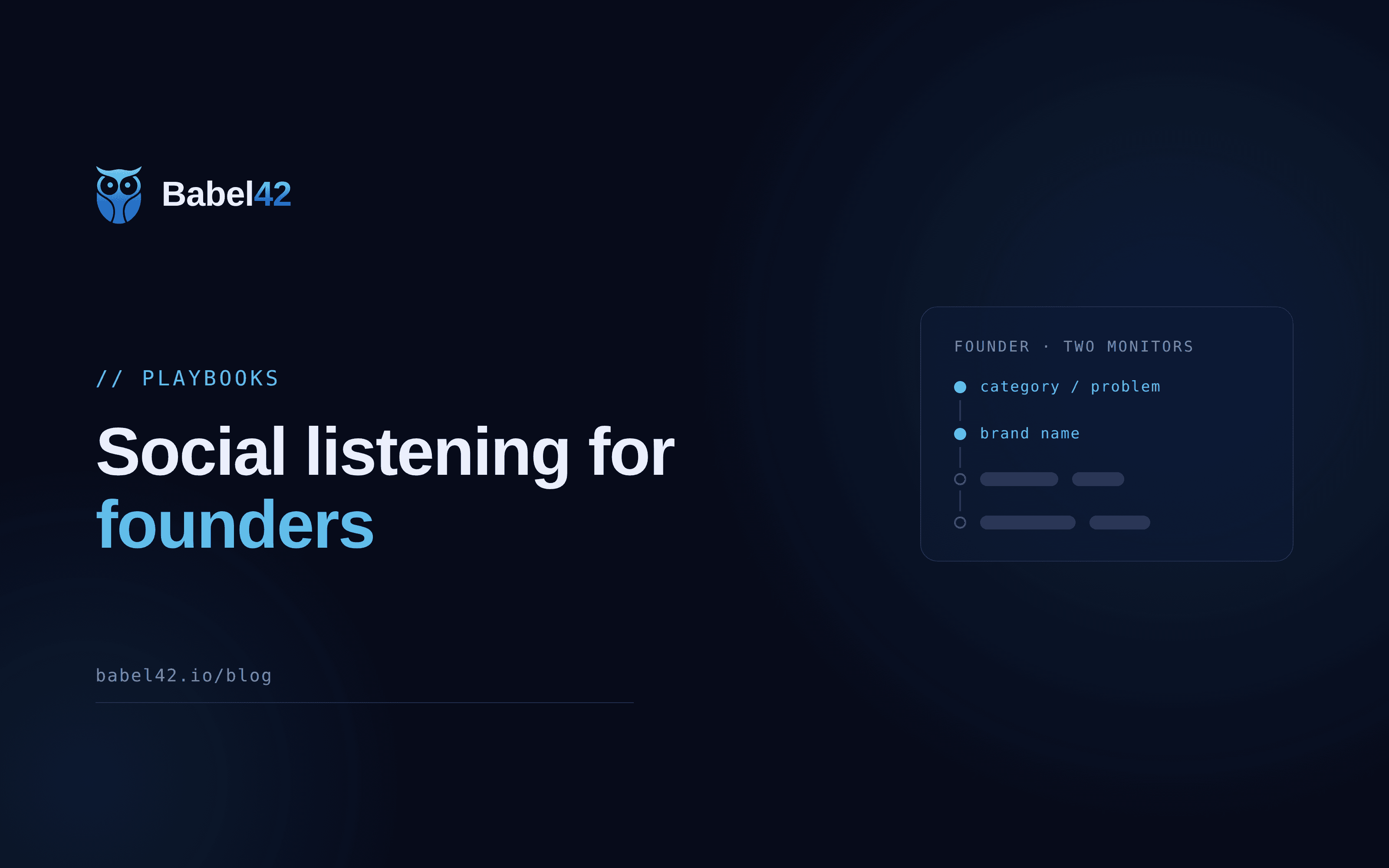
None of the five things above needs a dedicated hire or a big tool budget. In practice, it's one or two monitors: your category or problem space, and your brand name plus close variants. A query for the second one might look like "your brand" OR "yourbrand" NOT "@yourbrand", precise enough to catch the name and its obvious misspellings while dropping your own account's posts from the results. Add your two or three most-watched competitors as a Channel so you can see their posting cadence and engagement over time, not just individual mentions. Check the dashboard for ten minutes, a couple of times a week, more often in the days around a launch. That's the whole system, and it scales down to genuinely zero budget: our guide to doing social listening for free walks through the manual version and where it falls short, and Babel42's free plan (500 mentions a month, two monitors, one channel, across five networks, with AI sentiment analysis and 90 days of history) covers most of it properly, no card required.
Two monitors is a real constraint at this stage, so spend them deliberately. Most founders get the most value from one on the problem or category (the demand-validation and competitor signal) and one on the brand name (the launch and reputation signal), and treat the Channel slot as reserved for whichever competitor matters most right now, swapping it out as priorities shift rather than trying to track everyone at once.
What this is worth at founder stage
Founder-stage listening answers the five questions above cheaply enough that skipping them has no good excuse. The full share-of-voice programme and a year of trend data come later, with a bigger plan and a team to act on it. The point isn't to run a sophisticated operation. It's to not be the last person in the building to know what's being said about the thing you're building.
Start listening before you need to
If you're pre-marketing-team, start with one monitor on your category and one on your brand, and read our plain-English guide to what social listening actually is if you want the fuller picture of what a good tool does. Babel42's free plan is built for exactly this stage: real product, not a trial, with everything above ready when you outgrow it.