You open a listening dashboard, see a sentiment score sitting comfortably in positive territory, and move on with your day. That number feels solid, like a poll result. It isn't. It's a machine's best guess at what thousands of individual people meant, made one post at a time, and some of those guesses are wrong in predictable, specific ways.
This isn't an argument against using sentiment analysis. It's useful, which is exactly why it's worth knowing how it works and where it breaks, so you read the number correctly instead of trusting it the way you'd trust a headcount.
What social media sentiment analysis measures
Social media sentiment analysis takes a public post, whether that's a tweet, a review, a Bluesky reply or a comment under a news story, and classifies it as positive, negative or neutral. Scored one post at a time, those labels get rolled up into a trend: a percentage split for the week, a line that moves up or down, a spike worth investigating.
The label itself is the easy part. Any system can count words like "love" and "terrible" and tally a score. The hard part, and the part that separates a reliable reading from a misleading one, is handling the posts that don't say what they seem to say.
How does sentiment analysis work?
Most sentiment analysis today runs on a machine learning model trained on large amounts of labelled text: examples of posts a human has already tagged positive, negative or neutral, which the model learns patterns from and then applies to new, unseen text. Older approaches scored a post by tallying positive and negative words from a fixed list; that's fast, but it treats "not good" as containing the positive word "good," missing that the negation flips the entire meaning. Handling negation properly means tracking how far its effect reaches through a sentence, not just spotting the word "not" and moving on, which is one of the specific technical traps engineering teams building these systems run into, as Toptal's writeup on sentiment analysis accuracy walks through in more detail.
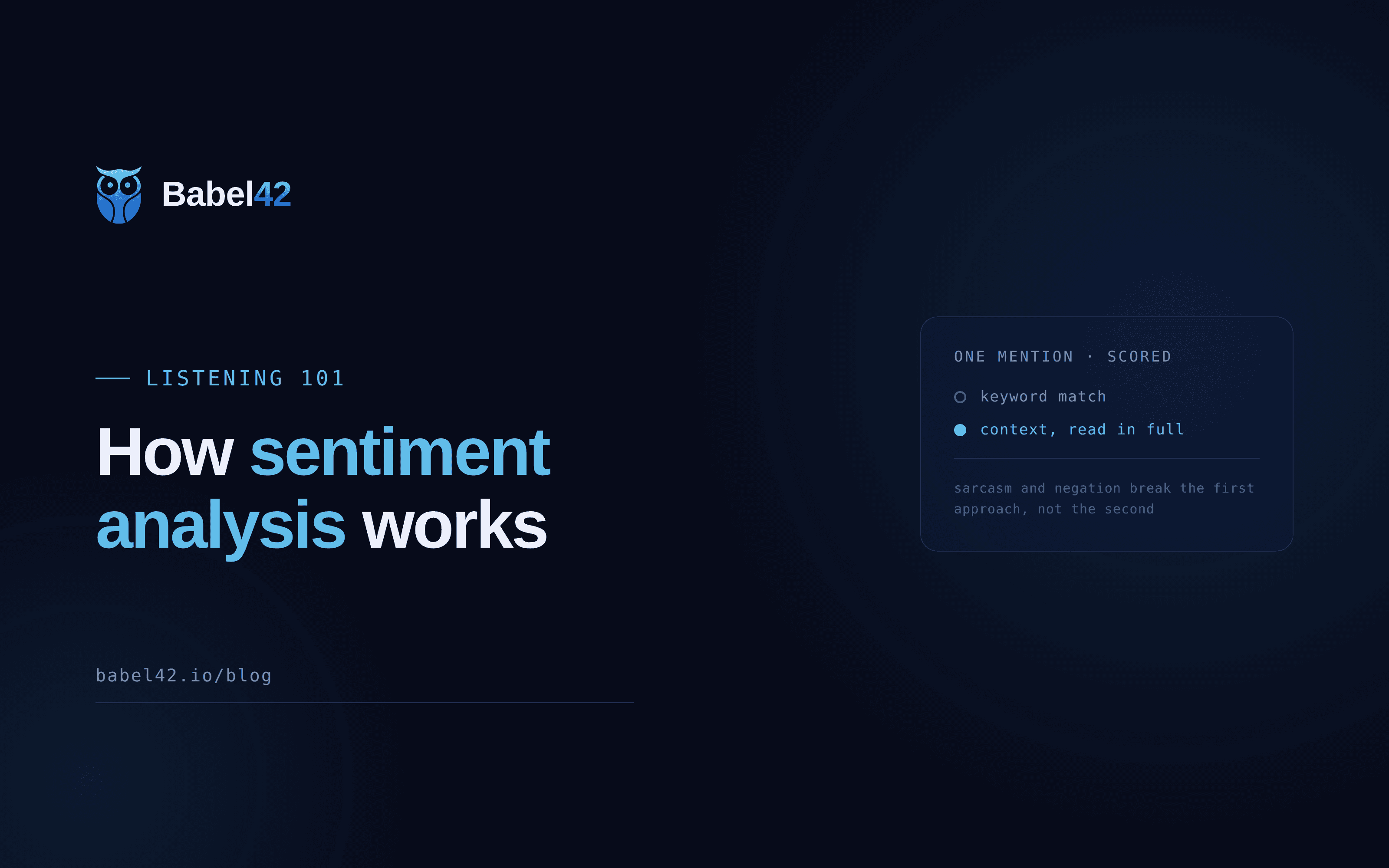
The other structural problem is that a post's sentiment isn't just the sum of its words. "Great, my flight got cancelled" is built entirely from positive vocabulary and means the opposite. A model that reads context, the surrounding words, the likely tone, rather than scoring each word in isolation, catches far more of this than one that doesn't. It still won't catch all of it, which is the part worth understanding next.
There are three common approaches, and each fails in its own way:
| Approach | How it scores a post | What it misses |
|---|---|---|
| Word lists | Counts positive and negative words from a fixed list | Negation ("not good"), sarcasm and slang |
| Trained classifier | A model trained on posts people have already labelled | Sarcasm, and words that mean something else in your niche |
| Large language model | Reads the whole post in context, closer to how a person would | Some sarcasm and in-jokes, and it costs more to run |
Babel42 uses a large language model. The other two are kept only as fallbacks, for the rare moment the model is unavailable.
Where sentiment analysis gets it wrong
Three patterns account for most of the mistakes.
Sarcasm. "Love when my internet crashes mid-meeting" reads positive to anything scoring vocabulary, and it's obviously the opposite to a person. Sarcasm works by using positive words to mean something negative, so there's no wording-level clue to catch, only tone and context, and even the people building sarcasm-specific detection models describe it as genuinely difficult: a peer-reviewed survey of sentiment analysis and sarcasm detection points to its subtlety and heavy reliance on context as the reason it resists most standard approaches, especially when the sarcasm depends on something the model has no way of knowing, like a shared joke or a recent event.
Mixed sentiment in one post. "The onboarding was confusing but support fixed it in ten minutes" is both negative and positive, about two different things. Collapse that into a single label and you lose which half mattered, and a dashboard that forces one score per post will pick a side, sometimes the wrong one, rather than showing you both.
Words that mean something different in your category. "Sick," "insane," and "unreal" read negative on a generic word list and are compliments in gaming, fashion and streetwear conversation. A general-purpose model trained mostly on formal or neutral text can misfire on any niche with its own vocabulary, and the fix isn't a bigger word list, it's a model reading the sentence as a whole rather than flagging individual words.
None of these is a reason to distrust sentiment scoring outright. They're the specific, known reasons a score can be off, which is different from it being unreliable at random.
How Babel42 handles that honestly
Babel42 scores each mention it collects positive, neutral or negative, with a confidence figure attached to the individual score, not just the aggregate. Those per-mention scores roll up so you can read sentiment for a whole monitor, one platform, or a single week. Where a platform's tone is hard to read automatically, the dashboard says so instead of quietly reporting a number as if it were solid, rather than forcing a confident-looking label onto a post the system can't read well.
That confidence figure exists because of exactly the failure modes above. A post that's plainly negative ("this broke again") scores with high confidence. A dry, sarcastic reply or a post mixing praise and complaint scores with lower confidence, and that's the signal worth noticing before you act on the headline number.
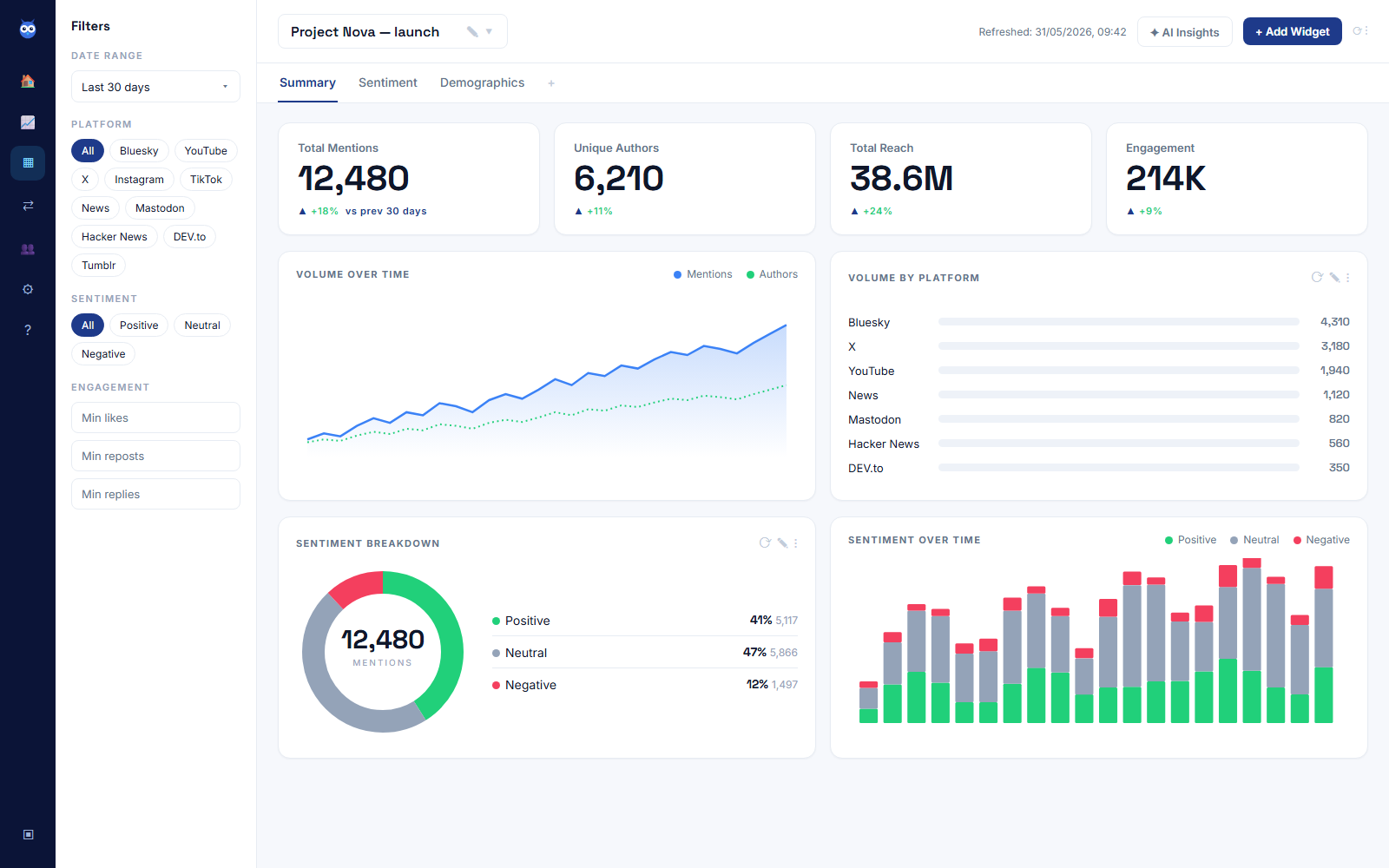
The screenshot above is a demo project, not a real customer account, but it shows the shape worth reading: the sentiment-over-time chart underneath the headline split, because a single week's dip or spike in that daily breakdown is where the actual story usually is, not in the 30-day aggregate sitting above it. For the fuller pipeline behind that number, how mentions get collected, deduplicated and scored before they ever reach a chart, our guide to how social listening tools work under the hood covers the mechanics end to end.
What should a sentiment dashboard show you?
A sentiment dashboard worth paying for shows more than a single positive, neutral or negative split. Four things separate a dashboard you can act on from one you can only glance at: a confidence figure attached to each mention, not just the aggregate score; the actual mentions behind any spike, one click away rather than buried; a trend over weeks, not a single day's snapshot; and category-aware reading, so niche vocabulary like "sick" or "insane" in a gaming or fashion monitor doesn't get flagged as negative by mistake.
Checking a tool against that list before you buy it matters more than checking its headline accuracy claim, because accuracy on a generic benchmark says little about how it handles your category's own words, or whether it shows you enough of the mention to judge a borderline case yourself.
Reading a score without getting fooled by it
A few habits make the difference between using sentiment analysis well and getting burned by it once:
- Treat the score as directional, not gospel. "Sentiment is down this week" is a reason to look closer, not a finished conclusion. Every automated sentiment reading, Babel42's included, is a best estimate rather than a verdict.
- Read the mentions behind a move, not just the number. If sentiment drops five points, open the negative bucket and read a sample. You'll usually find one of two things: a single repeating complaint worth fixing, or a batch of sarcasm and mixed posts the model scored with low confidence, which is a different problem entirely.
- Watch the trend line, not the snapshot. One noisy day is normal. A slide that holds for two or three weeks is the pattern worth acting on, which is the same read we cover in more depth in how to set up brand reputation monitoring.
- Expect lower confidence in niche or informal conversation. Gaming, fashion, and internal jargon-heavy B2B threads are exactly where category-specific vocabulary trips up a general model, so treat a surprising score there as worth a manual check first.
How to track social media sentiment over time
One reading tells you very little. Social media sentiment tracking is about the change, so set it up to show you change:
- Put your brand, product names and common misspellings in one monitor. Split them across monitors and the trend splits too.
- Take a baseline of two to four weeks before you judge any move. You need to know what a normal week looks like first.
- Read the weekly split, not the daily one. Daily numbers swing on a single viral post.
- Open the mentions behind every real move. The number tells you where to look. The posts tell you why.
- Track one competitor the same way. If their sentiment drops in the same week as yours, the cause is probably the market, not you. Our guide to share of voice covers the comparison.
Should you trust an automated sentiment score?
Yes, as a starting point for where to look, and no, not as a finished answer on its own. The score is what tells you a hundred mentions this week deserve attention instead of ten thousand; reading the actual mentions behind the number is still what tells you why, and that second step is the one worth never skipping.
Babel42's free plan includes AI sentiment analysis on 500 mentions a month, across two monitors and five networks (Bluesky, YouTube, News, Hacker News and DEV.to), with 90 days of history, no card required. If you haven't set up a monitor yet, our plain-English guide to what social listening is is the place to start, and how to do social listening for free walks through the first one end to end.