Most brands only think about their reputation twice: never, and during a crisis. The gap between those two moments is where the actual damage happens. Sentiment doesn't usually collapse overnight. It drifts, one mention at a time, for weeks before anyone in the company notices, because nobody was watching the trend line, only waiting for it to spike.
Brand reputation monitoring is the practice of watching that trend line on purpose, before you need it. This is a practical guide to setting it up: what to track, how to build the monitor, and a routine that keeps the dashboard part of your week rather than something you open only when it's too late.
What brand reputation monitoring tracks
Reputation is more than a single sentiment score. Four things move together and are worth tracking as a set, not one at a time:
- Mention volume, the raw amount of public conversation about your brand. A steady baseline is normal; a sudden jump, up or down, is the first sign something changed.
- Sentiment trend, the mix of positive, neutral and negative reactions over time. One negative thread is noise. A sentiment line that's been sliding for three weeks is a trend. Read it as a line rather than as a verdict on any single post, because automated scoring is an estimate: in Van Hee et al., "SemEval-2018 Task 3: Irony Detection in English Tweets", the best of dozens of competing systems reached an F1 of 0.71 on the plain question of whether a tweet was ironic.
- Who's driving the conversation, because ten thousand mentions from ordinary accounts read very differently from a thousand mentions led by one large one. Public conversation is lopsided by default: Pew Research Center's "Contending with the 80/20 rule when studying online behavior" found "the most active 10% of Twitter users produce 80% of all tweets from U.S. adults", so a volume figure on its own is partly a measure of how busy a small group is.
- Share of voice against named competitors, since reputation is relative. Holding steady while a rival's mentions and sentiment climb is still losing ground, even though nothing about your own numbers changed.
None of these on their own tells the full story. Together, they're what separates "someone's unhappy today" from "something is actually shifting."
What's the difference between reputation monitoring and a crisis response plan?
Reputation monitoring is the baseline you keep running all the time; a crisis response plan is what you do the moment that baseline breaks. Monitoring is how you notice the drift early enough to act calmly. If you're already mid-wobble, our guide to handling a reputation wobble covers the five-step response itself: sizing the moment, replying once at the source, and watching for the turn. This guide is about the watching that has to be running before that moment arrives, so the alert actually fires in time to matter.
Set up the monitor before you need it
A monitor built around your brand name alone catches too much noise: unrelated people or companies with a similar name, old threads resurfacing, passing mentions with no real opinion attached. Babel42's query builder turns a plain-English description into the underlying Boolean search, which you can then refine by hand with AND, OR and NOT. A workable starting point pairs your brand name and common misspellings with quoted phrases for your product name, so a mention of "the app" from an unrelated app doesn't slip through.
Add a second, narrower monitor for your top two or three named competitors. You'll use it for the share-of-voice comparison below, and it doubles as an early warning when a competitor's own bad week starts pulling attention, and comparisons, toward you.
Read sentiment as a trend, not a single score
A dashboard's job here is to make the trend visible at a glance, not just report today's number.
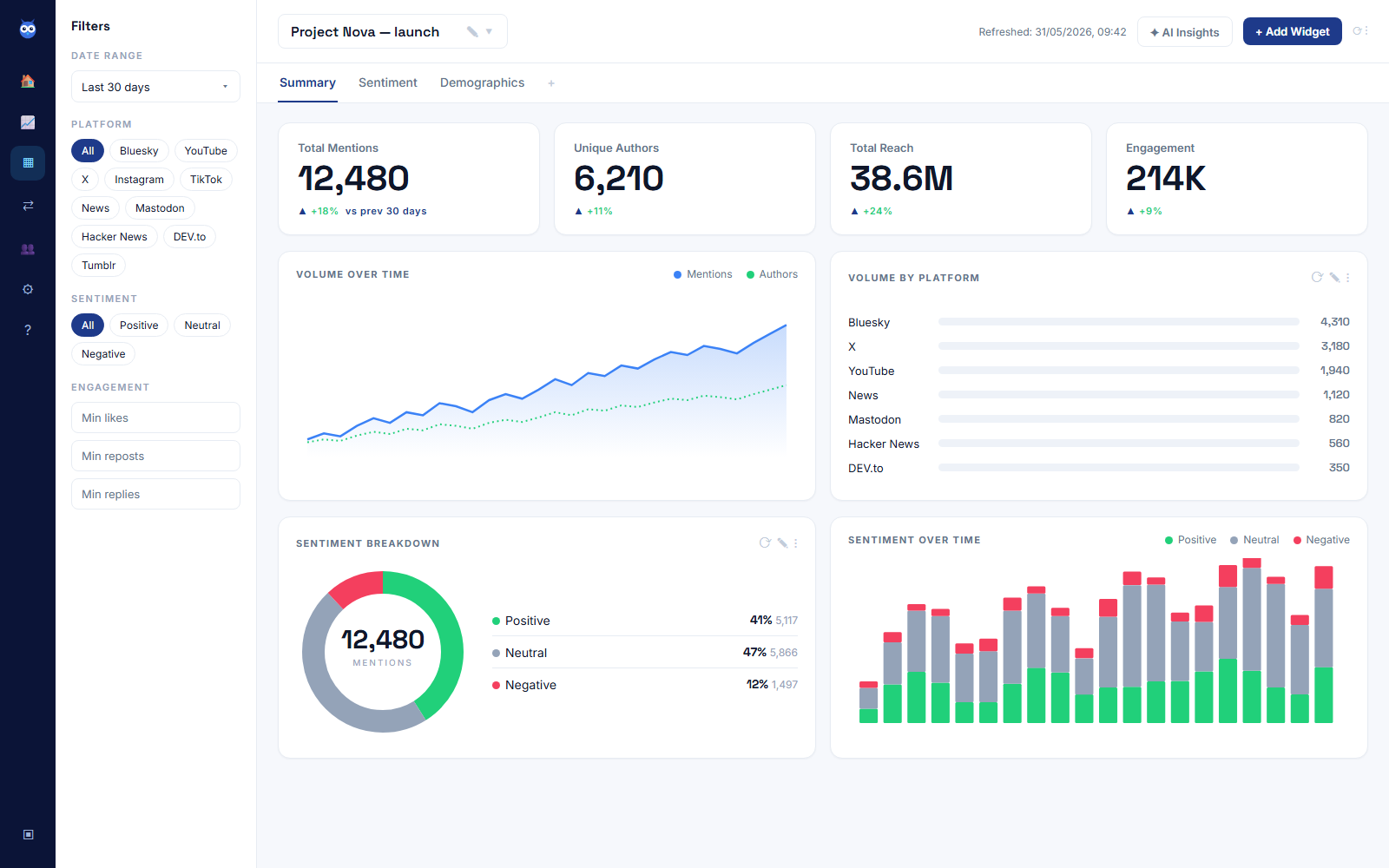
The screenshot above is a demo project, not a real customer's account, but the shape is the one worth learning to read: mentions climbing steadily is healthy on its own, but check it against the sentiment-over-time chart next to it. Volume and positive sentiment climbing together is genuine momentum. Volume climbing while the negative slice widens is the pattern that deserves a closer look at what's actually being said, not just how much of it there is.
Benchmark against the brands people compare you to
A sentiment score in isolation is hard to judge. A small negative slice can be normal in one category and a warning sign in another, depending on what your category looks like. Babel42's share of voice view puts your brand and the competitors from your second monitor side by side, so you can see whether a dip is something happening to you specifically, or something happening to everyone in the conversation that week.
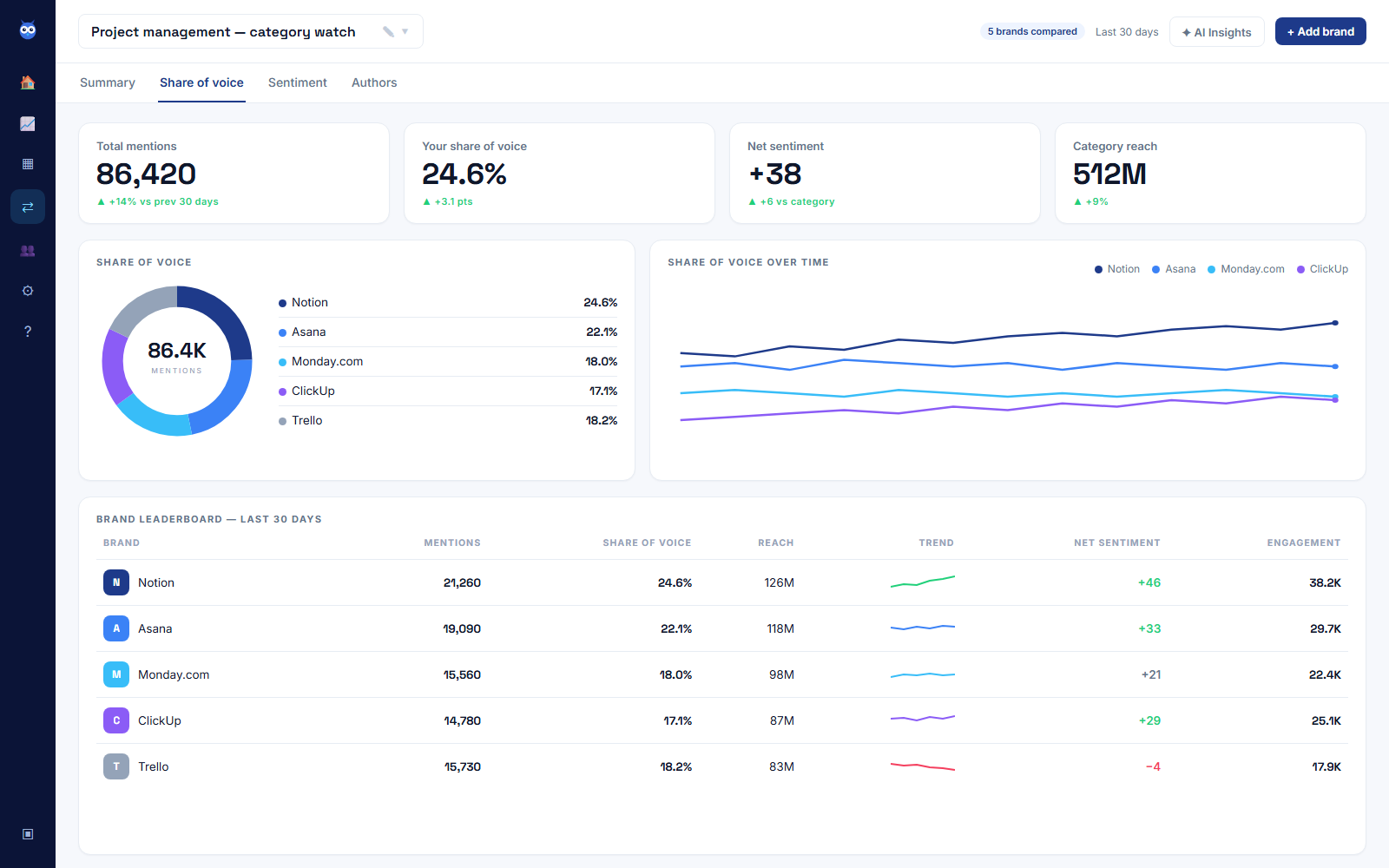
This is the same category-watch demo used elsewhere on this blog to illustrate competitor tracking, not a live customer account, shown here for the reputation angle specifically: net sentiment sitting well above a rival whose trend line is heading the other way is a much faster read of relative standing than scrolling each brand's mentions separately. Babel42's Channels feature adds the other half of this picture, following your own account and your competitors' directly, so you can see posting cadence and follower growth sitting next to how each brand's mentions are landing.
A weekly and monthly routine
Reputation monitoring only earns its keep if someone looks at it on a schedule, not just when something already feels wrong.
- Weekly, ten minutes: check the sentiment trend and mention volume for anything that moved, and skim the top negative mentions for a repeating complaint rather than a one-off.
- As alerts arrive: Babel42 can notify you on a volume spike, a sentiment dip or a mention from a high-reach account, so a fast-moving thread doesn't sit unread until your next weekly check.
- Monthly, fifteen minutes: compare your share of voice and net sentiment against the same competitor set, and note whether the gap widened or narrowed since last month.
That's under an hour most months for the ongoing watch, plus whatever time an actual alert costs you. The pattern-matching, which dips are noise and which are the start of something, gets faster the longer the monitor's been running.
What monitoring covers, and what still needs you
Babel42 watches the public conversation about your brand across the platforms it covers, scores each mention and tells you when the trend moves. That is the part that scales, and it is the part most teams are doing by memory and screenshot today. Private groups and communities behind a login, Reddit among them, are worth a manual search alongside your monitors when a meaningful slice of opinion about your brand lives there. Reddit is a rule rather than an oversight: its Data API Terms require a separate negotiated agreement for commercial use, so no tool covers it without one. And the why behind a mention, the reason someone feels the way they wrote, is a conversation you have with the person, using the alert as the prompt to go and have it.
On the free plan, you get 500 mentions a month, two monitors and one channel across five networks (Bluesky, YouTube, News, Hacker News and DEV.to), with AI sentiment analysis and 90 days of history, no card required. That's enough to run your brand monitor and one competitor monitor side by side; tracking several named competitors at once, or adding the extra networks, is where a paid plan helps. Either way, it's enough to see whether watching the trend, rather than waiting for the spike, changes how early you catch the next one.
If you haven't set up any listening yet, how to do social listening for free covers the first monitor this guide assumes you already have running. For the separate, earlier question of whether anyone's heard of you at all, how to measure brand awareness with social listening covers that side of the same dashboard. For the reactive side of this same conversation, handling a reputation wobble is the playbook for the moment your monitor fires. If that moment turns into more than a wobble, our guide to writing a brand crisis management plan covers the severity levels and named roles worth deciding before it happens. And if you're watching a specific rival rather than the category as a whole, how to monitor competitor activity goes deeper on that side of the same setup. The same "is this real or manufactured" question applies to the engagement you're watching, not only the mentions: LinkedIn's own numbers on AI-written posts and inauthentic activity are a recent, concrete example of why that distinction matters.