"AI citation rate" has started showing up in marketing meetings the way "domain authority" once did: everyone nods, and everyone means something slightly different by it. Some people use it as a synonym for appearing in an AI answer at all. Others mean something narrower and more useful: when an assistant names a source for what it just told the buyer, how often is that source you? Those two questions have different answers, and the gap between them is exactly what a citation rate is supposed to measure.
What's the difference between being mentioned and being cited?
Being mentioned means an assistant said your brand's name somewhere in its answer. Being cited means the assistant pointed at a specific page as the source for a claim, the way a footnote points at a reference. A brand can score well on one and badly on the other, because they measure different things: whether the model talks about you, versus whether it's actually pulling from your own pages when it does.
According to Semrush's 2026 AI Visibility Index, built from 126 million US AI search prompts analysed between January and April, this gap is common rather than an edge case (Semrush, "Semrush Releases Expanded 2026 AI Visibility Index"). On Gemini specifically, the overlap between brands mentioned in an answer and domains cited as sources could run as low as 30%, meaning most of the time a brand named in the answer wasn't the same brand whose page got the citation. Mentions and citations are two different scoreboards, and a strong showing on one tells you very little about the other.
One reason the two numbers can pull apart: a citation only happens when an assistant does a live retrieval step and reads a specific page. A mention needs none of that if the brand was well documented at training time. We've written before about the split between an assistant's live-search mode and its memory of what it learned during training; a brand can rack up mentions from memory while scoring badly on citations, because memory doesn't point at a page, it just recalls a name.
What we call it: own-site citation share
We track this ourselves, under a plainer name than "AI citation rate." Own-site citation share is the proportion of the sources an assistant cited that are pages on your own domain, out of every source it cited across the buyer journeys you're tracking. It's a straightforward count, not an estimate: every citation gets tagged as yours or a rival's, and the share is however many of those are yours.
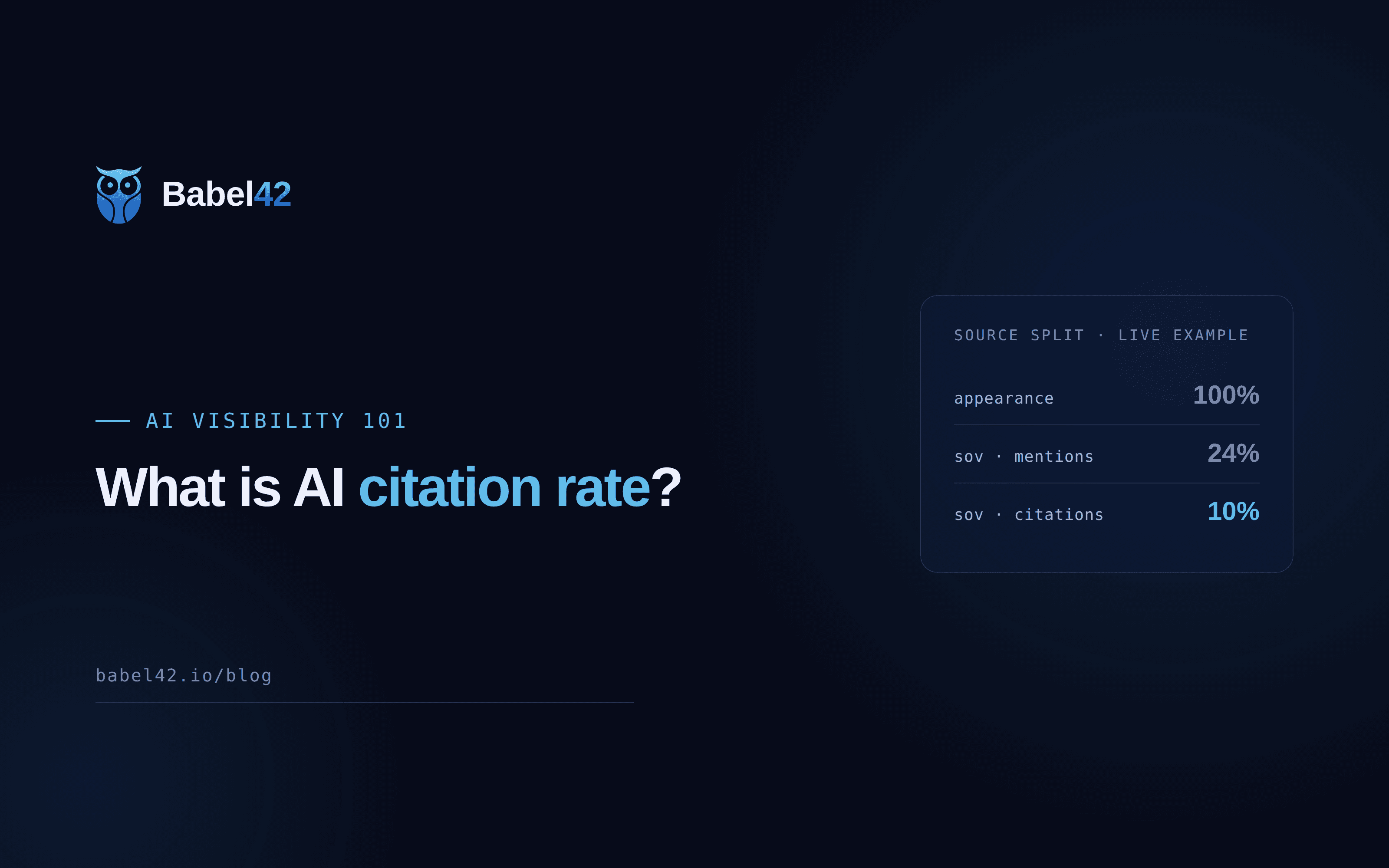
Here's what that split looks like in our own data, from a real demo workspace tracking an email marketing brand across two AI assistants. The brand appeared in 100% of the buyer journeys measured, a strong appearance rate by any read. Its share of AI voice by mentions was 24%: worth a look, but not dominant, in a scoreboard of 341 mentions out of 1,397 total. Its share by citations, though, was lower still, 10%, or 93 citations out of 896: a bigger gap than the mentions number alone would suggest. The dashboard's "top cited sources" table showed why: the brand's own domain and help centre held two of the top slots, but the busiest cited source in the set was a third-party product-comparison site, not the brand itself.
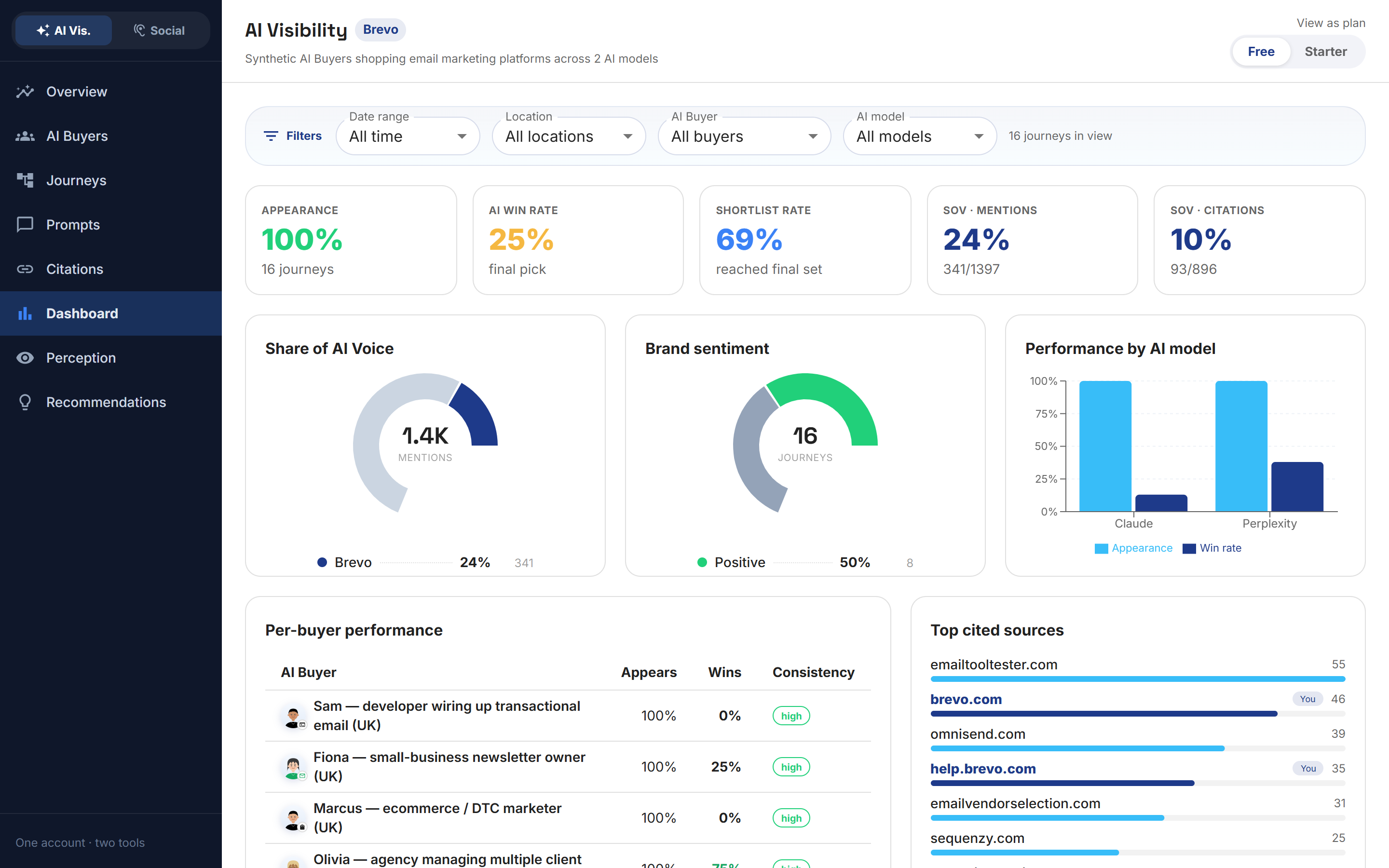
That's the pattern worth watching for in your own numbers: a mentions share that looks respectable while the citations share sitting right next to it tells a less flattering story about who the assistant is reading from.
How to check your own citation rate without a tool
You don't need a subscription to get a rough first read. Open ChatGPT, Claude and Perplexity in separate tabs and ask each one a genuine buyer question from your category, the kind of thing a real prospect would type rather than your own product name. Read past the headline answer to wherever the assistant lists or links its sources, and write down every domain that shows up, not just the brands mentioned in the prose.
Once you've got that list, sort it into two piles: pages on your own domain, and everything else. Divide the first pile by the total to get a rough citation rate for that run. Do this across a handful of realistic questions rather than one, because a single prompt tells you about that prompt, not about your category, the same trap our fuller measurement method warns about for appearance rate.
Why a low citation rate matters even when you're still getting mentioned
A mention without a citation is a borrowed position. The assistant knows enough about you, from training data or from a page it read somewhere else, to say your name, but when it comes to backing up a specific claim, it's reaching for someone else's page: a comparison site, a review aggregator, a competitor's own content. That's a fragile place to stand, because the moment your product changes, your pricing moves, or a rival's page gets more current than the one the assistant is quoting, you're relying on a third party to have noticed and updated theirs. Being cited from your own domain means the assistant read your account of the facts, not a summary of a summary.
This is also a different question to the crawlability mechanics we've covered before, how AI crawlers find and read your site. That post is about whether a crawler can reach and parse your pages at all. Citation rate assumes it can, and asks a narrower question on top of that: when the assistant had a page it could have used, did it pick yours?
What tends to move the number
A few things correlate with a page actually getting picked as the cited source, rather than just existing:
- A page that answers the specific question being asked, not just the category. A generic homepage rarely gets cited for a comparison question; a page built around that exact comparison has something concrete to point at.
- Facts stated plainly enough to lift without rewriting. An assistant citing a source is usually pulling a specific number, a specific feature claim, or a specific limitation, not a paragraph of tone-setting copy.
- Being the freshest accurate account of a fact that changes. Pricing, feature lists and integrations are exactly the kind of detail that goes stale on third-party pages faster than on your own, which is an opening if your own page is kept current.
- Structured, extractable formatting. Headings, tables and short factual sentences are easier for a retrieval system to lift cleanly than dense prose, the same groundwork covered in our guide to optimising content for AI search.
None of that promises a citation on any given question. It shifts the odds toward your own page being the one that's reachable, current and specific enough to quote.
Where this fits with the rest of your AI visibility numbers
Citation rate isn't a replacement for appearance rate, win rate or share of AI voice, it's the number that tells you something the others can't: whether the assistant is reading you, or just reading about you. None of these numbers is meant to be squashed into a single score either; what an AI visibility score actually measures covers why we keep them apart. Babel42's AI Visibility product tags every source an AI Buyer's journey cites as yours or a rival's automatically, alongside the appearance rate, win rate and share of AI voice covered in what AI search visibility measures, so the gap between being mentioned and being the source shows up as a tracked number rather than something you'd only notice by reading transcripts by hand.
The free plan runs one AI Buyer across any two of the seven assistants on a weekly cadence, no card required, enough to see your own mentions-versus-citations split before deciding whether it's worth digging into further. That split matters more as fewer readers click through at all. According to a 2026 study, Google's AI Mode cuts referral clicks without raising user satisfaction.