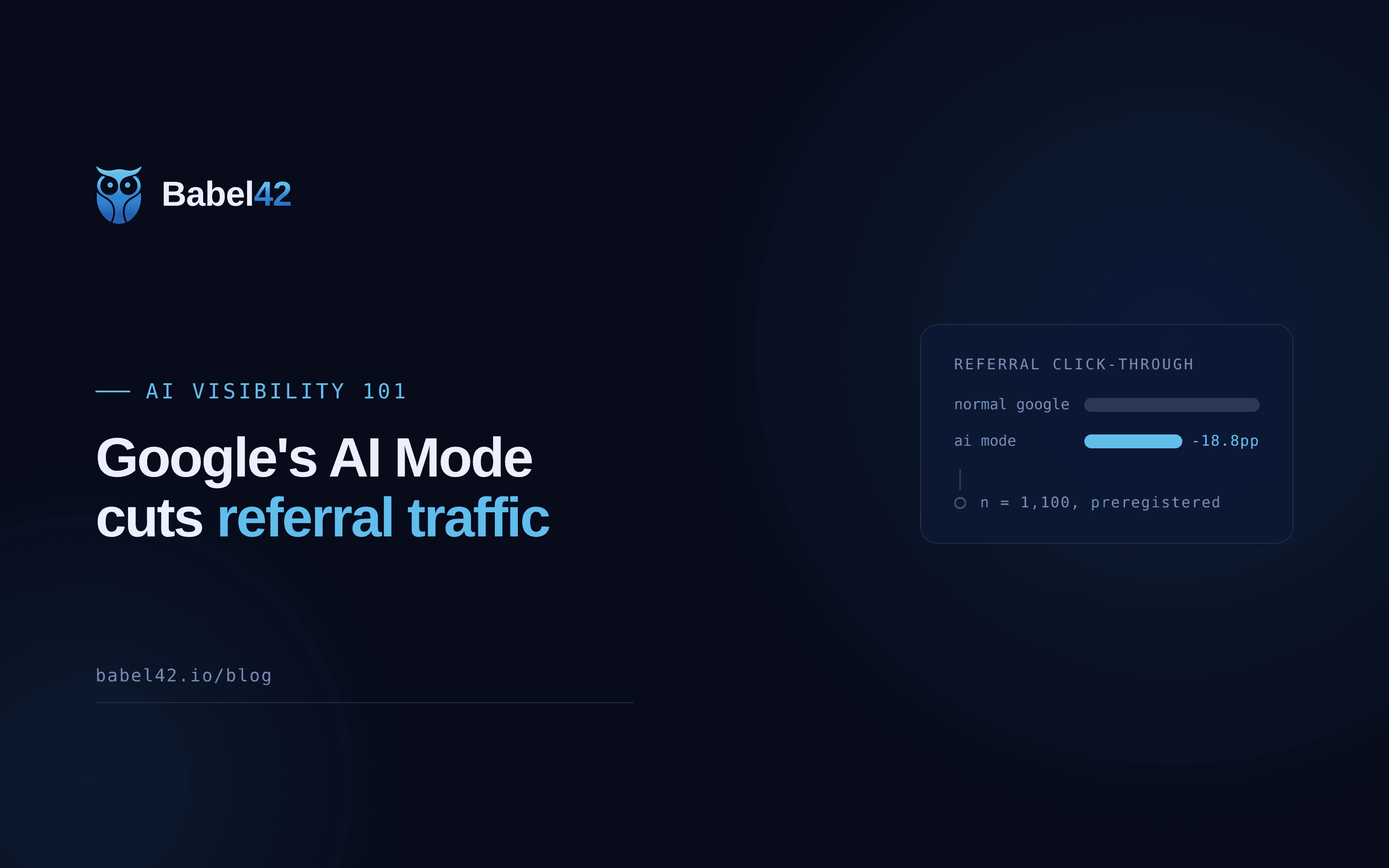
Google has always said AI Mode is additive: a new way to search, sitting alongside the links people already click. A new academic study, published this quarter, puts a number on what that trade costs. According to the study, users assigned to AI Mode clicked through to an outside website 18.8 percentage points less often than people using Google normally, and they rated the experience lower, not higher.
What did the study test?
Researchers ran a preregistered field experiment, randomly assigning each person to one of several search conditions: normal Google, AI Mode only, Google with AI Overviews removed, and a couple of other variants. The sample held 1,100 Google users in the United States. The paper is "AI in Search Reduces Publisher Referrals Without Improving User Experience: Experimental Evidence", by Stephanie T. Wang and Danaé Metaxa (University of Pennsylvania) and Jeffrey Gleason, Yakov Bart and Christo Wilson (Northeastern University), posted to arXiv on 18 August 2026 (arXiv:2608.18352; reported by Search Engine Land, "Google AI Mode cuts clicks and user satisfaction: Study"). Because people were randomly assigned rather than self-selecting into AI Mode, the design supports a causal claim, not just a correlation between AI Mode use and fewer clicks.
Does AI Mode reduce clicks to other websites?
Yes: the share of searches ending in a click to an external site fell 18.8 percentage points for the AI Mode group compared with people using Google as normal, according to the study. The drop held across the kinds of sites people searched for, not just one category.
| Destination | Change in referral click-through |
|---|---|
| External websites overall | -18.8 percentage points |
| -21.2 percentage points | |
| News sites | -12.5 percentage points |
| Wikipedia | -9.9 percentage points |
All four figures come from the same 1,100-person experiment. Reddit lost the largest share of its referrals, which matters for anyone leaning on Reddit threads as a visibility channel: a thread ranking well in classic Google results is a different asset to one an AI Mode answer merely summarises without sending a click its way.
Did removing AI Overviews change anything?
It did, and in the opposite direction. Participants who saw Google with AI Overviews removed entirely clicked through to external sites 8.8 percentage points more often than the normal-Google control group, according to the same study. Read next to the AI Mode result, the two findings point the same way: the more AI-generated synthesis sits between a query and a result, the fewer people click past it, whether that synthesis is a short Overview or the full AI Mode interface.
Did AI Mode at least make search better for users?
No. Participants assigned to AI Mode reported lower satisfaction, lower perceived usefulness, a weaker sense of control over their own search, and less trust in Google than the normal-search group, according to the study. They also ran fewer search sessions overall and were more likely to say they'd try Bing, DuckDuckGo or Yahoo instead. Google's own pitch for AI Mode is a faster, more complete answer; the experiment's participants didn't experience it that way, on the measures the researchers asked about.
How solid is a single study like this?
Solid enough to take seriously, with the normal caveats of any one piece of research. The experiment is preregistered, which means the researchers published their hypotheses and analysis plan before collecting data, a step that rules out quietly reshaping the question after seeing the results. Random assignment to each search condition is also what lets the paper claim AI Mode caused the drop in clicks, rather than merely coinciding with it, the way a survey of existing AI Mode users would. The honest limit is scale and scope: 1,100 participants in the United States is a meaningful sample for a controlled experiment, but it's one study, on one country's Google, at one point in AI Mode's rollout. Treat the direction of the finding as well-supported and the exact size of the gap as a snapshot that could move as Google keeps changing how AI Mode looks and behaves.
Why this matters more than it would have a few months ago
The study measured AI Mode specifically, a surface users have to opt into. But the same substitution logic applies to AI Overviews, the version Google shows by default inside ordinary search results, and those have spread fast. Google's AI Overviews appeared on more than 80% of tracked branded queries by late September 2026, up from around 26% at the start of that month, according to tracking data from DemandSphere reported by Search Engine Land (Search Engine Land, "Google AI Overviews jump from 26% to 80% of branded queries"). A click-suppression effect that applied to a quarter of branded searches a few weeks ago now applies to most of them. Whatever share of your own branded traffic used to arrive by a user typing your name into Google and clicking the first result, a larger share of that moment than before now shows an AI-generated summary in front of it first.
What does this mean if your traffic depends on Google referrals?
It means a shrinking share of the audience that sees your site named in an AI Mode answer ever lands on the page itself, which is exactly the gap between being mentioned and being the destination a reader reaches. A click is one proxy for whether your brand got through; it was never the only one, and on this evidence it's becoming a smaller slice of the real picture. The other proxy, whether the assistant actually named you and cited your page as a source at all, keeps working even when the click never happens.
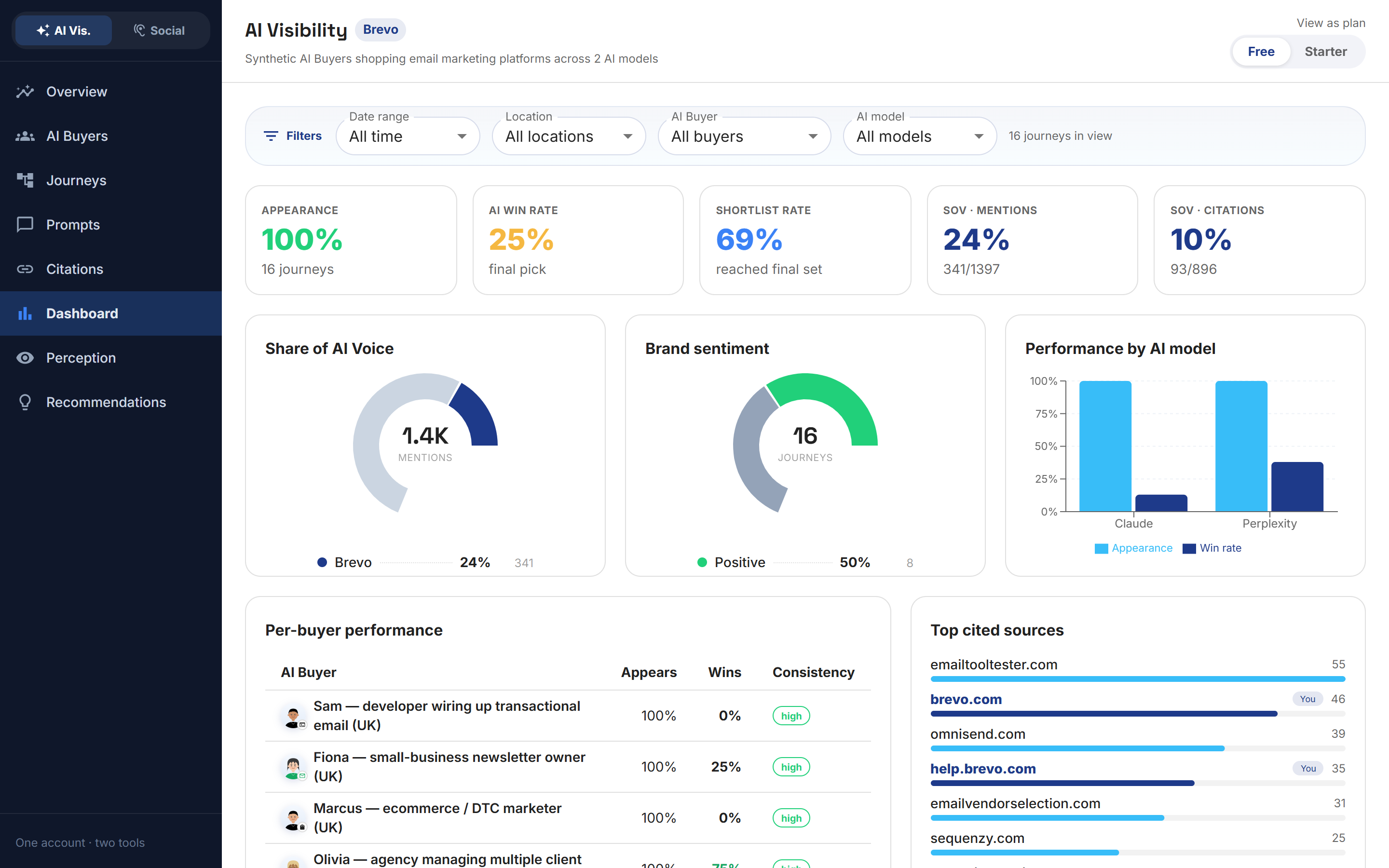
That's the same split Babel42's AI Visibility product tracks separately: a share-of-AI-voice number built from mentions (here, 24% of 1,397), and an own-site citation share built from which sources an assistant actually quoted (here, 10% of 896 citations were the brand's own domain, the rest split across rivals and reference sites). Neither number depends on a reader clicking through afterwards. What AI citation rate measures covers why that distinction matters on its own terms, separate from whichever AI answer a user happened to see.
Two things worth doing this week
- Stop treating organic click volume as a full read on AI-era visibility. If a chunk of your audience's AI Mode searches were already landing on competitor or reference-site answers, a flat or falling click count from Google won't show you that on its own. Check whether your brand is named and cited in AI Mode answers for your category's core questions, not just whether your rankings held.
- If Reddit or forum threads are part of your visibility strategy, recheck what they're earning you now. The study's largest referral drop was on Reddit, specifically; a thread that used to send real clicks may now mostly be getting summarised and read, not visited.
The short version
A preregistered experiment with 1,100 Google users found that AI Mode cut referral clicks to outside websites by 18.8 percentage points against normal Google search, with Reddit, news sites and Wikipedia all losing a meaningful share. Removing AI Overviews had the opposite effect, raising click-through by 8.8 points. Participants in AI Mode also reported lower satisfaction, usefulness and trust, not a better search experience in exchange for the fewer clicks. If your own numbers depend on Google referrals, the finding worth sitting with isn't just "AI Mode sends fewer clicks", it's that a click was always a proxy for being seen, and on this evidence it's measuring less of the whole picture than it used to. How Google AI Mode decides what to read and cite is the next layer down, and what AI search visibility measures covers the full set of numbers worth tracking instead of, or alongside, a click.