You've probably already done the strategic work: you know what AI search visibility measures, you've checked that the crawlers can reach your pages, and you've got a list of objections to fix from watching what AI assistants say about you. Then you sit down to rewrite the page, and the strategy runs out. What, on the sentence and paragraph level, makes a page easy for a model to lift a fact from?
That's the gap this post fills. Not why to optimise content for AI search engines, which we've covered elsewhere, but the specific habits of writing and structuring a page that make the difference between a fact getting quoted and a fact getting skipped.
Answer first, explain second
Most business writing opens with context and works towards the point. A model doing live retrieval doesn't read that way, it's scanning for the sentence that answers the question in front of it, and it will use whichever sentence gets there first, clean and quotable.
Take a pricing FAQ. The instinct is to write:
"We believe in transparent, flexible pricing that scales with your needs, so most customers find our plans offer real value as they grow."
That's a full paragraph and it answers nothing. Rewritten answer-first:
"The free plan includes 500 mentions a month, 2 monitors and 5 networks, no card required. Paid plans start at $29/month for 2,000 mentions."
Same page, same underlying facts, but the second version is something a model can drop straight into an answer without editing it down first. The first version has to be interpreted before it can be used; the second doesn't.
What does an AI-search-ready paragraph look like?
It states one fact, in the first sentence, in plain language, and everything after that sentence is supporting detail rather than a second attempt at the answer. If you can delete every sentence after the first and the paragraph still answers the question correctly, on its own, it's structured right. If the first sentence is scene-setting and the answer only shows up in sentence three, a reader (human or machine) has to do work you should have done for them.
This is a rewriting discipline more than a writing-from-scratch one. Go back through an existing page, find the paragraph that answers a question a buyer would ask, and check whether that answer is in the first sentence. Usually it isn't, and moving it there is a five-minute edit with an outsized effect on whether the paragraph is usable on its own.
Write headings that work without the paragraph beneath them
A heading that only makes sense once you've read the text under it isn't doing its job, for a skimming reader or for anything that indexes a page section by section. "Our approach" tells you nothing on its own. "How Babel42 scores AI search visibility" tells you exactly what the section covers before you've read a word of it.
This matters more than it looks like it should, because a heading is often the only thing that gets read in isolation, whether that's a table of contents, a search snippet, or a retrieval system deciding which section of a long page is relevant to a specific question. A vague heading over a good paragraph still loses to a clear heading, because the vague one never gets selected to be read in the first place.
We rely on this directly on our own blog: every post's headings are checked for exactly this, and any heading phrased as a genuine question, with a paragraph directly beneath that answers it, gets pulled automatically into that page's FAQ structured data, because our generator reads it straight off the rendered page rather than from a hand-maintained list. A vague heading, or a question heading followed by a list instead of an answer, simply doesn't qualify. That's a good discipline to borrow even if you don't build the same automation: write the heading as if it has to stand completely alone, because on some page, for some reader, it will.
Mark up your genuine FAQs, don't invent them
If a page already contains real question-and-answer content, structured data makes that explicit rather than leaving it for something else to infer. Google's own documentation on FAQPage structured data is the primary source here: it's a defined schema for marking up a question and its direct answer, intended for content presented as an FAQ on the page, not for questions invented purely to get the markup.
Providers don't publish how their retrieval step weighs structured data specifically, so we'll stick to what we can back up. What we can say from our own experience building this: writing content that's structured as a clean question paired with a direct answer is a useful discipline on its own, independent of whether any particular system reads the markup, because it forces the answer-first habit above. If the underlying content isn't structured that way, the markup won't fix it, and if it is, the markup is close to free to add.
Say the number, not the adjective
This is worth repeating briefly here even though we've written about it in the context of fixing specific objections: "generous limits" and "flexible plans" don't survive being lifted into an answer, because there's nothing concrete in them to lift. "500 mentions a month" does. Every page you're editing for this should get a pass where you find each adjective doing the job a number should be doing, and replace it.
The same applies to comparisons. "Significantly more affordable than competitors" is not something a model can state with confidence, because it has no number attached and no source to check it against. "Paid plans start at $29/month, with a free plan for anyone who wants to try it first" is something a model can repeat with confidence, because it's checkable on the pricing page itself.
Keep each idea in its own paragraph
A live-retrieval system typically works with a section or a paragraph at a time, not a whole page at once, so a paragraph that quietly covers two unrelated points is asking to have one of them dropped. If a paragraph answers "what does the free plan include" and then pivots, in the same block of text, to "why we built the product this way", split it. The mission-statement sentence and the plan facts don't need to live together, and keeping them apart means each survives being read on its own.
This is the same logic behind retrieval-augmented generation: a retrieval step pulls back a chunk of a page, not the whole document, and hands that chunk to the model to work from. A chunk that's internally consistent, one idea, stated plainly, is more useful to whatever process picks it up than a chunk that needs the paragraph before and after it to make sense.
What this looks like when it's working
Structure alone doesn't decide whether you get a citation, coverage and competition still matter, but it changes whether the facts you do have are usable when a model reaches your page. We tracked this gap directly on our own AI Visibility dashboard, in a demo workspace shopping for email marketing platforms: the brand appeared in 100% of buyer journeys but held only a 24% share of mentions across the category (341 of 1,397) and a 10% share of citations (93 of 896). Its own pages ranked second and fourth on the top-cited-source list, but the single most-cited source overall was an independent review site, not the brand's own content.
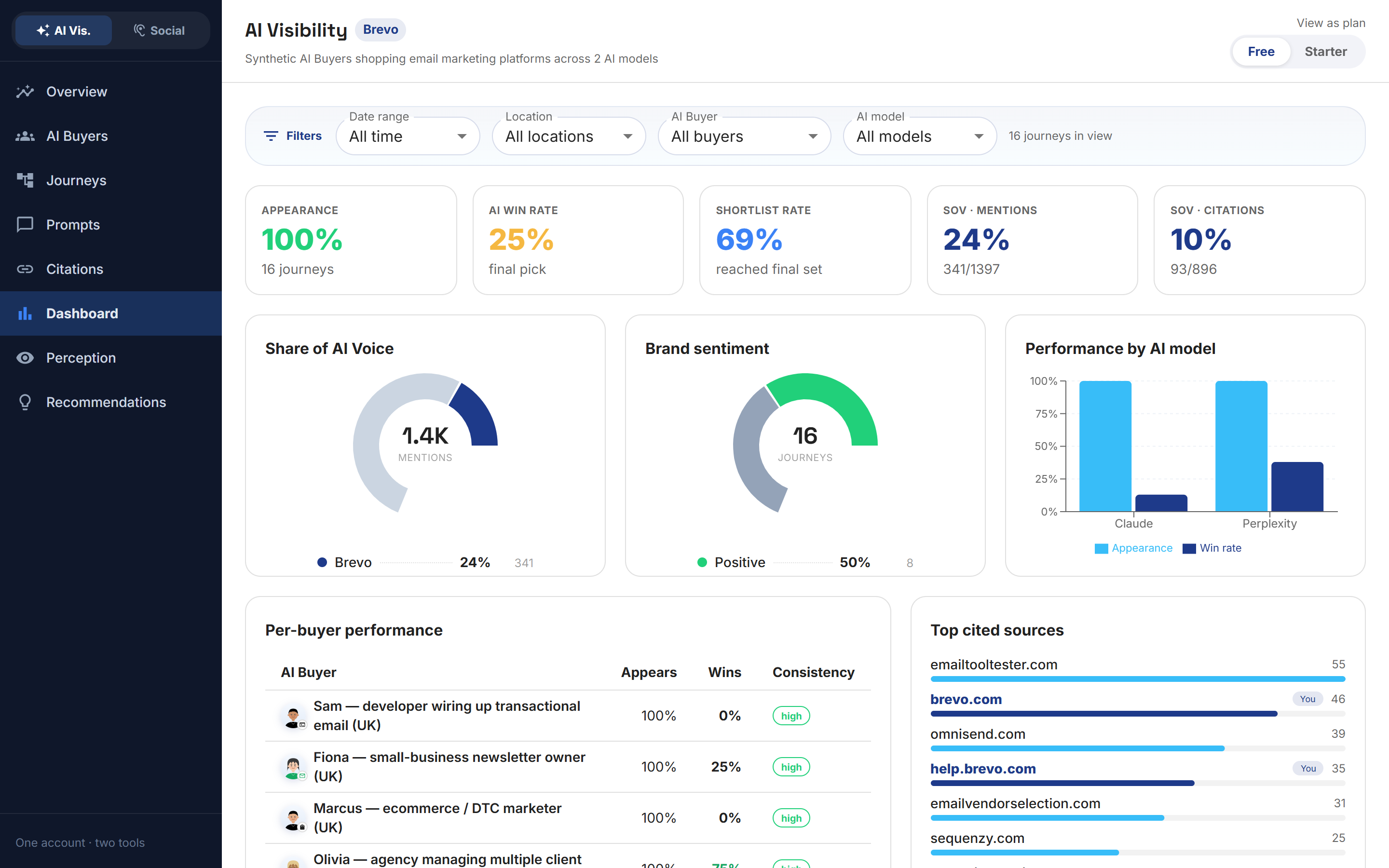
Being present in every conversation and still losing most of the citations to a third party is the practical cost of pages that get crawled but aren't structured to be lifted from. The gap between those two numbers is roughly the size of the opportunity sitting in a rewrite, not a new content plan.
Put this into practice this week
Pick your three highest-traffic or highest-intent pages and run this pass on each:
- Find the paragraph that answers your most-asked question. Move the answer to the first sentence if it isn't already there.
- Read every heading with the body text hidden. If it doesn't tell you what the section covers, rewrite it.
- Circle every adjective doing a number's job ("generous", "flexible", "affordable") and replace it with the actual figure.
- Split any paragraph that's quietly answering two different questions at once.
- If the page has real FAQ content, add FAQPage markup to it. If it doesn't, don't force the markup, fix the content first.
None of this replaces the slower work covered in how AI crawlers find and cite your brand or what earns you a citation; structure doesn't help a page a crawler can't reach, and it doesn't manufacture facts you haven't verified. But for the pages you've already made crawlable and accurate, this is the difference between a fact sitting on the page and a fact making it into the answer. To check the result the way a machine will, our free audit splits your pages at their headings the way retrieval does and measures whether each section still stands up on its own.
See how Babel42 tracks appearance rate, citations and share of AI voice, or start with what AI search visibility measures if this is your first stop. For a sense of how far most sites are from that bar, according to our own measurement of 164 sites, 83% carry almost nothing quotable at all.