Ask Perplexity a question and it runs a live search before it answers, every time. Ask ChatGPT the same question and it might do that, or it might not bother, and instead answer straight from what it learned during training, months or years ago. You can't always tell which one happened just by reading the reply. That difference is the reason "how do I rank on ChatGPT" doesn't have the same answer as "how do I rank on Perplexity", even though both questions get lumped into the same AI search visibility conversation.
We've written about what earns a citation across AI assistants generally and how AI buyers behave once they start shopping, including journeys where ChatGPT was one of five models in the room. This post narrows in on ChatGPT specifically: why it behaves differently to Perplexity, what that means for getting recommended, and what to check first if it currently never mentions you at all.
Why doesn't ChatGPT behave like Perplexity?
Per OpenAI's own help centre article on the feature, ChatGPT decides for itself whether a question calls for a web search, and you can also switch search on manually when it's offered (OpenAI Help Centre, "ChatGPT Search"). When it does search, the answer can carry inline citations you can click through to a source, plus a "Sources" list at the end of the reply. When it doesn't search, none of that applies, because there's nothing to cite: the answer is coming from the model's training data, not from a page it just read.
That's the practical split worth holding onto. A live-search answer works roughly like the Perplexity case we've written up before: whatever page is freshest, clearest and most reachable at that moment has the best shot at being quoted. A memory answer works nothing like that: no page gets fetched, no crawler runs, and no amount of tidying your robots.txt today changes what the model already learned. If your brand wasn't a clear, well-documented presence on the web during that training window, a memory answer has nothing recent to draw on, and it'll either skip you or say something dated.
How often does each mode happen? Semrush analysed more than a billion lines of US clickstream data between October 2024 and February 2026 and found ChatGPT enabled web search on 34.5% of queries as of February 2026, down from 46% in late 2024 (Semrush, "ChatGPT traffic analysis"). Treat that as a moving figure rather than a constant: the same study saw the monthly share swing between 15% and 66.3%. The order of magnitude is the useful part. Most questions are answered without a search, a large minority aren't, and you don't get to choose which one a given buyer lands on.
The two modes don't recommend the same brands
That split would be a technicality if both modes named the same companies. They don't. Visibility Labs ran 1,000 "What is the best [keyword]?" prompts through ChatGPT ten times with search enabled and ten times with it disabled, 20,000 responses in total, and 80.2% of the product recommendations changed between the two conditions. Only 19.8% of the products recommended without search were also recommended with it, and of the products that appeared in every single search-disabled response, just 15.8% carried over to the search-enabled ones (Visibility Labs, "ChatGPT's product recommendations change 80.2% when search is enabled vs disabled"). Being the brand ChatGPT names from memory tells you very little about whether it names you when it searches, and the reverse holds too.
There's a sector caveat worth adding, and it changes where you start. SALT.agency classified the responses to a set of travel prompts and found 31% answered from the model's weights alone against 62% using live retrieval, well above the 34.5% all-query average, on a small sample of 48 responses (SALT.agency, "A third of travel prompts in ChatGPT don't leave the training data"). The all-query average is dragged down by the general knowledge questions nobody is trying to rank for. Questions carrying a price, a date, a location or a shortlist are the ones that ask for current information, which is exactly when ChatGPT reaches for search. So the answers that decide a purchase sit disproportionately on the live-search path, and that's the path you can still do something about this week.
What gets a brand recommended by ChatGPT
Some of this holds regardless of which mode answered you. Some of it only matters for one.
- When it searches live, the crawl-and-cite mechanics are the same ones that apply everywhere. OpenAI's search crawler is
OAI-SearchBot, separate fromGPTBot, which is used for training instead (OpenAI Help Centre, "ChatGPT Search"). We've covered the full list of AI crawlers and how to check you're not accidentally blocking them in how AI crawlers find and cite your brand; that check applies to ChatGPT's live search exactly as it does to Perplexity's. - When it's answering from memory, the question becomes whether your brand was a clear, documented presence on the web before the model's training cut-off. That's a slower, less controllable lever than fixing a robots.txt file this afternoon, which is why ChatGPT visibility work has to think in quarters as well as days. It's the work to start now rather than the work to start with: it runs in the background while the crawlable fixes do the near-term lifting. We've written separately about how AI models are actually trained, including where that training data comes from, if you want the fuller mechanism.
- Either way, a specific fact beats a vague one. "$99 a month, five AI Buyers, twice-weekly" gives a model something to state plainly, whether it read that sentence five minutes ago or absorbed it during training. "Flexible pricing for growing teams" gives it nothing to repeat with confidence.
- Third-party mentions still outweigh backlinks. Ahrefs' analysis of roughly 75,000 brands found branded web mentions correlating with AI visibility at 0.66 to 0.71, against 0.22 to 0.27 for backlinks (Ahrefs, "Top Brand Visibility Factors in ChatGPT, AI Mode, and AI Overviews"). That study looked at ChatGPT specifically, alongside Google's AI Overviews and AI Mode, which makes it a closer fit here than a general GEO citation would be.
You can't buy your way into a ChatGPT recommendation
A common assumption is that money buys the recommendation. ChatGPT started showing ads to free and entry-tier US users in January 2026, but per OpenAI's own help centre, an advertiser can't pay to be the thing ChatGPT recommends. Ask it for a product recommendation and that answer stays separate from any ad slot next to it (OpenAI Help Centre, "Ads in ChatGPT: The Basics"). We covered the ad format itself, and the Yelp review data OpenAI licensed alongside it, in ChatGPT ads now skip the landing page. The upshot for this post: there's no media-buy shortcut here. Whatever gets you named in an organic answer has to be true of your training-data footprint, your live-crawlable pages, or both.
Appearing is not the same as winning
This is worth showing rather than just asserting, and it holds for ChatGPT the same way it holds for every assistant we track.
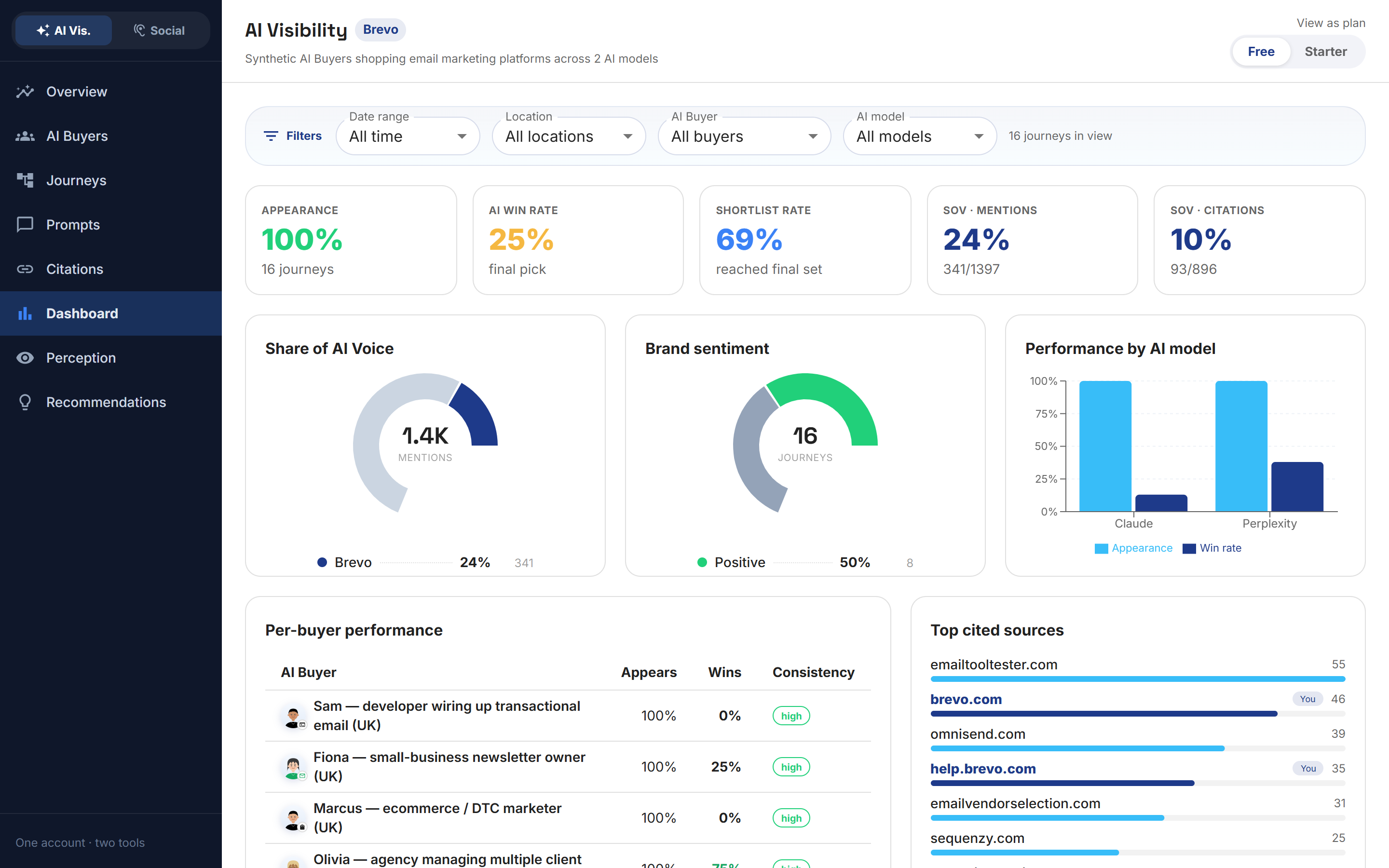
The screenshot above is a real demo workspace in Babel42's AI Visibility product, running the free plan, which tracks one AI Buyer across two of the seven assistants at a time; this particular workspace has Claude and Perplexity switched on, which is why those are the two bars in the "Performance by AI model" chart, not ChatGPT. We tracked the headline numbers next to it straight off that same dashboard, and they hold regardless of which two models are selected: the brand appears in 100% of buyer journeys but wins the actual recommendation only 25% of the time, with a 24% share of AI voice. Swap ChatGPT in as one of the two tracked models, on the Starter plan or above, and you get the same chart with a ChatGPT bar instead, built the same way: named constantly, winning rarely, is a pattern we see across models, not something specific to whichever two happen to be switched on.
What to do if ChatGPT never mentions you
Start by working out which situation you're in, because the fix is different for each. Ask the question a few times and look for the globe icon, the inline citations and the "Sources" list at the end; those only show up when it searched, though they don't appear on every searched answer.
If a search-enabled ChatGPT answer skips you, treat it like the Perplexity case: check you're not blocking OAI-SearchBot, check the fact you want quoted is in plain crawlable text and not buried in a script-rendered widget, and check the page has been touched recently enough to look current. That's a this-week fix.
If a plain, non-search ChatGPT answer skips you, there's no setting to change and no crawl to re-run, because the weights are already trained. The lever is being a well-documented, frequently-mentioned brand on the open web over time, so a future training run has more to work with. That's not a task you finish this quarter, and it's the same work that improves every other AI assistant's memory of you, so it isn't effort wasted on ChatGPT alone. What it isn't is a reason to stop there. Buyers rarely ask one question, and the follow-ups that add a budget, a year or a rival's name are the ones most likely to send ChatGPT looking at pages it can read today, so the crawlable fixes still decide the second half of that conversation.
Either way, read what the answer actually says about you when it does mention a rival instead. A named objection, "no free tier", "not built for enterprise", "smaller community", tells you exactly what to go fix. A brand that simply never comes up tells you less on its own, which is why testing across a spread of real buyer questions, not one, matters more here than on most channels.
Where ChatGPT fits in a wider AI visibility check
ChatGPT is one of seven AI assistants Babel42's AI Visibility product tracks: ChatGPT, Claude, Perplexity, Gemini and Grok are shopped as full multi-turn buyer journeys through to a decision, while Google's AI Overviews and AI Mode are checked once per question for appearance and citation. Watching ChatGPT alone tells you whether one model's mix of memory and live search currently favours you. Watching it next to the other six, on the same question, in the same week, is what tells you whether that's a ChatGPT-specific gap or a wider problem every assistant agrees on.
The free plan runs one AI Buyer across any two of those seven assistants on a weekly cadence, and ChatGPT can be one of your two from day one. What separates the seven is worth a look before you choose. If Gemini or Perplexity is the assistant you're more worried about instead, how to rank on Gemini and how to rank on Perplexity cover the same question for those two. For the fuller, evidence-ranked list of what drives citations across every assistant, AI search visibility factors is the place to go next.