Typing "AI search visibility consultant" into a search bar usually means one of two things. You want to hand off the work of getting named by ChatGPT, Perplexity and Gemini, or you want to know what you would be paying for before you call anyone. Either way, the answer starts with the job itself, not the price. It splits into four parts, and a free tool already handles two of them.
What does an AI search visibility consultant do?
An AI search visibility consultant runs the same four-part audit you could run yourself: buyer-question coverage, technical crawlability, source accuracy, competitive position. Our own audit framework sets out all four in detail. A job title changes nothing about the method underneath it.
Coverage asks whether your brand comes up when a real buyer asks an assistant for a recommendation. Crawlability asks whether AI bots can reach and read the pages that would answer that question. Accuracy asks whether what gets said about you, on your own site and elsewhere, is current. Position asks whether you win the comparison once you do appear, or just make the list. Paying someone to do this work buys you the same four answers. It does not change what the answers are.
The technical half, a free tool already checks
Crawlability is the one part of the job a free tool already covers, without a consultant. Babel42's free AI visibility checker requests your pages the way an AI crawler would and reports what comes back: whether your robots.txt blocks the bots that feed AI answers, whether your content survives with JavaScript turned off, whether your sitemap has dead links, how your pages split into sections a model can quote, and what share of those sections carry a statistic, a quotation or an outside link.
The free version checks ten pages and needs no account. A one-off full-site audit, covering up to a thousand pages with per-page scores, three named competitor comparisons and five re-runs over thirty days, costs $9.99, and comes included on any paid AI Visibility plan. A perfect score on either one means nothing technical is stopping an assistant from reading you. It does not mean the assistant will recommend you, which is a separate question entirely.
Tracking the recommendation itself is the part that keeps running
A one-off audit tells you where you stand today. Whether an assistant recommends you is not a fact you check once. Models and retrieval both drift, sometimes within weeks. Measuring AI search visibility covers why this has to run on a schedule rather than as a single pass.
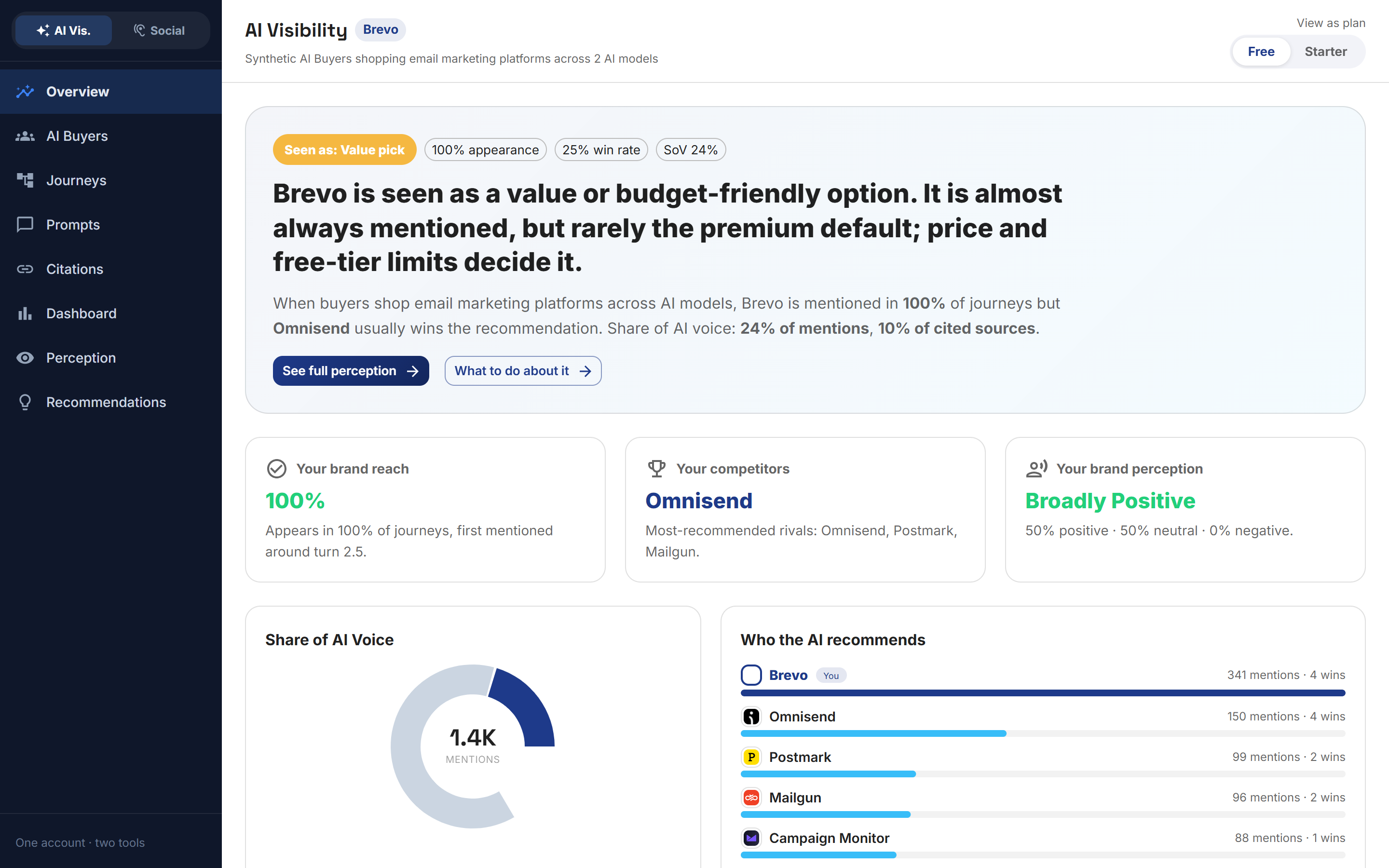
Babel42's AI Visibility product runs that schedule for you: synthetic AI Buyers shop your category across the assistants that matter, and appearance rate, win rate and share of AI voice come back as a trend rather than a snapshot. The free plan runs one AI Buyer across any two of the seven assistants, weekly, with no card required. A consultant watching this by hand, across several assistants, every week, is watching a number a tool already tracks on its own.
Where a consultant's judgement is harder to replace
Two parts of the job resist automation, and this is where a fee buys something real. The first is the question set itself. A useful audit runs on ten to fifteen questions pulled from real sales calls, not product copy. Getting that wording right takes someone who has sat in on the calls or read the transcripts closely.
The second is reading the loss. A score tells you that you lost a comparison. It does not tell you why, and the "why" is usually a specific sentence an assistant gives for picking a rival instead: a missing integration, a thinner page, an objection your site never answers. Turning that sentence into the right fix, and deciding which fix matters most this quarter, is a judgement call tied to your own roadmap and positioning. No audit, free or paid, makes that call for you.
So, do you need to hire one?
Run the free technical check first. It costs nothing and takes minutes. It either clears the crawlability question or hands you a specific list of pages to fix. If your pages already read cleanly to a crawler, the open question is whether assistants recommend you. The free check does not answer that. An ongoing AI Visibility tool, or a consultant watching the same numbers, is what tracks it.
Hire the judgement, not the checklist.
Pay for help building the buyer-question set from your own sales conversations, and for someone who can turn a losing answer into the right next fix. A tool already handles the mechanical parts, crawlability and weekly tracking, for the price of a subscription, not a retainer.
The short version
An AI search visibility consultant's job is the same four-part audit anyone can run: question coverage, crawlability, accuracy, competitive position. A free tool already checks crawlability. An AI Visibility product already tracks the recommendation itself, on a schedule. What is left, building the right question set and interpreting why you lost, is the part worth paying a person for.
Start with our own audit framework to see the full method, what AI search visibility measures if the terms above are new, or run the free AI visibility checker against your own site before deciding whether to hire anyone at all.