You've maybe already read about measuring AI search visibility as an ongoing method, and improving it as a running list of fixes. Both are right, but neither answers a simpler question a lot of marketing leads actually have: "if I sat down this afternoon, what would I do?" That's what an AI search visibility audit is for. It's a bounded session, not a subscription: you run a fixed set of checks once, end up with a scorecard and a short list of gaps, and repeat the whole thing on a schedule rather than leaving it running in the background.
This is the framework we'd use, whether you're doing it by hand in an afternoon or with a tool built to run it for you.
What an AI search visibility audit covers
A proper audit has four parts, and skipping any one of them leaves a blind spot:
- Buyer-question coverage. Does your brand come up at all when a real buyer asks an AI assistant for a recommendation?
- Technical crawlability. Can AI crawlers even reach and read the pages that would answer that question?
- Source accuracy. Is what gets said about you, on your own site and elsewhere, actually true and current?
- Competitive position. When you do appear, are you winning the comparison or just making the list?
Each part on its own is a narrower question than "how's our AI visibility doing", and each has a clear pass or fail you can write down, which is what makes an audit a checklist rather than a vague impression.
Step 1: build a fixed buyer-question set
Before you can score anything, write down ten to fifteen questions a real buyer in your category would type into ChatGPT or Perplexity: "what's the best tool for X", "compare A and B for Y", "I need something that does Z on a budget". Pull the wording from your own sales calls or support tickets rather than your product team's language, buyers rarely phrase things the way a feature list does.
Keep this list fixed between audits. If you rewrite it every time, you can't tell whether a score moved because your visibility changed or because your questions did. We've covered the full method for building and scoring this set in our piece on measuring AI search visibility; an audit borrows that same question set rather than reinventing it each time.
Step 2: run the set and score four numbers
Ask every question across at least two or three assistants (ChatGPT, Claude and Perplexity draw on different retrieval behaviour, so one alone isn't representative), and for each answer record:
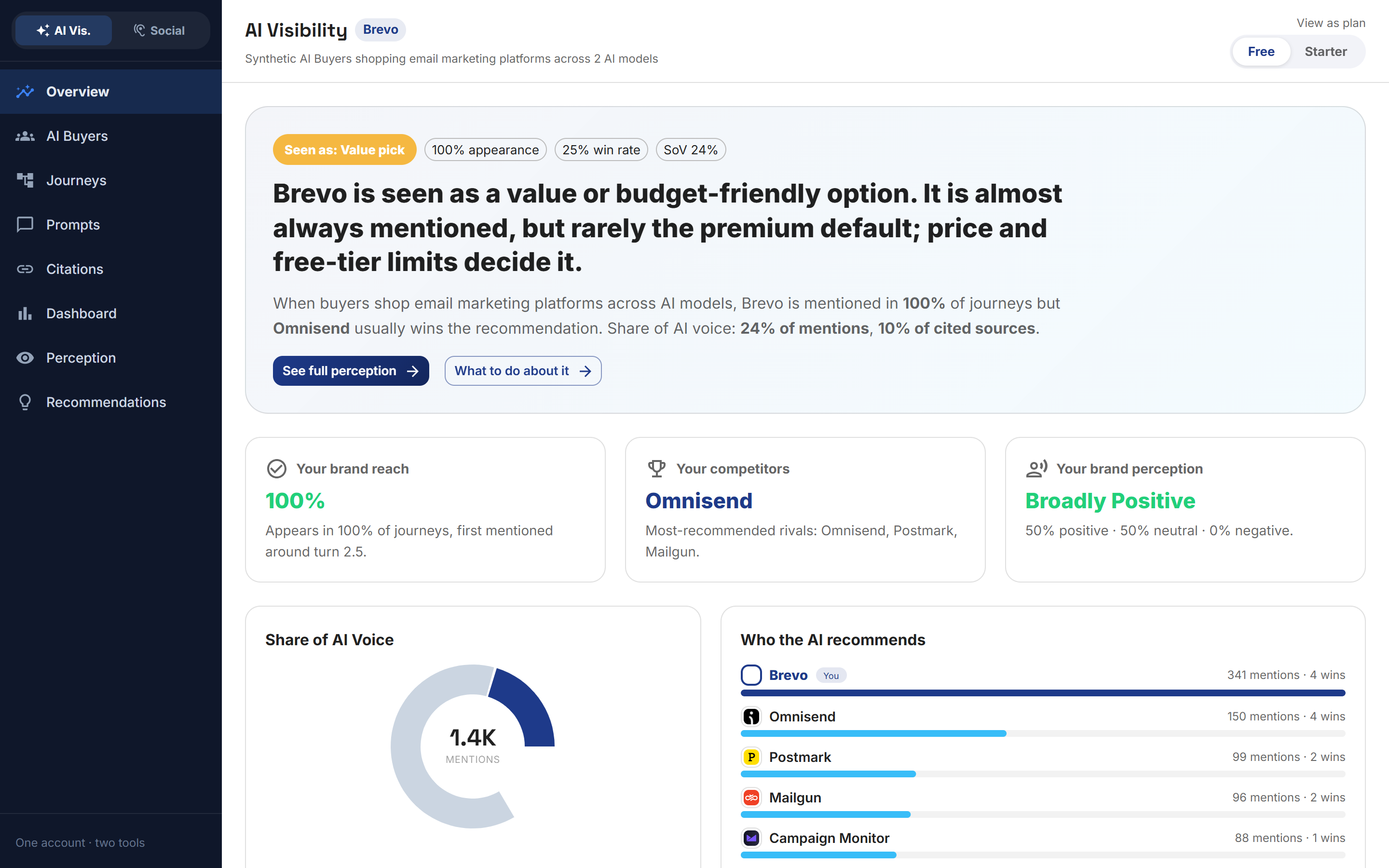
- Appearance rate: did your brand get mentioned at all?
- Share of AI voice: out of every brand named, what fraction of the mentions are yours?
- Recommendation rate: were you the pick, a runner-up, or the one the model steered the buyer away from?
- Sentiment: unreserved, hedged with a caveat, or negative, and what was the exact caveat?
This is the slowest step, and it's the one worth timeboxing: run the full set once, write the numbers down, and move on rather than re-running individual prompts to chase a better answer.
Step 3: check the plumbing, not just the answers
A weak appearance rate sometimes has nothing to do with what you've written and everything to do with whether AI crawlers can reach it. Before you draw conclusions from step 2, spend ten minutes on the technical side:
- Open your
robots.txtand confirm you're not accidentally blockingGPTBot,ClaudeBot,PerplexityBot,Google-ExtendedorBingbot. Every vendor publishes the exact agent names and what each one is for, and they are worth reading rather than guessing at: OpenAI's, Anthropic's, Perplexity's and Google's. The distinction that catches people out is that blocking a training crawler and blocking the crawler that fetches a page to cite it are two different decisions. - Check that your two or three most important factual pages (pricing, what you do, key differentiators) state facts in plain, crawlable text rather than behind a form or a client-side render.
- Confirm a price or limit you'd want quoted is stated as a specific number, not an adjective.
We've written the full version of this check, including what llms.txt is and why it buys less than people assume, in how AI crawlers find and cite your brand. Be aware that no assistant has committed to reading it: Google's "AI features and your website" says outright that "you don't need to create new machine readable files, AI text files, or markup to appear in these features". An audit doesn't need the whole explanation again, just the ten-minute pass to rule out a plumbing problem before you go chasing a content one. If you would rather see the result than work through it by hand, our free AI SEO audit runs the same pass in a few seconds: it requests your pages as an identified crawler, reads your robots.txt against the crawlers that feed AI answers, and reports what actually came back.
Step 4: benchmark named competitors on the same questions
Score isn't meaningful in isolation. If your appearance rate is flat this quarter, that's a different story depending on whether a named competitor's rate is also flat, rising, or falling. Run the exact same question set with your two or three closest competitors substituted in as the subject, using the same models and the same day if you can, so nothing else about the comparison shifts. The audit isn't complete until you know where you stand and whether that position is moving.
Step 5: turn the four scores into a short list, not a report
An audit that ends in a spreadsheet nobody reads has failed. For each of the four dimensions, write down the single biggest gap and a next step:
- Coverage gap: a buyer question you never appear in? That's the content brief.
- Technical gap: a blocked crawler or a vague pricing sentence? That's a same-day fix.
- Accuracy gap: a stale fact repeated confidently by an AI assistant? Trace and correct the source.
- Competitive gap: a segment a named rival is winning? That's where the next quarter's effort goes.
We've laid out the deeper version of turning gaps into fixes in our AI search visibility improvement playbook; the audit's job is just to point at which of those fixes matters most right now, not to do the fixing itself.
How often to run it
Quarterly is a sensible default cadence for a from-scratch audit, plus an unscheduled one whenever something changes that would plausibly move the numbers: a pricing change, a rebrand, a funding announcement, or a new competitor entering your category. Model behaviour and retrieval also shift on their own, sometimes within weeks and without an announcement, so a stale audit can look fine and still be wrong.
Running this by hand, across a dozen questions and three or four models, every quarter, is a lot of manual work to do well, which is why Babel42's AI Visibility product exists: AI Buyers run structured, multi-turn shopping journeys across the assistants your buyers use, and appearance rate, share of AI voice, recommendation rate and sentiment come out as a tracked trend rather than a one-off snapshot you have to rebuild from scratch each time. The free plan runs one AI Buyer across any two of the seven assistants weekly, enough to get your first real audit numbers without spending anything; paid plans add more buyers, more assistants and a faster cadence, and Babel42's own competitor comparison covers step 4 above automatically instead of you re-running prompts by hand.
The short version
An AI search visibility audit is a bounded exercise, not an ongoing subscription: fix a buyer-question set, score it across models, rule out a technical blocker, benchmark named competitors, and end with a short list of the biggest gap in each of the four areas. Do that once and you have a snapshot. Do it on a repeatable schedule and you have a trend line worth acting on.
Start with what AI search visibility measures if this is your first stop, how to implement GEO from a cold start if the audit is step one of a longer sequence, or see how Babel42 runs this audit for you continuously. If the next question is what continuous monitoring actually costs, what drives AI visibility monitoring cost breaks the price down into buyers, assistants and cadence rather than a feature list.