A marketing lead comparing AI visibility monitoring tools usually ends up with three or four quotes, a set of feature lists that all sound similar, and no clean way to explain to a CFO why one plan costs three times another. The easy assumption is that the pricier plan buys more seats, or a nicer dashboard. It doesn't, not mainly. AI visibility monitoring cost tracks one thing closely: how many questions a plan puts to AI assistants each month on your behalf, and how often it repeats them.
We've written before about what AI search visibility measures and how to audit it in an afternoon. This is the piece for the budget conversation that usually comes right after: what a plan's price is actually paying for, using our own published pricing as the worked example, because it's the one set of numbers we can show in full rather than describe from memory.
What drives AI visibility monitoring cost?
The price of an AI visibility plan is driven by volume, not seats: how many buyer personas it runs, how many AI assistants each one is checked against, and how often the whole set repeats. Move any one of those and the monthly total moves with it, whether or not anyone touches a login limit.
- Buyers. Each buyer is a synthetic persona shopping a category the way a real customer would, holding a multi-question conversation rather than firing off a single prompt. More buyers means covering more segments, personas or use cases at once.
- Assistants. Checking two AI assistants costs less than checking all seven, for the obvious reason that it's fewer conversations to run.
- Cadence. Weekly, twice-weekly or daily monitoring multiplies the same buyer-and-assistant set by how many times a month it repeats.
A vendor quote that only mentions seats or a vague "advanced" tier is skipping the part that explains the number on the invoice.
The unit you're buying is questions, not seats
Multiply buyers by assistants by cadence and you get a monthly question volume, which is the number that tracks with cost. Babel42's own four paid tiers state this volume directly, so it's checkable rather than estimated:
| Plan | Price/mo | AI buyers | Assistants checked | Cadence | Questions/mo | Per 1,000 questions |
|---|---|---|---|---|---|---|
| Free | $0 | 1 | 2 of 7 | Weekly | ~85 | n/a |
| Starter | $99 | 5 | 5 of 7 | Twice a week | ~2,100 | ~$47 |
| Growth | $299 | 10 | All 7 | Three times a week | ~9,000 | ~$33 |
| Pro | $599 | 20 | All 7 | Daily | ~42,000 | ~$14 |
Figures read from babel42.io/pricing. The per-1,000-questions column is our own division of price by volume, not a published figure, and it shows the pattern worth expecting from any vendor priced this way: the entry tier costs the most per question, because a chunk of that price is the fixed cost of running the product at all, and that per-question cost falls as volume rises through the middle tiers.
Does a higher tier just mean more seats?
No. Seat count is usually the wrong question to ask a vendor at all. On Babel42's plans, price doesn't move with how many people are logged into the workspace; it moves with the buyers, assistants and cadence levers above. A five-person team on the Starter plan and a five-person team on the Growth plan are paying for a different amount of AI-assistant coverage, not a different number of logins.
The buyers-assistants-cadence distinction matters most at the point a buying committee is deciding between two tiers a few hundred dollars apart. The question worth asking a vendor isn't "what do we get for the extra spend", answered with adjectives; it's "how many more buyers, assistants or checks a week does that buy", answered with numbers.
A procurement lead comparing two tiers can apply the same check without needing a vendor to explain it first: look at whether the buyer count, assistant count or cadence changed between the two prices being compared. If all three moved together, the jump explains itself. If none of them moved and the price still went up, that's worth a direct question before signing anything.
What changes as the price goes up
Past the core volume formula, a few things scale alongside it rather than separately:
- Assistant coverage. Entry tiers typically check a subset of assistants; higher tiers check all of them, which matters if a competitor is winning recommendations specifically on an assistant you're not watching.
- Journey history. Babel42's paid tiers keep the full journey history and transcripts behind each result, so a trend can be traced back to the exact conversation that produced it, not just a score on a given day.
- Depth of read. Babel42's paid tiers add a full site audit each month on top of the AI Buyer runs, which is a different kind of check (technical crawlability, not just buyer-conversation outcomes) bundled into the same price rather than billed separately.
None of these show up as a "more seats" line item, which is exactly why a quote that only talks about seats is hiding the part of the price that explains it.
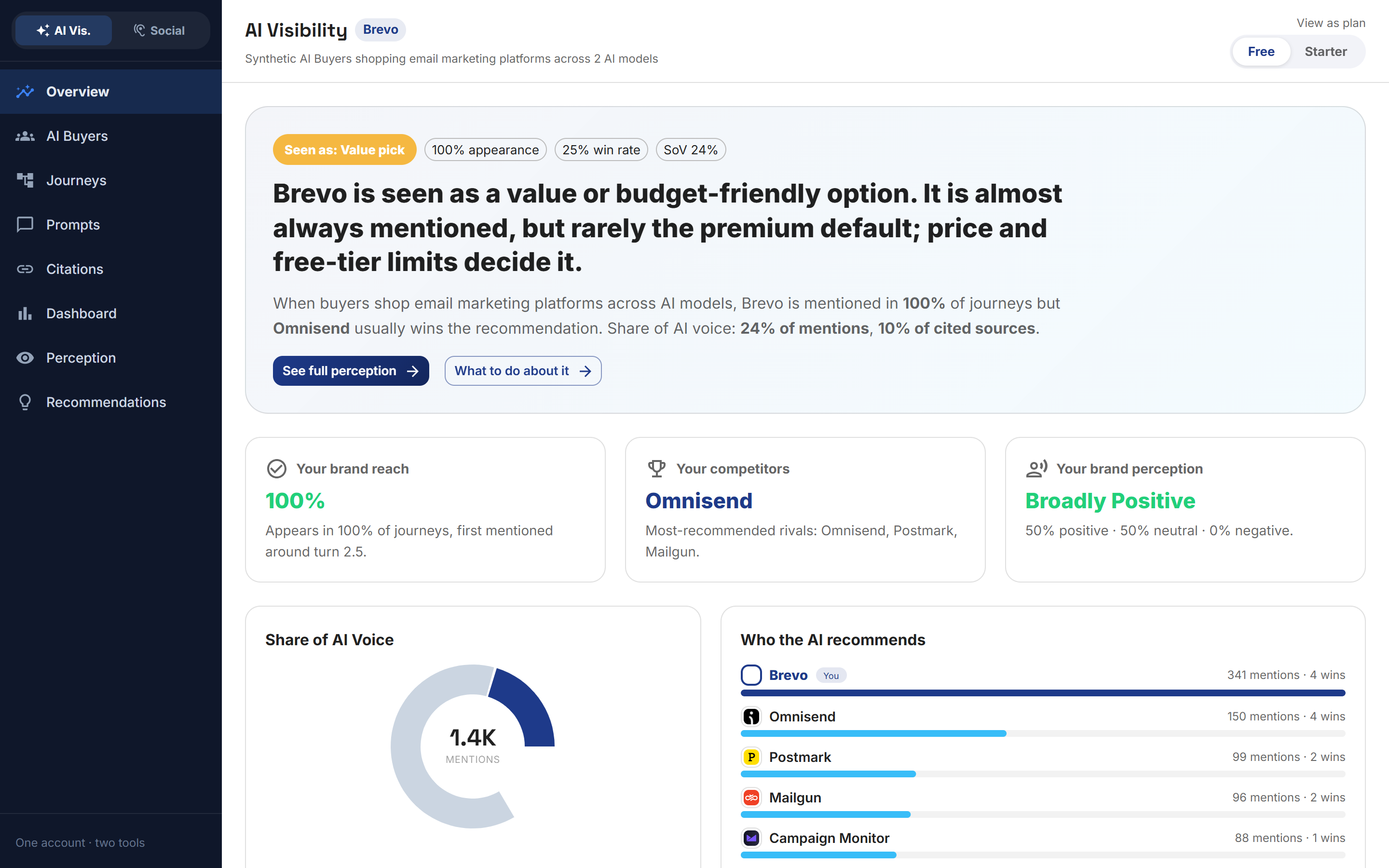
The screenshot above is read straight off a real Babel42 workspace on the "AI Vis." tab, with the plan toggle in the top right switched to Free. It's shopping email marketing platforms across two AI models, the exact Free-tier shape from the table above: one buyer, two assistants. According to that dashboard, the brand appears in 100% of journeys, wins 25% of them, and holds 24% share of AI voice, the kind of read a single buyer on two assistants gives you: real, but a narrower slice than the same brand checked across all seven assistants on the Growth plan would return.
How to compare quotes without getting misled
A quote that leads with a feature list ("advanced reporting", "priority support") is easy to compare on paper and hard to compare in practice, because those words don't map to a number. Before comparing price, ask any vendor, ourselves included, for the same four figures in the table above: how many buyer personas, how many assistants, how often it runs, and what that comes to in questions a month. Once two quotes are stated in the same unit, the price difference either makes sense or it doesn't.
It's also worth checking whether a quote's assistant count matches where your buyers are. Paying for coverage across seven assistants when your category conversation mostly happens on two of them is coverage you're not using; how AI visibility tools compare on coverage and pricing model is a useful reference before pricing anything.
The short version
AI visibility monitoring cost isn't a mystery once it's broken into its parts: buyers, assistants and cadence multiply into a monthly question volume, and that volume, not seat count, is what a price buys. Babel42's own pricing states that volume on every tier rather than leaving it implied, from roughly 85 questions a month on the free plan up to roughly 42,000 on Pro. Start with the free plan if you want to see the shape of your own numbers before comparing anything else, or read how to run an AI search visibility audit for what to do with the results once you're tracking them.