You already track your own AI visibility: how often ChatGPT or Gemini name your brand, and whether the assistant recommends you. That number means little on its own. A strong appearance rate in a category with one credible rival is a weak one in a category with ten. The fix is to run the identical method on a competitor and read the two side by side. That is what auditing a competitor's AI visibility means.
What does it mean to audit a competitor's AI visibility?
Auditing a competitor's AI visibility means running the same buyer-question set, across the same assistants, with a rival as the subject instead of you. Then you score their numbers next to yours. It is not a broad scan of your whole market. You pick one competitor, fix the method, and repeat it on a schedule. Our own-brand audit framework already covers this exercise; this is the same method, pointed at someone else.
Start with one rival, not your category
Pick the single competitor your deals are lost to, not a long list of everyone in your space. A category-wide scan spreads a fixed set of buyer questions across too many names. It says nothing precise about any one of them, and it takes longer to repeat.
The point is one specific, answerable question: against this rival, on these exact prompts, who does the assistant pick, and why? Choose the competitor your sales team names most often in lost-deal notes, or the one your own audit already flagged as winning a segment you expected to hold. Audit a second rival once the first pass is done, rather than splitting one run across several.
Step 1: reuse your own buyer-question set
Do not write a new prompt set for this. Use the same ten to fifteen buyer questions from your own AI search visibility audit, pulled from real sales calls rather than your product team's language.
The value of the comparison comes from holding the method fixed and changing only which brand you are watching for. Rewrite the questions for every rival, and a shift in the score could mean the AI changed its mind, or it could mean your questions changed. There is no way to tell which. Our audit framework covers building that question set the first time.
Step 2: run the questions with the rival as the subject
Ask the same questions across the same two or three assistants. ChatGPT, Claude and Perplexity cover most buyer traffic between them. Read each answer for the rival's position, not your own.
For every answer, record whether the rival is named at all, where it lands if a shortlist comes back, and what the assistant says about it. Note whether your own brand appears too, as a comparison or not at all.
Keep the wording identical to your own audit run, and run both audits close together in time. That way, neither comparison is skewed by the assistant's answers simply drifting between runs.
Step 3: score the rival's numbers too
Score the rival on the same readings you use for your own brand, not a new scale built for the comparison. Babel42's AI visibility metrics page states the reasoning directly: "a visibility score with no rival in it is not a market position."
Appearance, wins and share of AI voice are computed for whichever brands the assistant names in an answer, not only for the one you set out to track. The same run that produces your own numbers already contains the rival's. Four readings carry across from your own audit unchanged:
| Reading | What it tells you about the rival |
|---|---|
| Appearance rate | Whether the assistant knows this rival is in your category at all |
| Share of AI voice | What fraction of every brand mention across your journeys belongs to them |
| Win quality | How convincingly they won: strong, standard or weak, not just a mention |
| Own-site citation share | Whether the assistant is reading their pages directly, or someone else's account of them |
Appearance rate and share of AI voice tell you whether the rival is in the room. Win quality and citation share tell you whether they are winning, and why. A strong win means the assistant named the rival first, unprompted. A weak one means the rival only surfaced after you pushed for more options. What an AI visibility score actually measures covers that same distinction in more depth.
Step 4: read the loss, not just the score
A losing score tells you something is wrong. It does not tell you what. The useful part of a competitor audit is the sentence the assistant gives for picking the rival over you, not the percentage.
Babel42's metrics page puts it directly: journeys can be filtered to a single competitor, "so you can read every conversation where a particular rival beat you," with "the stated reason attached to each win." That reason is usually one of a handful of things: price, a missing integration, thinner documentation, or a claim the rival makes that you have not addressed anywhere a crawler can read.
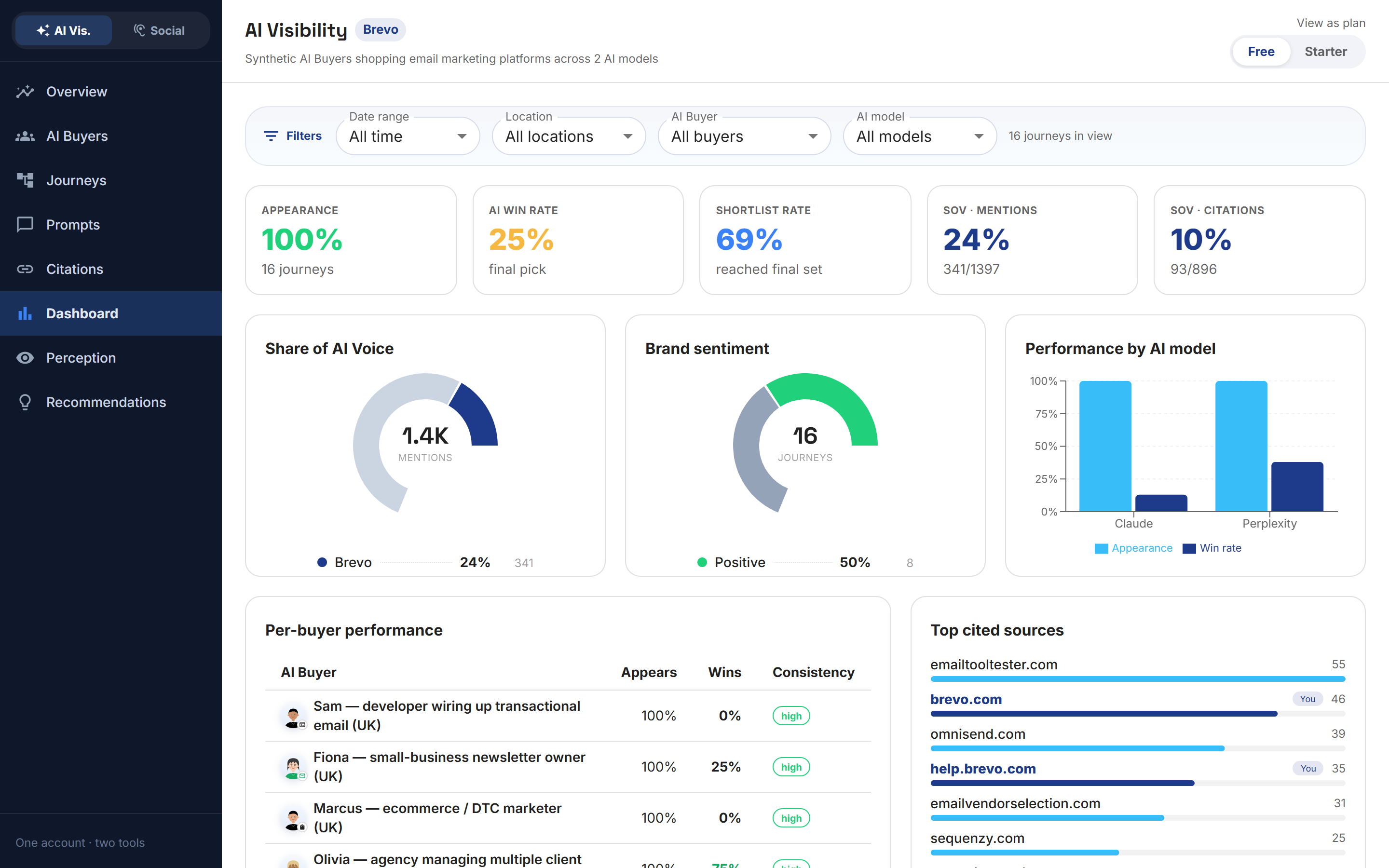
The same logic applies to citations. In this demo workspace, the brand's own domain and a help-centre subdomain are marked "You" among the sources the assistants cited. Four other domains sit alongside them, each with its own count.
A domain appearing in that list more often than yours is not a sentiment problem. It is a pages problem: the assistant is reading someone else's account of the category, on exactly the pages buyers compare you by.
Turn the gap into one fix
An audit that ends in a comparison table nobody acts on has failed, the same way a solo audit does. Pick the single biggest gap between you and the rival, not every gap.
Write down what closes it: a content brief if the gap is appearance, a technical check if your own pages are not being crawled, or a pricing and proof point to add if the loss reason keeps naming the same objection. Our playbook for improving AI search visibility covers the fixes in full, once you know which one to reach for first.
How often to repeat it
Quarterly is a reasonable cadence for most categories, the same as a solo audit. Repeat it sooner if the rival changes something publicly: a pricing update, a funding announcement, a rebrand, or a new feature a buyer would ask about by name.
Model behaviour drifts on its own too, sometimes within weeks. A six-month-old comparison can go stale even if neither business has changed.
The short version
Auditing a competitor's AI visibility is the same bounded method as auditing your own, pointed at one rival instead: the same questions, the same assistants, the same four readings, and a look at the sentence the assistant gives for choosing them. Do it properly for one competitor before trying to cover your whole category at once.
Running this by hand for even one rival, across a dozen prompts and two or three assistants, every quarter, adds up fast. Babel42's AI visibility tool computes these same readings for every rival a journey names, not only for the brand you set out to track. Setting a specific rival up as a second tracked brand, with its own full journey history, is one of the things the Starter plan adds on top of Free's single AI Buyer.
Start with what AI search visibility measures if the metrics above are new, or our own-brand audit framework if you have not run the first half of this method on yourself yet.