ChatGPT ads crossed a $1 billion annualised revenue run rate roughly 200 days after the first ad appeared, and the milestone landed the same week OpenAI opened self-serve buying to marketers across 31 European countries, India, and the Middle East and North Africa (Forbes, "OpenAI Hits $1 Billion Run Rate With ChatGPT Ads In Just 200 Days"; Digiday, "OpenAI's ChatGPT ads business hits $1 billion run rate as Europe gets self-serve access"). That's a fast climb for a channel that didn't exist a year ago, and it's the kind of number that makes a marketing team ask whether ChatGPT ads belong on next quarter's plan. Worth answering properly, because the honest answer is "it depends what you're selling," not a flat yes or no.
How did ChatGPT ads get here this fast?
OpenAI began testing ads with a small US pilot in February 2026, shown only to logged-in adult users on the Free and ChatGPT Go tiers, never to paying Plus, Pro, Business, Enterprise or Education accounts (OpenAI Help Center, "Ads in ChatGPT: The Basics"). From there the rollout moved in stages rather than one global launch: a self-serve Ads Manager for US businesses followed within a few months, then broader country coverage through the summer, and by 31 August 2026 self-serve access had reached 31 European markets, India, and the Middle East and North Africa, the expansion Forbes and Digiday both tie to the billion-dollar milestone. OpenAI's own count puts the advertiser base at tens of thousands of businesses across more than 40 countries at this point.
That "$1 billion" needs unpacking before anyone plans around it. An annualised run rate takes whatever OpenAI is currently earning from ads and multiplies it out to a full year, it isn't $1 billion already banked. It's a real, fast-growing number, but it's a projection built on the current rate holding, not a closed set of books.
Should you advertise on ChatGPT now?
For some businesses, yes, worth a small test; for most, not yet as anything more than that. The case for testing rests on genuine early-mover conditions: OpenAI's own documentation confirms an advertiser can't pay for inclusion in ChatGPT's actual answer, only for a separate, clearly labelled slot next to it, so a test doesn't touch your organic standing either way. Demand from advertisers is still catching up to the inventory OpenAI has to sell, which tends to make an early auction cheaper than it will be once the channel matures, the same pattern early Facebook and TikTok ad buyers saw. And the person clicking is mid-conversation about a problem your product might solve, arguably a warmer moment than a display impression.
The case for waiting is just as concrete. Ads only reach Free and Go tier users, and OpenAI's own tier breakdown means anyone paying for ChatGPT, which skews toward the professionals and repeat power users a B2B seller most wants, never sees an ad at all. Pricing is also moving fast in a way that makes any single number unreliable: CPMs opened around $60 when the pilot launched in February 2026 and had dropped to around $25 within about nine weeks, as OpenAI widened the auction and cut the minimum spend needed to buy in (Digiday, "'Everything is coming down': ChatGPT ads are getting cheaper"; PPC Land, "ChatGPT ad CPMs drop to $25 as OpenAI races toward global auction"). A number that moves that much in nine weeks isn't a stable line item to plan a budget around yet. And the self-serve Ads Manager itself is genuinely new: reporting is thin, and nobody has more than a few months of comparable performance data to benchmark against.
If what you sell is a considered, researched purchase to a free-tier consumer audience, the current moment is worth a modest, bounded test. If you're selling to professionals who'd be paying for ChatGPT themselves, or you don't have budget to spend on a channel with no track record yet, there's no rush: the self-serve access that just opened isn't going anywhere.
What this means beyond your ad account
We've made this point before and it holds again here: a business could buy every ChatGPT ad slot in its category and still lose every organic recommendation to a competitor, because paid placement and being recommended by the model itself are separate scoreboards. This week's numbers are entirely about the paid side. They say nothing about whether ChatGPT actually recommends your brand when someone asks it an unprompted buying question, which is a different, ongoing thing to track regardless of whether you ever open an ads account.
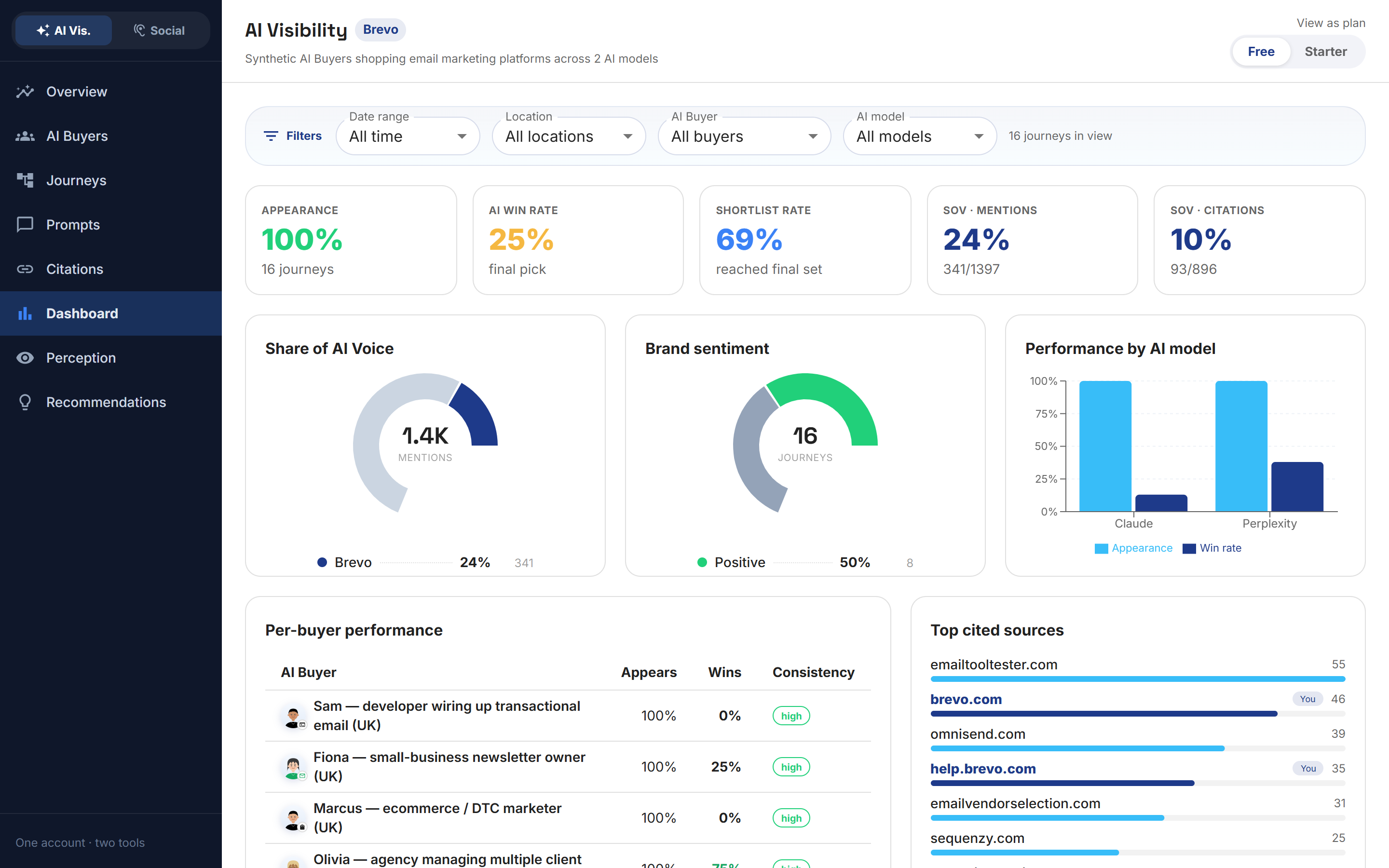
That's the earned half of the same conversation, and it's worth having a way to check it that doesn't depend on running a campaign. Babel42's AI Visibility product tracks whether ChatGPT, alongside six other AI assistants, actually recommends a brand across real buyer-style conversations, the same discipline behind AI search visibility that a paid test can't substitute for. A dashboard like the one below shows both sides at once: how often a brand appears, how often it wins, and which sources the model is citing to back that answer up.
If you're weighing a ChatGPT ads test, it's worth running that same organic check first. Read how to show up in ChatGPT's own answers before deciding whether to pay for a slot next to them.
Two things worth doing this week
- If you're considering a test, size it as a test and treat the CPM you're quoted as provisional. A few hundred dollars, one campaign, one clear objective, judged against your actual cost per lead elsewhere. Pricing has already moved a long way in nine weeks once this year; there's no reason to assume it's settled now.
- Check whether your buyers are even in the room. If your ideal customer is the kind of professional who'd expense a ChatGPT subscription, they're on a paid tier and won't see the ad at all. That's a five-minute gut check that can save you from testing a channel your actual audience has opted out of by paying for it.
The short version
ChatGPT's ad business crossed a $1 billion annualised run rate roughly 200 days after launch, and self-serve buying just opened across Europe, India, the Middle East and North Africa alongside that milestone. It's a real, fast-growing channel, and early conditions (thin competition, no pay-for-recommendation risk to your organic standing) make a small test reasonable for businesses selling to a free-tier consumer audience. It's a weaker case if your buyers pay for ChatGPT themselves, since they'd never see the ad, or if you'd rather wait for the reporting and benchmarks to mature, which they will, given the trajectory. Either way, the paid and earned questions are separate: what ChatGPT recommends for free is worth tracking whether or not you ever run a campaign.