Two things changed inside ChatGPT in the last couple of weeks that most marketing teams haven't clocked yet. OpenAI started testing a new ad format where clicking the ad opens a conversation with the business instead of sending you to its website. And Yelp licensed its reviews, ratings and business listings into ChatGPT, so a local recommendation now has a named data source behind it. Neither change is really about search ranking or getting cited. They're both about what happens after someone's already interested, and that's worth ten minutes of anyone's attention who runs marketing for a business people might ask ChatGPT about.
How does an ad in ChatGPT work?
ChatGPT ads launched to US free and entry-level users in January 2026: clearly labelled, visually distinct placements that show up alongside or after the AI's answer, never inside the answer itself. Per OpenAI's own help centre, an advertiser can't pay to be the thing ChatGPT recommends: if you ask for a product recommendation, that answer stays neutral, and a separate ad slot sits next to it. Targeting works differently to a search ad too. Instead of matching a typed keyword, OpenAI says its system reads the context of the conversation itself, the topic, the stage of the exchange, the follow-up questions, checks it for brand safety, and then a relevance model picks the closest-matching ad (OpenAI Help Centre, "Ads in ChatGPT: The Basics"). Paid subscribers don't see ads at all; this is a free-tier and entry-tier feature.
What changed on 31 July: the ad that opens a conversation
That's the model that's been running since January. What's new is the destination. OpenAI is testing a campaign type, reported as "Agent", where clicking the ad doesn't take you to a landing page at all: it opens a business-specific ChatGPT conversation, pre-loaded with context about that business, that can answer questions, walk through products, or collect a lead on the spot (Search Engine Roundtable, "OpenAI ChatGPT Ads Manager With Business Agent Conversation Campaign Type"). It's live for a limited group of advertisers in the ChatGPT Ads Manager as of the end of July.
Read that again: the conversation is the destination, not a stop on the way to one. A landing page's job is to answer the two or three questions a visitor has before they'll act. If the ad itself opens something that can answer those questions directly, back-and-forth, the landing page isn't in that path at all for that particular visitor.
Yelp's reviews are now a data source inside ChatGPT
The second change is a licensing deal, not an ad product. Yelp agreed to license its reviews, ratings, photos and business listings, more than 330 million cumulative reviews across upwards of 8 million business listings, to OpenAI, so ChatGPT can cite that data directly when someone asks about a local business (Search Engine Land, "ChatGPT gains access to Yelp reviews, ratings, and photos"). A "Request a Quote" feature lets a ChatGPT user go straight from that answer to contacting a local business, without the deal preventing Yelp from licensing the same data to other AI companies too.
Local search has historically been a weak spot for ChatGPT, because it doesn't have the kind of structured, constantly-refreshed local data Google built up over two decades. This deal is OpenAI buying that gap closed rather than building it from scratch, and it means a local business's Yelp rating and review volume now feed directly into what ChatGPT says about it, on top of whatever else the model has picked up from the open web.
Does this change whether ChatGPT recommends you for free?
No, and the difference is worth pinning down, because the two get conflated easily. OpenAI's own documentation states that an advertiser cannot pay for inclusion in the AI's actual recommendation, only for a separate, clearly labelled slot next to it. So if you ask ChatGPT to recommend a tool in your category, the answer it gives is still built from whatever the model has learned and retrieved, unrelated to who's bought a Business Agent campaign. The two systems sit next to each other on the same screen, not inside each other.
That distinction matters if you're already tracking how AI assistants describe your brand: a business could buy every Business Agent slot in its category and still lose every organic recommendation to a competitor. Paid and earned are separate scoreboards here, the same way a search ad next to the organic results doesn't change your ranking in them.
What this means if you're not planning to buy ChatGPT ads
Most businesses reading this aren't about to become ChatGPT advertisers, and that's fine, because the more useful implication in both changes isn't about paid media at all.
The Business Agent format is a preview of a broader shift: ChatGPT increasingly treats "answer the question" and "let the person act on it" as one connected step, not two. Whether or not you ever run an ad there, it's worth asking the same question about your own site: if someone lands on your pricing or product page from an AI assistant's answer, can they get their remaining question answered right there, or does it dead-end into a contact form? That's a content and UX question you can act on regardless of what OpenAI does with ads next.
The Yelp deal is a sharper, more immediate one for any business with a public review presence. If Yelp's review data now flows straight into ChatGPT's answers, then a business's review volume and rating on that platform, and by extension the same dynamic on any platform an AI provider licenses next, stops being a reputation-management afterthought and becomes something closer to a visibility input. It's the same principle we've written about before with branded mentions and AI search visibility: being talked about, specifically and by name, on sites you don't control, feeds what an AI assistant ends up saying about you.
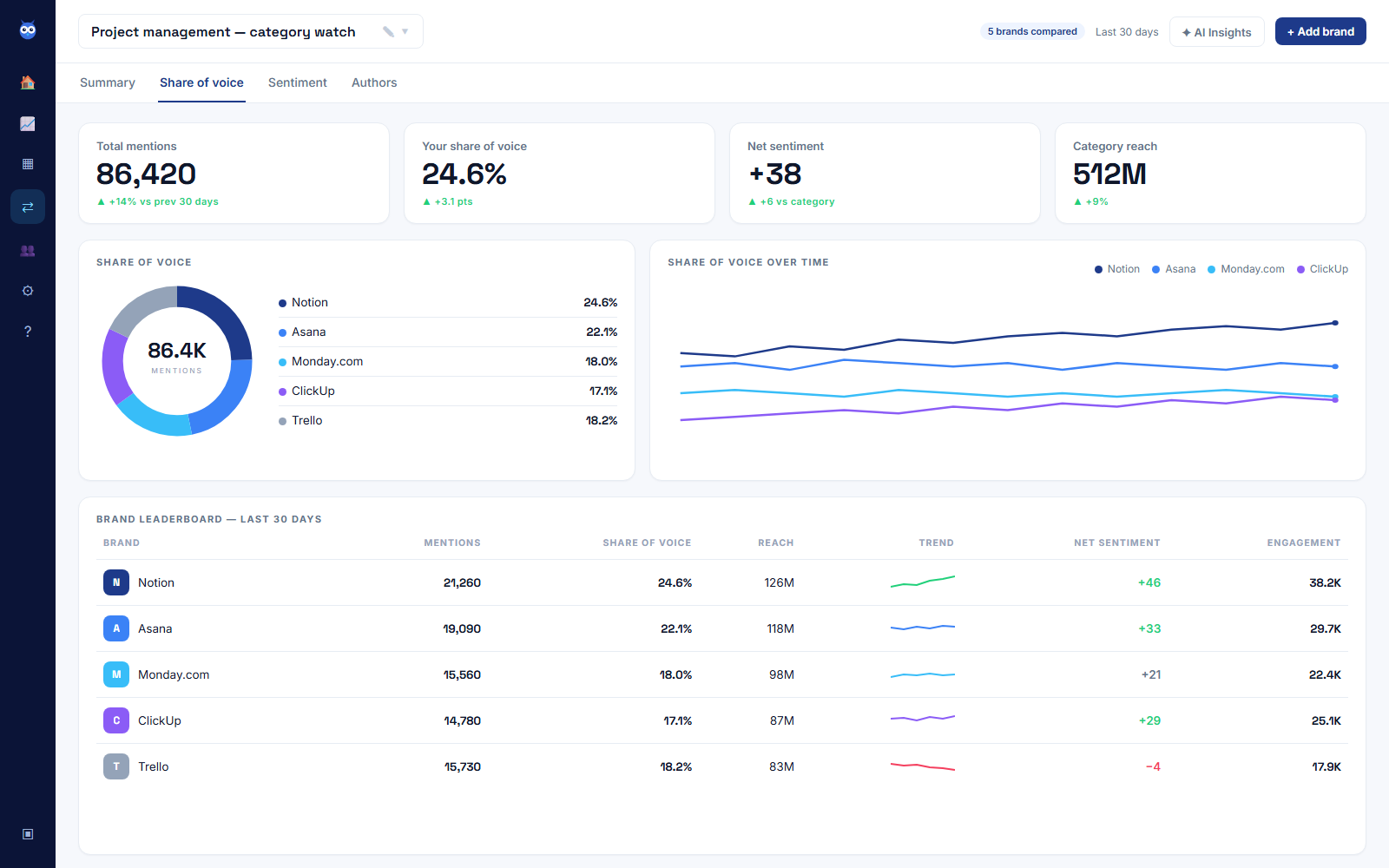
The discipline underneath it is the one social listening has always been for: knowing what's being said about your brand across the platforms you don't own, in something closer to real time than checking each one by hand. Babel42 runs that watch across the public networks it covers, reviews on Trustpilot included, and scores the sentiment on every mention it collects, so a rating problem shows up as a trend rather than as a surprise in someone's AI answer.
Two things worth doing this week
Neither of these needs a budget or a new tool, just attention:
- If your business has a Yelp presence, look at it as if OpenAI were reading it today. Is the listing claimed, are the categories accurate, and does the review volume and rating reflect where the business actually stands? That page is no longer just for people who happen to open Yelp.
- If you'd ever consider a Business Agent-style ad, write down the three questions a prospect would ask before they'd act, and check whether anyone at your company could answer them cleanly in a live conversation. If the honest answer is "we'd need to check with someone", that's the gap to close before the format is worth testing, not after.
The short version
OpenAI added an ad format where the click opens a conversation instead of a website, and separately licensed Yelp's review data so ChatGPT can answer local questions with a named, structured source behind it. Neither is a ranking change or a new way to get cited for free. But both point at the same direction of travel: what happens after someone's interested is moving inside the AI assistant itself, whether that's a paid conversation or a cited review. If you're already paying attention to what AI assistants say about your brand, this is one more surface worth watching, not a reason to change strategy overnight.
The same shift is happening on the paid-search side too: see what changes when Google auto-upgrades Search campaigns onto AI Max. And the same real-versus-manufactured question is playing out on the organic side of LinkedIn right now, where a reach penalty now applies to generic, unedited AI content. If you're wondering whether it's worth actually buying one of these ChatGPT ad slots now that the channel has scaled, ChatGPT ads hit a $1 billion run rate walks through the numbers and the case for testing.