Ask most marketing teams for their crisis plan and you'll get a Slack channel called #fires and a shrug. That's not a plan, it's an instinct, and instincts are exactly what go missing at 11pm when something is spreading. A real plan doesn't stop a bad day from happening. It decides, in advance, who does what, so nobody's first move during a crisis is figuring out whose job this is.
This is a guide to writing that plan before you need it: how to tell a genuine crisis from an ordinary bad week, who has to be looped in and when, and the line you say first, drafted while you're calm rather than composed under pressure.
What counts as a crisis, and what's just a wobble
Not every angry thread is a crisis, and treating every one like it is trains your team to either panic constantly or ignore the real one when it arrives. If a handful of people are annoyed, sentiment dips for a day, and it settles once you reply, that's a wobble: normal, forgettable, and the subject of our separate guide to handling one. A crisis is a different kind of problem. It spreads faster than you can read it, it gets picked up by accounts with real reach, or it touches something people won't forgive quietly: safety, money or a broken promise. The plan below is for that second case. If you're not sure which one you're in, the next section is how you tell.
What should a brand crisis management plan include?
Four things, and all four need to exist before anything happens, not get improvised during it: severity levels that tell you how hard to react, named roles so nobody's waiting to be asked, a holding line drafted and approved in advance, and a monitor that notices in time to use any of it. Skip the monitor and the other three are theoretical. Skip the roles and the first hour is spent finding out who's allowed to post. Most teams have none of these written down; writing them down is most of the work.
Set severity levels before anything happens
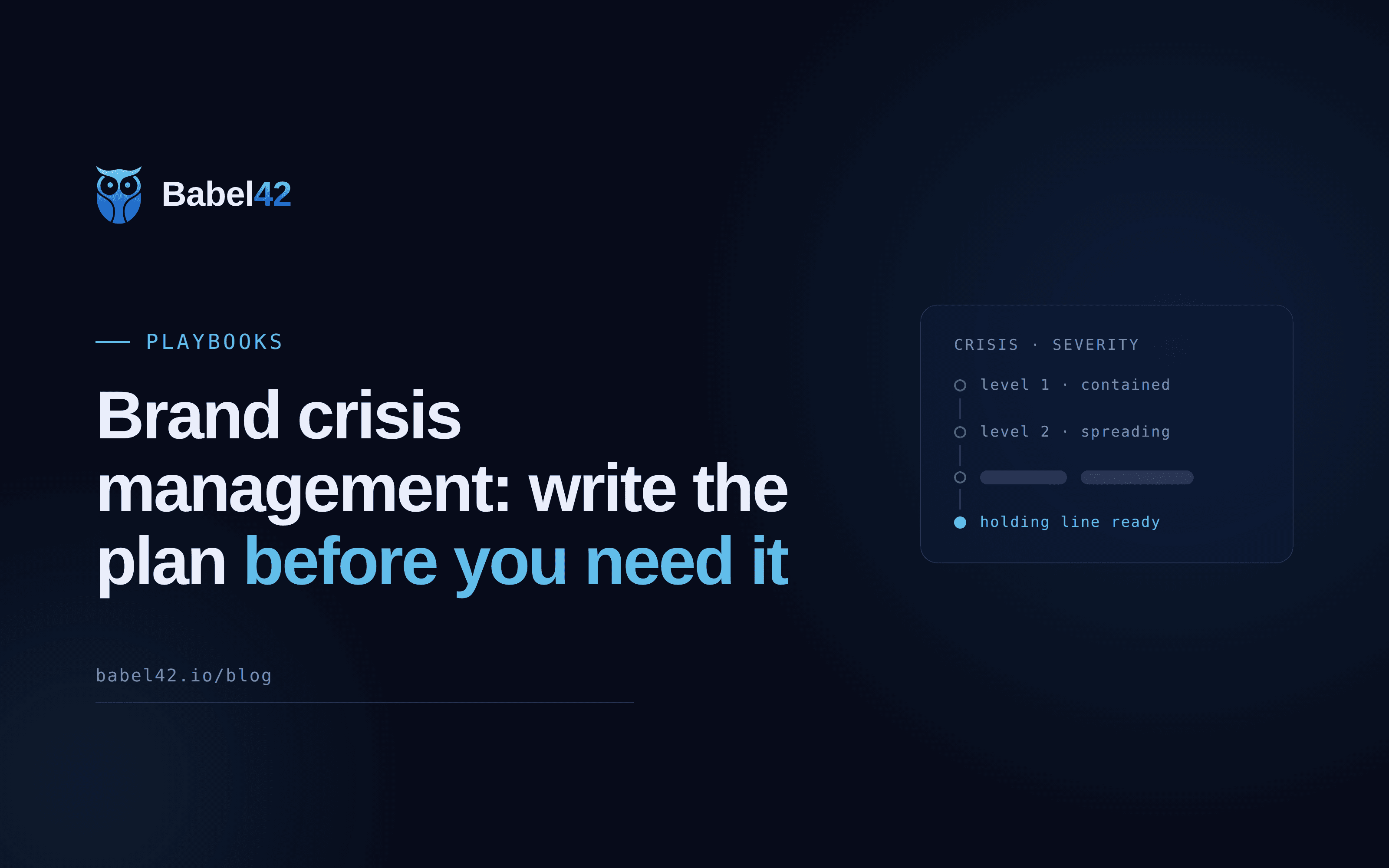
A plan with one setting, panic, gets used either constantly or never. Three levels, agreed on a calm afternoon, do most of the work:
- Level 1: contained. A handful of complaints, ordinary accounts, sentiment dips but stays flat rather than climbing. Reply and move on; no plan needed.
- Level 2: spreading. Mention volume is climbing hour over hour, or a mid-reach account has picked it up. Time to loop in the named owner below and draft a holding line, even if you don't post it yet.
- Level 3: crisis. A high-reach account or a journalist is carrying it, the story touches safety, money or trust, or it's spread to a second platform on its own. Full plan: named owner, legal or exec sign-off if your levels require it, holding statement out fast.
Write the thresholds down somewhere everyone on the team can find at 11pm, not just in the head of whoever built the plan. Attach a rough example to each level too, drawn from a wobble you've already had if you've got one on file: a sentence someone can compare a new situation against usually settles the "is this a 1 or a 2" argument faster than the definition alone.
Decide who gets looped in, and at what level
A plan is just a list of names next to a list of triggers. At minimum you need: someone with the authority to approve a public reply without waiting for a meeting, someone who can post it (make sure more than one person has access), and a line for when legal or an executive has to sign off, usually reserved for Level 3 or anything involving a safety or financial claim. If personal data is part of the story, that line is not yours to draw: the ICO's "Personal data breaches: a guide" says you must report a notifiable breach "without undue delay, but not later than 72 hours after becoming aware of it", a clock that usually runs faster than a comms timetable. Write their names next to the levels above, not just their job titles; job titles change hands and someone needs to know exactly who to message at midnight.
Know who's driving it before you respond
Ten thousand mentions from ordinary accounts and a thousand mentions led by one large one call for genuinely different responses, and you can't tell the difference by scrolling a feed. Lopsided is the normal state of things. According to Pew Research Center's "Contending with the 80/20 rule when studying online behavior", "the most active 10% of Twitter users produce 80% of all tweets from U.S. adults".
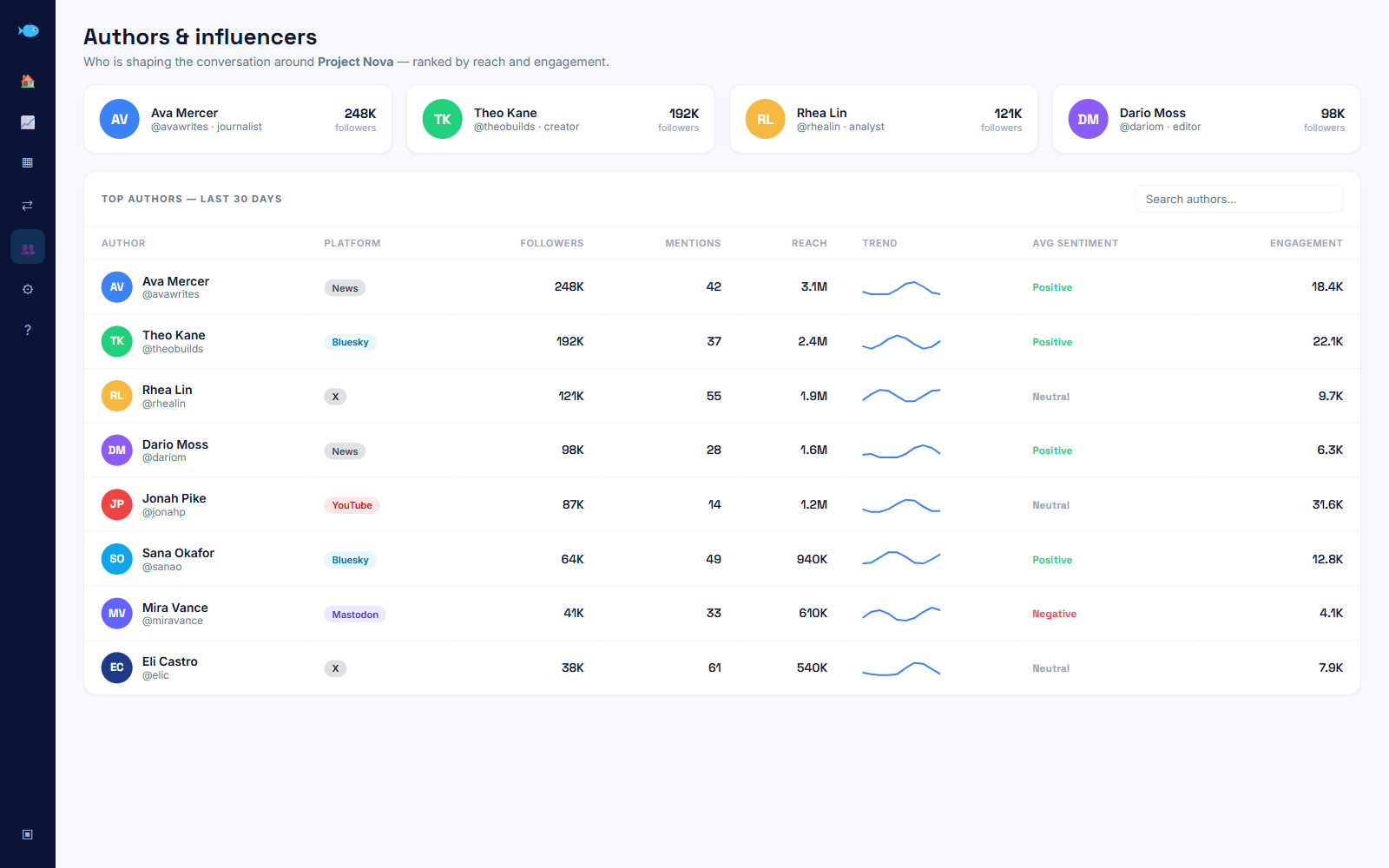
The view above ranks who's shaping a conversation, not simply how much of it there is: a journalist or a creator with a six-figure following at the top of that list is a different situation from the same volume spread across accounts with a few hundred followers each. Check this before you decide your severity level, not after. A quiet-looking mention count can still be a Level 2 or 3 if the one account driving it has the reach to make it everyone's problem within the hour. The sentiment column matters here too: a high-reach account with a neutral, curious tone calls for a different response than one that's already decided you're guilty.
Draft the first line before you need it
The Tylenol tampering case from 1982 is still the standard teaching example in crisis management, for one reason: Johnson & Johnson pulled the product from shelves nationwide within days, before being told to, and said so plainly. The regulator's own history of the episode is short and worth reading, in the FDA's "Promoting Safe & Effective Drugs for 100 Years": "after seven people in Chicago died from swallowing Tylenol capsules laced with cyanide, the FDA issued Tamper-Resistant Packaging Requirements in 1982", and Congress followed with the Federal Anti-Tampering Act the next year. A whole industry's packaging changed because one company moved before it was made to. Nobody remembers the exact wording of their statement. Everyone remembers that they moved first and didn't get defensive.
You don't need a polished statement sitting in a drawer for every possible scenario. You need one structure, agreed in advance: acknowledge what's happening in plain language, say what you're doing about it right now (not what you'll eventually do), and stop. Don't argue the specifics in the replies, and don't promise a fix you haven't confirmed. A holding line that buys you an hour to get the real answer right beats a fast, wrong one every time.
Run the drill once a quarter
A plan nobody has rehearsed reads well and fails under pressure, mostly because the first time anyone uses it is also the worst possible time to learn it doesn't quite work. Once a quarter, pick a plausible scenario, pull up your monitor as though it were live, and walk the team through it: who gets pinged first, who drafts the holding line, who has to approve it. Twenty minutes is enough. You're not rehearsing the words, you're rehearsing the handoffs, and the handoffs are what break under real pressure.
Where a plan ends and judgement starts
A plan tells your own team what to do. The story still moves at its own speed, and the scenario nobody wrote down will arrive eventually, so the value of the document is the speed of your first hour rather than certainty about the week. Babel42's social listening tool watches public conversation across the platforms it covers and puts the early signal in front of you, an alert while the thread is still small enough to steer. Communities that sit behind a login, Reddit among them, are worth searching by hand alongside those monitors. And judgement in the room still decides the response. The plan just means the room isn't also arguing about who's allowed to be in it.
On the free plan, you get 500 mentions a month, two monitors and one channel across five networks (Bluesky, YouTube, News, Hacker News and DEV.to), with AI sentiment analysis and 90 days of history, no card required. Babel42 can alert you the moment volume spikes, sentiment dips or a high-reach account weighs in, which is the trigger your severity levels depend on; that's enough to test this plan against a real monitor before you need it for real.
If you haven't set up a monitor yet, how to do social listening for free is the starting point this guide assumes you already have running. For the ongoing watch that should be catching the drift long before it reaches Level 2, see how to set up brand reputation monitoring. And when you're mid-wobble rather than planning ahead of one, handling a reputation wobble is the five-step response for that moment itself.