Most teams run a competitor analysis once, early, then treat it as finished. The document sits in a shared drive. It is accurate for the week someone wrote it, then slowly wrong after that. A rival's pricing page changes without an announcement. A feature ships, and gets one line in a release note nobody reads. A single complaint turns into a pattern across a dozen reviews, and nobody notices until a prospect brings it up on a call.
This guide covers what a competitor analysis is, the three inputs it is usually built from, and the specific gap that opens up between one review and the next.
What is competitor analysis?
Competitor analysis is the process of identifying your direct and indirect rivals, then comparing what they charge, what they have built and what their customers say about them against your own position. A direct competitor sells the same kind of product to the same buyer. An indirect one solves the same problem a different way. The comparison turns a list of names into something you can act on: a pricing decision, a feature priority, a line in your sales messaging.
None of this is specific to one industry. The same shape works whether you sell project-management software or garden furniture. Find who you are actually up against, then compare them to yourself on the dimensions a buyer weighs.
Which competitors belong in the comparison?
Both direct and indirect competitors belong in the comparison, because losing a deal to either looks identical from where you sit. A direct competitor sells a close substitute to the same buyer: same budget line, same decision-maker, same shortlist. An indirect one solves the same underlying problem a different way, often instead of buying anything in your category at all.
A practical way to build the list: start with the names that come up unprompted in your own deal reviews. Add whoever ranks for your category's main search terms. Check your own customer reviews for a name a buyer mentions switching from. Three or four direct competitors and one or two indirect ones is usually enough. A list of fifteen dilutes the comparison into something nobody reads twice, and most of those fifteen will turn out to be niche players nobody on your deal reviews ever actually names.
What a typical analysis compares
Three sources make up most competitor analyses. Each answers a different question about a rival.
| Input | What it tells you | Where it comes from |
|---|---|---|
| Pricing pages | What they charge, and for what | Their own site |
| Feature lists and release notes | What they have built, and what is still missing | Their own site |
| Customer reviews | What buyers think, once they have actually used it | G2, Capterra, app stores |
Some teams add a SWOT grid on top, weighing each rival's strengths, weaknesses, opportunities and threats against your own. That organises the same three inputs into a decision. It is not a fourth source of information.
Why does a competitor analysis go stale?
A competitor analysis goes stale because each of those three inputs is read once, then filed away, while the market underneath it keeps moving. The pricing page you checked in January is a photograph, not a live feed. A feature ships two weeks after your last review and sits unflagged until the next one.
A complaint that shows up in one review this month, and three more next month, only reads as a pattern if someone rereads all four in order. Almost nobody does that on a schedule built around quarters. The three inputs are not wrong. They are read at the pace of a calendar, and a competitor's customers do not wait for yours to catch up.
What the standard three inputs miss
Pricing pages, feature lists and reviews miss the conversation that happens before any of them update: a customer complaining about a bug today that will not surface in a published review for months, someone asking on a forum whether there is an alternative the week before they switch, a founder announcing a feature that users are already reacting to while your team reads last quarter's document.
Take a pricing change as the concrete case. A rival quietly doubles their entry-level tier in March. Their pricing page now shows the new number, so a scheduled analysis would catch it eventually. What it will not show is the week of complaints that followed, or whether the backlash settled or kept growing.
That window, between the change and your next review, is what a continuous read catches and a quarterly one misses by design. Our guide to monitoring competitor activity covers the specific shapes worth watching for and how to set a monitor up to catch them.
Closing the gap between reviews
The fix is not running the same three-input analysis more often, though that helps on its own. It is adding a layer that watches continuously, in the gap between one formal review and the next, so a pricing change or a pattern in the complaints reaches you the week it happens.
Babel42's competitor analysis feature is built around three things. A side-by-side comparison of mention volume, reach and sentiment for every rival you track. The reaction when a competitor announces something, including the actual posts, so you can tell whether buyers responded or only their existing audience did. And an AI read of the recurring themes in a rival's complaints, so a pattern shows up without you rereading every review yourself.
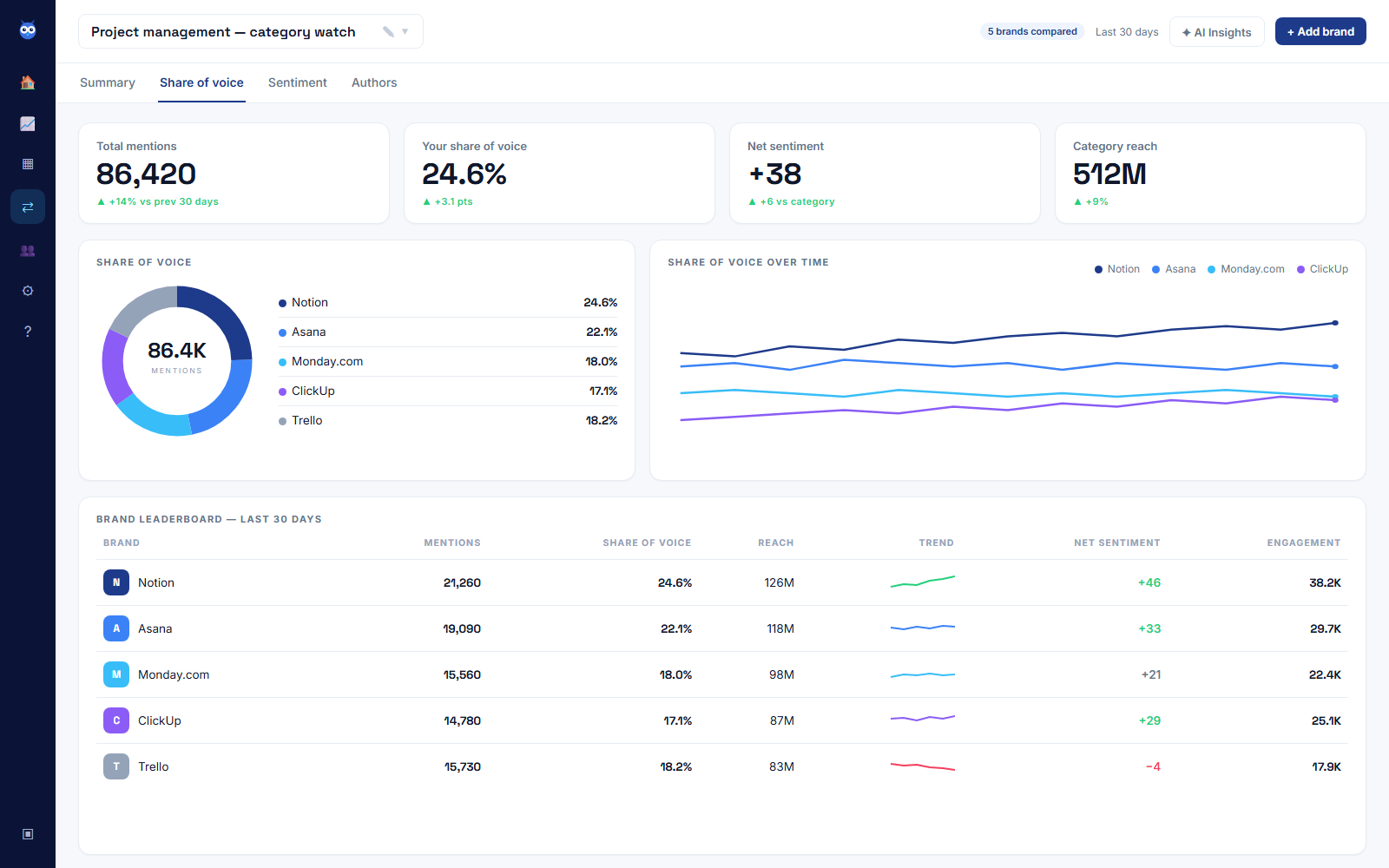
The screenshot above is a category watch across five project-management tools, not a live customer account. It shows what the comparison looks like once it is running: every rival's share, sentiment and trend in one view, rather than five separate browser tabs.
The gap identification piece works the same way on complaints. Say a rival's support process slips for a month and three separate reviewers mention a slow response time, in different words, weeks apart. Read one at a time, each looks like an isolated gripe. Read together, grouped by theme, they are a pattern worth a line in your sales messaging, and worth checking against your own response times before you use it.
Does continuous monitoring replace a competitor analysis?
No. The formal analysis still decides which rivals you compare yourself against, and on what dimensions, the same way a brand tracking survey still sets the questions a listening monitor cannot ask on its own. Continuous monitoring keeps that comparison current between the reviews. It does not replace doing the review. Run both: the analysis sets the frame, the monitor keeps it from going stale inside it.
On the free plan, you get 500 mentions a month, two monitors and one channel, across five networks (Bluesky, YouTube, News, Hacker News and DEV.to), with 90 days of history and no card required. That is enough to run one competitor's keyword monitor alongside your own brand's. Tracking several rivals at once, or adding further networks, is where a paid plan comes in.
If you have not set up a monitor yet, our guide to what social listening is is the place to start, and how to do social listening for free walks through the first one end to end. For the practical setup only briefly covered here, from building the right Boolean query to a weekly routine that does not take over your week, see how to monitor competitor activity online. Babel42 is a social listening tool built to run both the comparison and the monitor from the same account.