Search "GEO for ecommerce" and most of what comes back reads like the general GEO playbook with the word "store" pasted in: write clear headings, get cited, chase backlinks. None of it says what's actually different when what you're selling is a physical product with a price, a size chart and a returns policy, rather than a piece of software with a features page. It is different, mostly because the inputs an AI assistant has to work with are different, and because a shopper asking about a jacket is doing something more concrete than a shopper asking about accounting software.
Does GEO for ecommerce need a different playbook from GEO generally?
No, not a different one, an adapted one. The same three conditions that decide whether any brand gets cited, covered in full for AI search visibility generally, still hold: the assistant has to be able to reach your content, what it finds has to answer the question plainly enough to quote, and your brand has to read as specific and trustworthy rather than vague. What changes for a store is what "plain and specific" looks like. A SaaS page states a price and a feature list. A product page has to state a price, a size range, stock status, materials and shipping terms, correctly, in text a crawler can read, not only in a size-chart image or a JavaScript-rendered variant picker. Get that plumbing wrong and the rest of GEO doesn't matter, because there's nothing concrete for the assistant to lift.
What an AI shopping question looks like
A shopper doesn't type "waterproof jacket" into ChatGPT the way they'd type it into Google. They ask something closer to "what's a good waterproof jacket for hiking in Scotland that packs down small, budget around £150", and the assistant treats that as the start of a conversation rather than a single query. It narrows, compares two or three named options against the stated constraints, and usually ends with a pick and a reason. We've watched this pattern play out at length in our study of 59 real AI buying journeys: buyers interrogate, they compare, and they pick a winner, and every one of those steps is a fresh chance to be dropped from the shortlist if the assistant can't find a clean answer to whatever was just asked.
That has a direct consequence for a product page: it needs to answer the follow-up questions a real shopper would ask, not just the ones a search-engine keyword implies. "Packs down small" and "budget around £150" are the kind of constraint an assistant will check against your page directly, so if your jacket's packed size or price isn't stated in plain text somewhere reachable, you can be a perfectly good fit for the question and still lose the recommendation to a competitor whose page simply says so.
The product data an assistant can use
Three things make the biggest difference here, and none of them require rewriting your brand voice.
State facts as facts, not adjectives. "Packs down to the size of a water bottle" and "waterproof to 20,000mm" are quotable. "Ultra-packable and highly waterproof" is not, because there's nothing in it an assistant can lift into an answer with confidence. This is the same plain-text-over-adjective rule that applies to any AI search visibility page, just more literal for a store: price, size range, stock status and material are facts; "premium quality" is not.
Put structured data behind the facts you already state in prose. Schema.org's Product markup, the same structured-data vocabulary search engines have used for years, lets you mark up price, availability, rating and reviews in a form a crawler can parse even if the on-page copy is written more loosely, according to schema.org's own Product type documentation. It doesn't replace stating the fact in plain text; it backs it up in a format that survives a messier page layout.
Make sure a bot can see the fact, not just a shopper. A price or a stock count that only appears after a size is selected in a JavaScript widget is invisible to a crawler that isn't running your front-end code. If a fact matters enough to put on the page, it needs to exist somewhere in the page's initial, crawlable text, not only behind an interaction.
Third-party proof matters more for a product than a pitch
The same asymmetry that applies everywhere in AI search visibility applies harder here: what other people say about a product tends to carry more weight than what the brand says about itself. Ahrefs' analysis of roughly 75,000 brands found that branded mentions on sites the brand doesn't control correlate with AI visibility at 0.66 to 0.71, against just 0.22 to 0.27 for backlinks (Ahrefs, "Top Brand Visibility Factors in ChatGPT, AI Mode, and AI Overviews"). For a store, those third-party mentions have familiar shapes: a review roundup, a "best of" comparison on an independent site, a genuine customer review with specifics in it, a mention in a forum thread about the actual problem your product solves. None of that lives on your own domain, which is exactly why a model checking whether a claim is trustworthy leans on it more than on your own product copy.
This is also where AI-driven shopping is turning into something worth paying attention to at all: AI-referred traffic to US retail sites grew 138% year on year by May 2026, and that traffic was converting 42% better than non-AI traffic, a reversal from converting worse a year earlier, according to Adobe's own Digital Insights analysis (Adobe, reported by Digital Commerce 360, "Adobe: AI-referred traffic to retail sites doubles in a year"). It's a small slice of total traffic today, but a growing one, and the shoppers arriving through it have already had a product recommended to them by name before they land on your site.
Where Babel42 fits for a store
Babel42's AI Visibility product shows you what AI assistants say about your category. It runs a synthetic AI Buyer through a real, multi-turn shopping conversation on a category question, then reports which brands ChatGPT, Claude, Perplexity, Gemini and Grok recommend by name, which is exactly the shape of decision a shopper goes through when asking an assistant what to buy. The buyer prompts are anchored to the queries your own domain already ranks for in Google, so a store's existing category and product pages become the starting point rather than a generic script. For a retail team, that turns "does the assistant put us in the answer" from a hunch into something you can read off a dashboard.
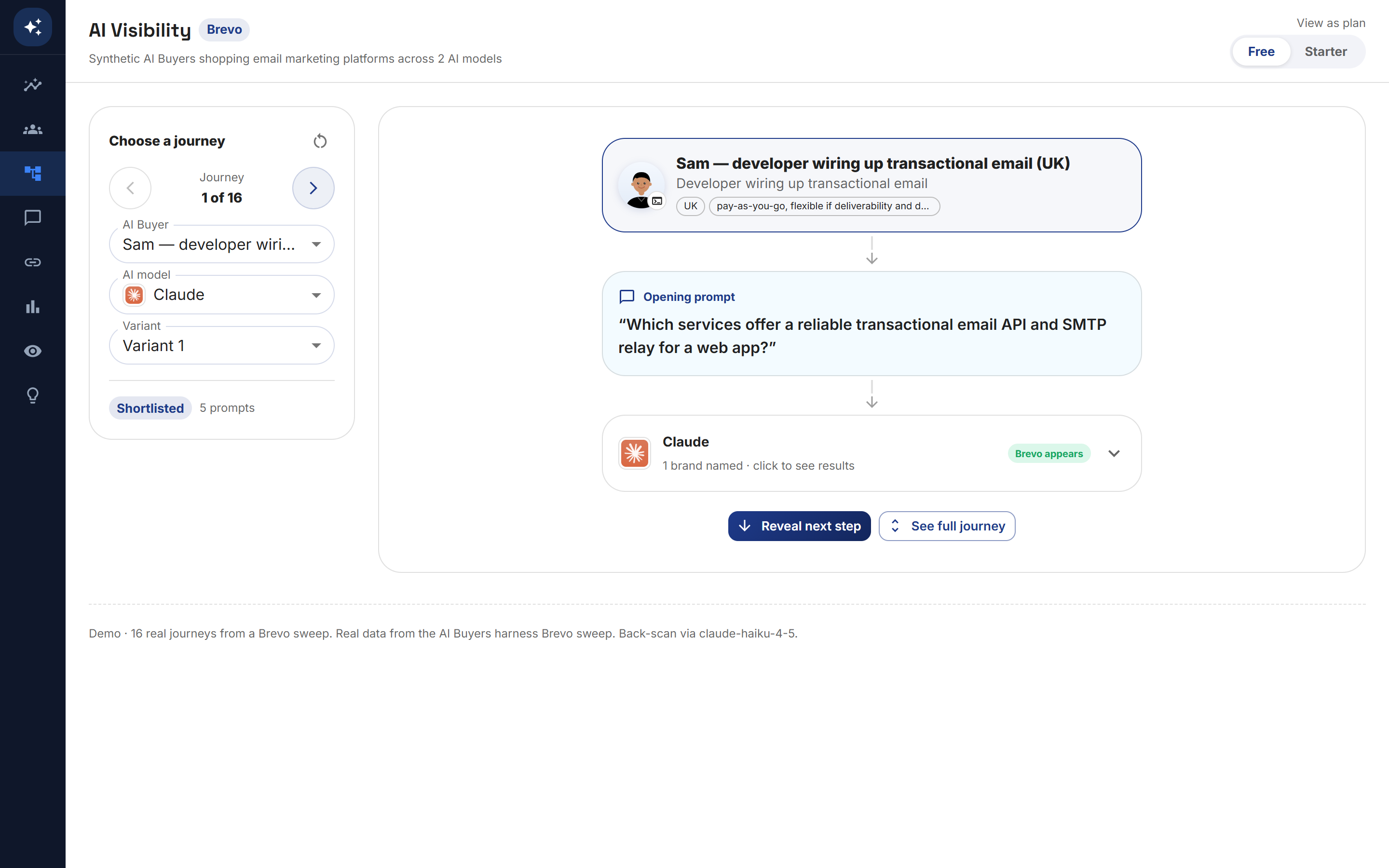
This journey, a UK developer shopping for a transactional email API, shows the mechanism any category question runs through: a real question, run across several assistants, with the outcome read straight off the dashboard. In our own data from this workspace, the AI Buyer's win rate across five assistants sat at 32%, against a 100% appearance rate, meaning it was named in every conversation but only picked less than a third of the time. That gap between being known and being chosen is the number worth watching for a store's own category question, whether the category is email software or hiking jackets.
What to check this week
Four things, roughly in the order we'd spend an afternoon on them:
- Pick your three or four best-selling product pages and confirm price, size range and stock status are stated in plain text an assistant could quote, not only inside a variant picker.
- Add or check Product schema markup for those pages so the same facts exist in a structured form.
- Search for your product category the way a buyer would, "best X for Y under £Z", not your brand name, and read what ChatGPT or Claude names and why.
- Look at where genuine, specific customer reviews and independent comparisons already mention you, and where they don't, that's the gap third-party mentions need to close.
Our free AI SEO audit checks the crawlability side of the first two automatically, against the wider AI SEO checklist, reading your pages as an identified crawler would and reporting what comes back. If what you find on the conversational side is worth tracking properly, the free plan runs one AI Buyer across any two of the seven assistants Babel42 tracks, weekly, no card required, enough to see whether your category recommends you before deciding whether to go further. And if this is your first stop with any of this, what AI search visibility actually measures is the place to start.