Ask how Google AI Mode works and most answers stop at "it's like AI Overviews, but more so." That undersells it, and it hides a fact that matters more for anyone tracking brand visibility: AI Mode, AI Overviews and the Gemini app are three separate products built by the same company, and Babel42's own AI Buyer data shows they draw on almost entirely different parts of the web to build an answer. Knowing which one you're missing changes what you'd fix.
How does Google AI Mode work?
AI Mode is a dedicated, conversational search tab inside Google Search, built to handle a question that a single search doesn't answer well on its own. Rather than matching your query to a set of ranked pages, it uses what Google calls "query fan-out": it breaks one question into several related searches, runs them at the same time, and combines what comes back into one written answer with citations attached, per Google's own announcement of the feature (Google, "Expanding AI Overviews and introducing AI Mode").
That's a different mechanism from an AI Overview, which stays on the standard results page and summarises from Google's existing search index without necessarily firing new queries per turn. It's also a different product from the Gemini app, which is a standalone assistant you open on purpose, closer in shape to ChatGPT or Claude. We've covered that Gemini-versus-AI-Overview distinction, and the separate robots.txt controls behind it, in more depth in how to rank on Gemini; this piece focuses on AI Mode specifically, and on what Babel42's own measurement shows about what it reads.
Google's three AI surfaces read three different webs
We tracked 387 AI shopping journeys our AI Buyer engine ran across seven assistants between 21 July and 7 September 2026, then split out the three surfaces Google runs on their own. The sample held 1,812 sources across Gemini, AI Overviews and AI Mode, and the three don't look alike at all.
| Source type | Gemini | AI Overviews | AI Mode |
|---|---|---|---|
| Ordinary business and vendor sites | 89.5% | 70.5% | 48.4% |
| Social and community platforms | 1.2% | 19.5% | 46.0% |
| Review sites and directories | 0.1% | 1.0% | 0.0% |
| News and trade press | 2.2% | 0.0% | 2.5% |
Gemini's diet is almost entirely ordinary company websites, and it barely touches a social platform or a review site. The figure for AI Overviews sits in between the two. Nearly half of everything the third surface, AI Mode, cites comes from a social or community platform, roughly the same share as ordinary business sites. Same company, same week, same underlying questions, three different reading habits.
AI Mode names one brand. Gemini names fourteen
The source mix is one gap. How many brands each surface is even willing to name is a bigger one for anyone judging their own visibility by a single check.
| Assistant | Journeys measured | Median brands named per answer |
|---|---|---|
| Claude | 78 | 14.5 |
| Gemini | 58 | 14 |
| ChatGPT | 88 | 11 |
| Perplexity | 81 | 11 |
| Grok | 12 | 6.5 |
| AI Overviews | 58 | 3 |
| AI Mode | 12 | 1 |
A conversational assistant hands a buyer a shortlist. Gemini's median answer names fourteen brands, close to Claude and comfortably ahead of ChatGPT and Perplexity. That narrows to three for AI Overviews, and to typically exactly one for AI Mode: not a shortlist to be considered for, a single pick. Appearing in a Gemini answer and appearing in an AI Mode answer are not comparable events; one is joining a long list, the other is winning outright or not appearing at all.
Why LinkedIn dominates what AI Mode reads
The concentration goes further than the source-type split above shows. Looking at the single most-cited domain per surface, out of 161 AI Mode sources across those 12 journeys, linkedin.com alone accounts for 31.1%, and the top ten sources together cover 52.8% of everything AI Mode read. Gemini's equivalent top source, seranking.com, is only 1.8% of its 949 sources, with the top ten covering 12.1%; nothing comes close to dominating its reading list the way LinkedIn dominates AI Mode's.
That's a small base, 12 journeys, and worth reading as directional rather than settled; a handful more journeys could move the exact percentages. But the shape of the finding, one platform standing in for half the source mix, showed up consistently enough in this corpus that it's not a rounding artefact of a single unusual conversation. The practical read: if AI Mode is the surface you're missing from, checking whether your brand, or people talking about it, show up on LinkedIn is a more targeted first step than a general content push aimed at "the AI overviews."
What this means for checking your own AI visibility
Treating "are we visible in Google's AI" as one question hides which of three very different problems you actually have. A brand absent from AI Mode but doing fine in Gemini has a LinkedIn-and-social-presence gap, not a general content gap; a brand missing from Gemini specifically is more likely to have an ordinary-website crawlability or citation problem, the kind covered in AI search visibility factors. Checking only one of the three and generalising to "Google" gets the diagnosis wrong more often than it gets it right, given how little the three source mixes overlap.
This is also why Babel42's AI Visibility product tracks Google's AI Overviews and AI Mode as their own row rather than folding them into "Gemini" or "Google." Both are probed once per question for appearance and citation, since neither runs the back-and-forth conversation a buyer journey needs, with an honest "no AI Overview was shown" recorded when Google doesn't return one for that query. That's a different check from the five conversational assistants, and it's deliberate: a brand that only ever checks Gemini has learned nothing about whether AI Mode names it at all.
The limits of this data
The 1,812 sources above come from Babel42's own AI Buyer runs, not a random sample of the web: the 20 tracked brands are mostly small companies across B2B software, legal services and consumer tools, and the questions are the buying journeys those companies chose to run, not a survey of every possible search. AI Mode's 12 journeys and 161 sources is the smallest base in the set by a wide margin, which is why the LinkedIn figure above is flagged as directional rather than a fixed rate. Read the assistant-level table as showing a real, repeated pattern rather than a precise, stable percentage that will hold at a larger sample size.
See where your own brand stands on each surface
The dashboard below is a live example from Babel42's AI Visibility product: a demo brand, Brevo, shopped for email marketing platforms across two AI assistants on the free plan. It appears in 100% of journeys, wins the final recommendation in 25% of them, holds 24% share of AI voice, and is perceived as a "Value pick" against its top competitor, Omnisend.
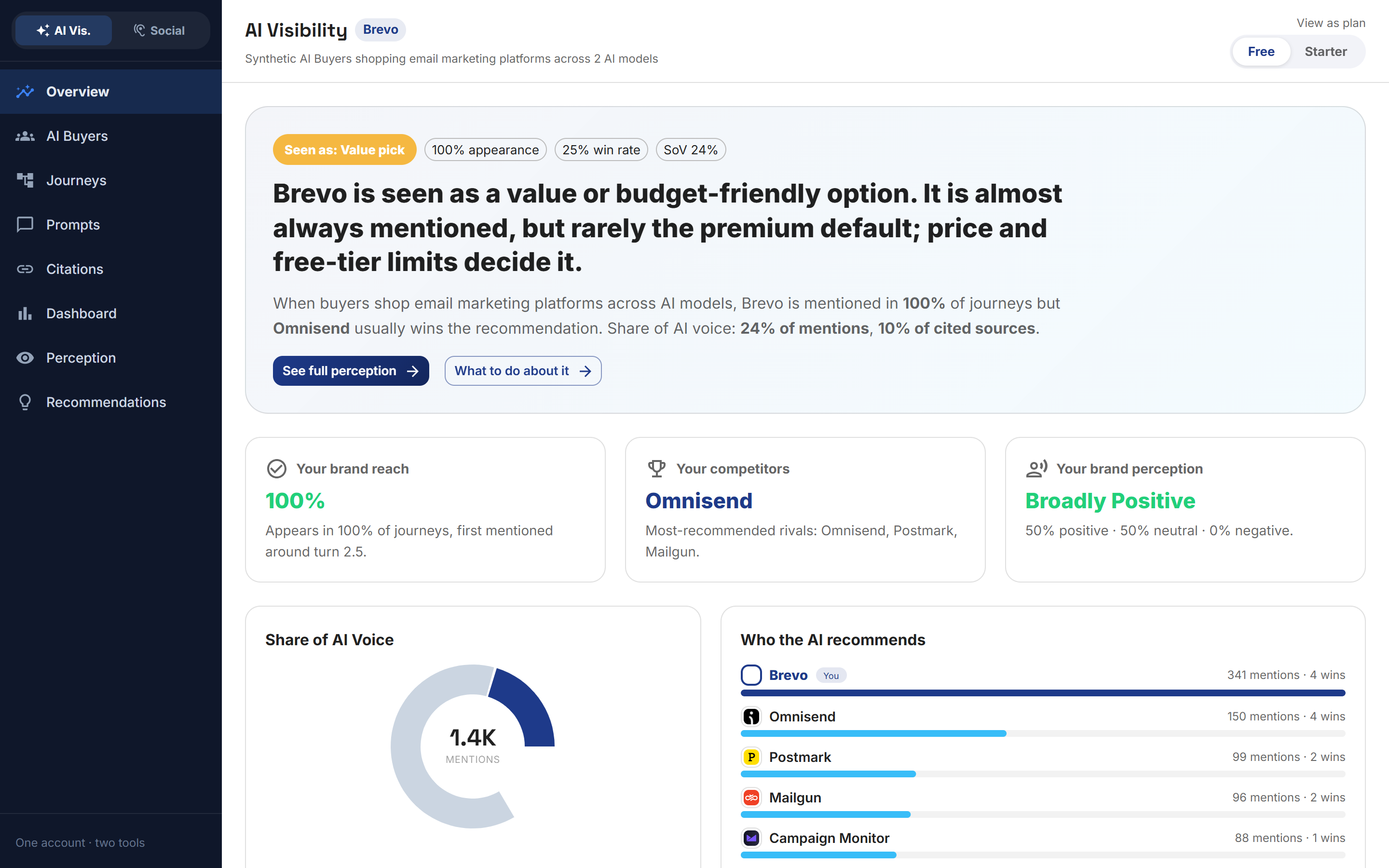
That same structure applies whichever surface you're checking: an appearance number on its own says less than appearance next to a win rate, and a single surface says less than the same check run across Gemini, AI Overviews and AI Mode separately. The free plan runs one AI Buyer across any two of Babel42's seven tracked assistants every week, so you can start with the surface you're most worried about missing. If you're new to what any of these numbers measure, what AI search visibility actually measures is the place to start.