Ask someone what "ranking on Gemini" means and you'll get two different answers. Some mean the chatbot at gemini.google.com, the one you open on purpose and type a question into. Others mean the AI-written summary that sometimes appears above the blue links on a normal Google search. Both run on Google's AI, and both can name your brand or skip it, but they're separate products with separate mechanics, and conflating them is why "we're not showing up in Gemini" sometimes turns out to be true of one and false of the other.
We've written before about what earns a citation across AI assistants generally, and narrower versions of that question for ChatGPT and Perplexity. This is the Gemini version: what's different about it, and a real example of it recommending a brand outright, in a journey where another assistant picked a rival instead.
Is ranking on Gemini the same as ranking in Google's AI Overview?
No. The Gemini app is a standalone conversational assistant you open and talk to directly, closer in shape to ChatGPT or Claude. Google's AI Overview is a different surface: a short, AI-generated summary that can appear at the top of an ordinary search results page, with no back-and-forth conversation involved, sitting above the usual list of links.
That's also how Babel42's own AI Visibility product treats them, for a straightforward reason: Gemini is one of the five conversational assistants shopped through a full, multi-turn buyer journey to an actual decision, alongside ChatGPT, Claude, Perplexity and Grok. Google AI Overviews, and the related AI Mode, are checked differently: once per question, for whether they appear at all and what they cite, because there's no conversation to run. Treating "Gemini" and "the AI Overview above my Google search" as one channel means you can't tell which one is actually the problem when a buyer says they didn't see you.
How does Gemini decide when to search the live web?
Google's own developer documentation describes this as "grounding with Google Search": when the feature is switched on, the model looks at the prompt and decides for itself whether a search would improve the answer, generates one or more search queries if it thinks so, runs them, and then writes a reply with inline citations pointing at what it used (Google AI for Developers, "Grounding with Google Search"). Two details in that worth holding onto: the decision to search happens per prompt, not as a fixed setting, and a single turn can trigger more than one search query, not just one.
That second point is the practical difference from a single-query search. If a buyer's question touches two or three separable facts, Gemini's grounding can chase all of them in one turn rather than only the first one it notices. It also means a brand missing from just one of those queries' results can still get picked up by another, which is a small but real reason breadth across a topic, not just one perfectly-optimised page, tends to matter here.
What gets a brand recommended by Gemini
Most of this is the same groundwork that helps everywhere, with one Gemini-specific addition.
- Check the right control, because the two surfaces don't share one. Per Google's own crawler documentation,
Google-Extendedis therobots.txttoken used by the Gemini apps and Vertex AI, separate from classicGooglebot(Google Search Central, "Google's common crawlers"). AI Overviews are a different matter: Google's guidance on AI features says the control there is your ordinaryGooglebotdirectives, alongside snippet-level controls likenosnippetandmax-snippet(Google Search Central, "AI features and your website"). So blocking one doesn't necessarily hide you from the other, which is another reason to keep the two apart in your head. We've covered the wider crawler list in how AI crawlers find and cite your brand, and keep a page-by-page reference for every named crawler current alongside it. - State the fact, not the adjective. "$99 a month, 5 AI Buyers, twice-weekly cadence" is something a search-grounded answer can quote directly. "Flexible plans for growing teams" gives it nothing to lift.
- Keep the fact in plain, crawlable text. The same rule that applies to every AI crawler applies here: a number buried in a PDF, gated behind a form, or rendered in a way that only a browser can parse, is invisible to this pipeline even if a person would find it easily.
- Cover the topic from more than one angle. Because a single Gemini turn can run several search queries, a page (or a small cluster of pages) that answers the buyer's question from a few different phrasings has more chances to be the one result grounding lands on, not just the one with the cleverest headline.
- Third-party mentions still outweigh backlinks. Ahrefs' analysis of roughly 75,000 brands found branded web mentions correlating with AI visibility at 0.66 to 0.71, against 0.22 to 0.27 for backlinks (Ahrefs, "Top Brand Visibility Factors in ChatGPT, AI Mode, and AI Overviews"). That study covered Google's AI Overviews and AI Mode specifically, alongside ChatGPT, which makes it a reasonable read on Gemini's own family of products too.
A real journey where Gemini recommended the brand outright
This is worth showing, not just asserting. It's the same real Babel42 AI Visibility journey we've written about before: a synthetic buyer persona, a UK developer wiring up transactional email, asking "Which services offer a reliable transactional email API and SMTP relay for a web app?" across five assistants.
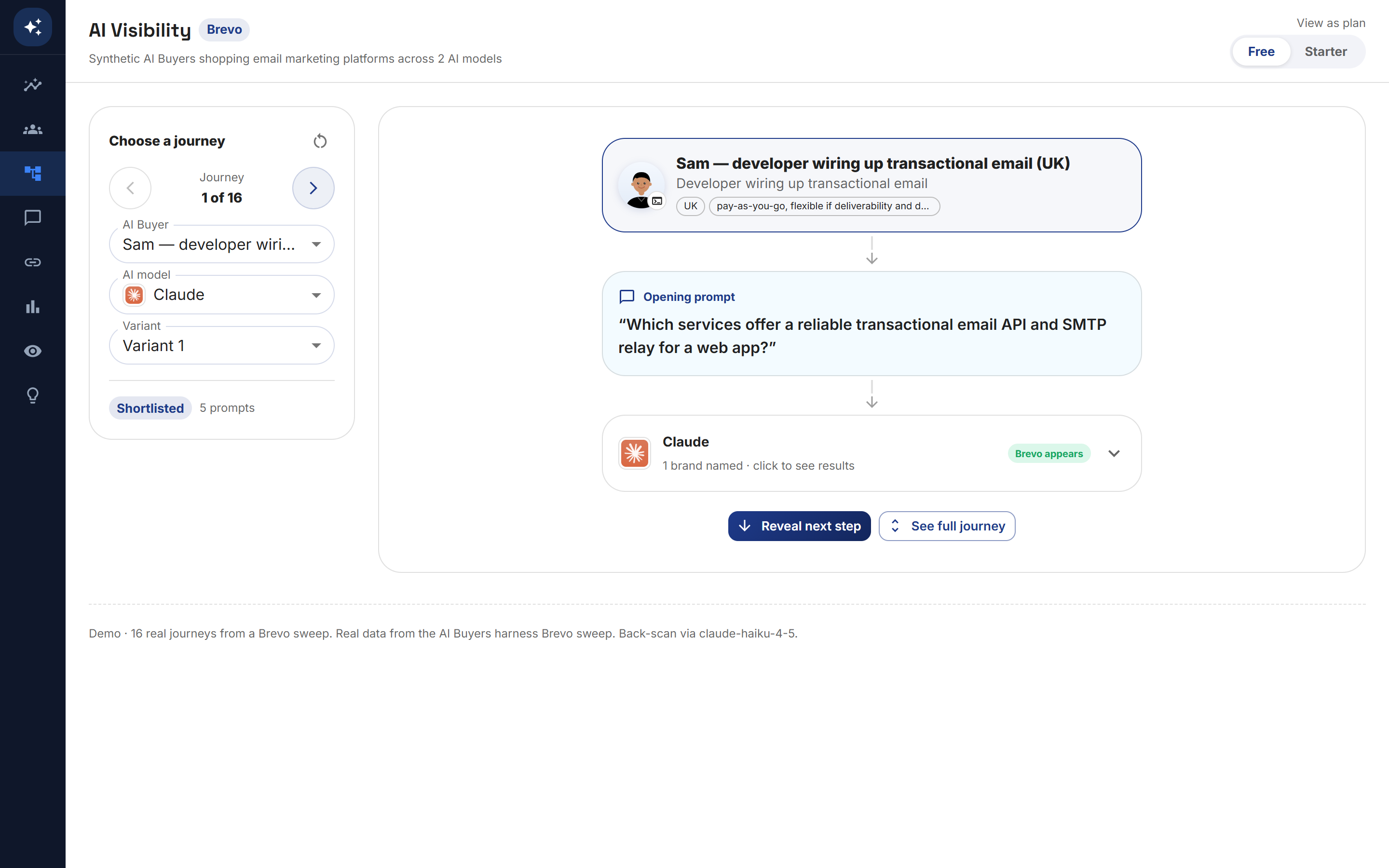
The screenshot above shows the journey with Claude selected, because that's the model this particular view has open, not Gemini; the workspace lets you switch the "AI model" dropdown to see any of the five. Read straight off that same dashboard, the outcomes across the five assistants on this one journey were: Claude "Shortlisted you", Gemini "Recommended you", Grok "Didn't name you", and Perplexity "Picked a rival". Gemini was the clean win in a set of otherwise mixed results, on the same question, the same week, for the same brand.
That spread, one assistant recommending outright while another on the same journey picks a rival, is the reason it's worth checking Gemini on its own rather than assuming every AI assistant reads a buyer's question the same way. We tracked this buyer's win rate, read straight off that same dashboard, at 32% across all five models, against a 100% appearance rate. Named in every journey, actually recommended in less than a third of them. That gap between showing up and winning is the thing AI search visibility is built to measure; Gemini here is just the assistant the gap closed on.
What to do if Gemini keeps skipping you
Start by working out which Gemini you mean, per the distinction above. If it's the AI Overview on a Google search, check whether one appears at all for the query you care about: Google doesn't show one on every search, and an honest "no AI Overview was shown" is a different problem to being shown one that names a rival. If it's the chatbot, ask it the actual question a buyer would type, watch for the moment it says it's searching, and check whether the reply carries inline source links; that only happens on a grounded answer.
If a grounded answer skips you, work through the usual checks: confirm you aren't blocking the relevant token in your robots.txt (Google-Extended for the Gemini apps, Googlebot for AI Overviews, per the split above), confirm the fact you want quoted sits in plain text rather than a script-rendered widget, and confirm the page is recent enough to look current. Because grounding can fire more than one search query per turn, it's also worth asking the same underlying question two or three different ways yourself; if you show up for some phrasings and not others, that's a coverage gap on your site, not a Gemini quirk.
If Gemini names a rival with a reason attached, "cheaper", "better documented", "more integrations", that reason is more useful than the fact of losing. A named objection tells you what to go fix. A brand that simply never comes up tells you less on its own, which is why testing a spread of real buyer phrasing matters more than checking a single query once.
Where Gemini fits in a wider AI visibility check
Gemini is one of seven AI assistants Babel42's AI Visibility product tracks: ChatGPT, Claude, Perplexity, Gemini and Grok are shopped as full multi-turn buyer journeys through to a decision, while Google's AI Overviews and AI Mode are checked once per question for appearance and citation, which is also why they're worth watching as a separate row rather than folded into "Gemini". Watching Gemini alone tells you whether Google's grounding currently favours you. Watching it next to the other six, on the same question, in the same week, is what tells you whether a gap is Gemini-specific or a wider problem every assistant agrees on.
The free plan runs one AI Buyer across any two of those seven assistants on a weekly cadence, and Gemini can be one of your two from day one. The seven assistants side by side covers how each one differs. If ChatGPT or Perplexity is the assistant you're more worried about instead, how to rank on ChatGPT and how to rank on Perplexity cover the same question for those two. For the fuller, evidence-ranked list of what drives citations across every assistant, AI search visibility factors is the place to go next, and for what our own data shows about how differently Gemini, AI Overviews and AI Mode each read the web, see how Google AI Mode works.