Someone on your team read about generative engine optimisation, agreed it's worth doing, and then asked the obvious next question: fine, but what do we actually do, in what order, starting Monday? That's a different question from "what is GEO" or "why does it differ from SEO", and most of what's written about it answers those two instead. This is the practical answer: a start-to-cadence sequence for a team that hasn't done any of this yet, pulling together the crawlability, measurement and content pieces into one ordered checklist rather than five separate ideas to juggle at once.
Where do you start with generative engine optimization?
Start with crawlability, before anything about content or measurement. It's the only step on this list that's a binary gate rather than a matter of degree: if an AI crawler can't reach your pages, nothing else you do this month will register, no matter how good the content is. Everything after that builds in roughly the order it pays off, not the order that feels most urgent.
Step 1: confirm AI crawlers can reach you
This is a ten-minute check, and it's worth doing before anything else because it's the cheapest way to rule out the most basic failure mode. Open your robots.txt and confirm you're not accidentally blocking GPTBot, ClaudeBot, PerplexityBot, Google-Extended or Bingbot, the crawlers behind ChatGPT, Claude, Perplexity, Gemini's grounded answers and Copilot respectively. The full list, with what each one is for, is worth keeping to hand, because the names change more often than the advice does. Plenty of sites block these by accident, usually because a boilerplate robots.txt predates the crawlers existing. Then check that the two or three pages you'd most want quoted, pricing, what you do, key differentiators, state their facts in plain text a bot can parse, not behind a form or rendered client-side in a way a crawler can't read.
We've written the full version of this check, including what an llms.txt file is and why it helps, in how AI crawlers find and cite your brand. For this first step you don't need the whole explanation, just the pass: confirm nothing's blocked, confirm the key facts are readable, move on. Our free audit does exactly that pass for you, including the part robots.txt cannot tell you: whether bot protection is turning AI crawlers away before they ever reach it.
Step 2: get a real baseline before you change anything
It's tempting to jump straight to rewriting content, but you can't tell whether a rewrite worked if you don't know where you started. Before touching a single page, run a bounded round of measurement: write down ten to fifteen questions a real buyer in your category would ask an AI assistant, phrased the way buyers talk rather than how your product team talks, and run them across two or three assistants (ChatGPT, Claude and Perplexity draw on different retrieval behaviour, so one alone isn't representative). For each answer, note whether you appeared at all, what share of the mentions were yours against named competitors, and whether you were the pick or just on the list.
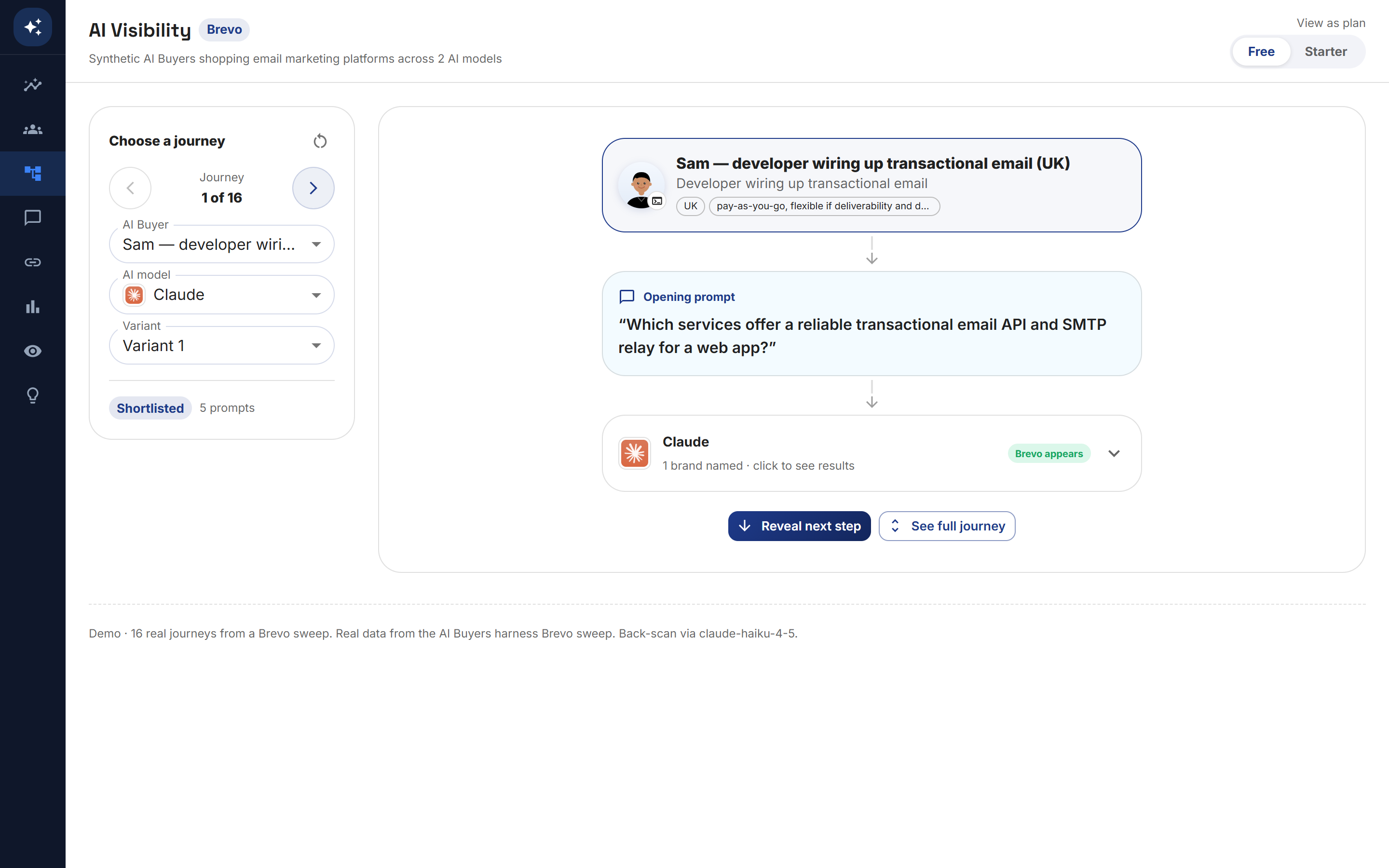
The screenshot above shows what a single tracked journey looks like in practice: a synthetic buyer persona opens with a real question, "which services offer a reliable transactional email API and SMTP relay for a web app", and the result records which brand the model actually named. Running a handful of these by hand, on paper, gets you the same kind of baseline. We've written the fuller versions of this as a bounded audit if you want the couple-of-hours framework, and the ongoing measurement method once you're ready to keep it running rather than run it once.
Step 3: rewrite the vaguest sentence on your three highest-intent pages
With a baseline and a clean crawl in hand, start on content, and start narrow: your pricing page, your "what we do" page, and whichever comparison or features page a buyer would read right before deciding. On each, find the sentence most likely to get lifted into an AI answer, and check whether it's a specific, quotable fact or a vague adjective. "Generous limits on our free tier" gives a model nothing concrete to repeat. "500 mentions a month, 2 monitors, 1 channel, 5 networks, 90-day history, no card required", which is what Babel42's own free plan page states, is something a model can lift whole. That's the pattern to apply to your own three pages: find the vague sentence, replace it with the actual number.
Don't try to rewrite the whole site in week one. Three pages, done properly, beats twenty pages half-fixed, and it's also the fastest way to see whether the exercise is working before you invest more time in it.
Step 4: chase citable third-party mentions before more backlinks
Once your own pages are stating facts plainly, the next lever is outside your control: what independent sites say about you. This is the one place where the evidence is stronger than a working theory rather than our own observation. Ahrefs' analysis of roughly 75,000 brands found that branded web mentions, how consistently your name shows up as a named entity across sites you don't own, correlated with AI visibility at 0.66 to 0.71, against just 0.22 to 0.27 for backlinks (Ahrefs, "Top Brand Visibility Factors in ChatGPT, AI Mode, and AI Overviews"). Practically, that means spending time on getting your name mentioned accurately on sites your buyers already read, comparison articles, review sites, trade press, matters more than chasing another link. Pick two or three publications or newsletters that already cover your category and pitch them a fact they can quote directly, not just a link back to you.
Step 5: put it on a repeating cadence, not a one-off list
A single round of fixes tells you whether today's problems are solved. It says nothing about next month's, because model behaviour shifts as providers update training data and retrieval, sometimes within weeks and without an announcement. Re-run the same buyer-question set from step 2 on a fixed schedule, weekly is a sensible default, and log each run rather than overwriting the last one, so a dip or a rise shows up as a trend instead of a surprise. We've written more about building this into a standing habit rather than a project with an end date in our AI search visibility playbook.
A realistic first month
Roughly how this sequence lands on a calendar, for a team starting from nothing:
- Week 1: the ten-minute crawlability check, plus the baseline question set, run once across two or three assistants.
- Weeks 2 to 3: rewrite the vaguest sentence on your three highest-intent pages, and pitch two or three publications with a quotable fact.
- Week 4: re-run the exact same question set from week 1 and compare. Don't reword the questions, or you're comparing noise to noise.
- After that: keep the weekly cadence going, and treat any newly-appearing objection in the answers as the next content brief, the same way step 3 treated the first one.
Where the manual version starts to strain
Everything above works by hand, and month one is fine that way. It gets old at scale: a dozen questions across three or four models, every week, indefinitely, is a lot of repetitive checking to keep doing accurately. That's the practical case for Babel42's AI Visibility product: it runs structured AI Buyer personas through multi-turn shopping journeys across ChatGPT, Claude, Perplexity, Gemini and Grok, probes Google's AI Overviews and AI Mode for appearance and citation, and turns appearance rate, share of AI voice and sentiment into a tracked trend instead of a spreadsheet you rebuild from scratch each week. The free plan runs one AI Buyer across any two of those seven assistants weekly, which is enough to run the step 2 baseline and the step 5 cadence above without spending anything; paid plans add more buyers, more assistants and a faster cadence as you need it.
The short version
Start with the ten-minute crawlability check, because it's the one binary gate. Get a real baseline before changing anything, so you can tell whether later work is doing anything. Rewrite the vaguest sentence on your three most important pages before touching the rest of the site. Chase citable third-party mentions, which the evidence says matters more than backlinks. Then put the whole thing on a weekly cadence, because a one-off round tells you about today and nothing about next month.
Start with what AI search visibility measures if you haven't yet, or see how Babel42 runs the baseline and the cadence for you. The audit and the tracking sit side by side on our GEO tools page.