Type "what is GEO" into an AI assistant and you'll get three different answers depending on which one you ask: a marketing agency's pitch, a vague gesture at "SEO for AI", or, occasionally, something closer to the actual, original definition. That spread is a sign the term has been repurposed faster than it's been agreed on. If you're trying to work out whether GEO is a real discipline worth budget or a rebrand of something you already do, here's the plain-English version, including where the term came from.
GEO, defined
Generative engine optimisation (GEO) is the practice of structuring content and managing your online presence so that generative AI systems, ChatGPT, Perplexity, Gemini and similar, are more likely to surface, cite and recommend it when answering a user's question. Instead of earning a ranked position on a results page, the goal is to earn a mention, a citation, or a favourable line inside an answer the AI writes itself.
That's the constant part. The confusion comes from how loosely the term gets used day to day, often interchangeably with "AI search visibility" or "AEO", when each points at a slightly different piece of the same problem.
Where the term came from
GEO isn't a marketing coinage. It comes from a 2023 research paper, "GEO: Generative Engine Optimization", by Pranjal Aggarwal, Vishvak Murahari, Tanmay Rajpurohit, Ashwin Kalyan, Karthik Narasimhan and Ameet Deshpande, first posted to arXiv that November. The paper's framing is worth knowing because it's more precise than most of what's been built on top of it since: the authors formalised "Generative Engines" as a new category of search system that gathers and synthesises information into a written response, distinct from a traditional engine that returns a ranked list of links. GEO, in their original sense, is a black-box optimisation method for making content more likely to be surfaced and cited by those systems, and their experiments found specific content changes could lift visibility in generative engine responses by as much as 40%.
Two things about that origin are easy to miss once a term goes mainstream. First, it predates ChatGPT's mainstream adoption of live web search by some margin, the researchers were describing a shift they saw coming, not one that had already fully arrived. Second, the original paper is about optimising content itself, phrasing, structure, the kind of evidence you include, not about link-building or the site-wide technical work classic SEO involves. That distinction is where most of the practical difference between GEO and SEO still lives today.
GEO, AEO and SEO aren't the same job
We've written a full comparison of GEO vs SEO in practice, and a separate piece on what AEO means, so we won't repeat either in full here. The ranked list of what earns an answer sits alongside both. The short version, to place GEO among its neighbours:
- SEO earns you a ranked position among a list of links. The user does the choosing.
- AEO, in its original and narrower sense, earns your content the single direct-answer slot for a literal question, a featured snippet, a "People Also Ask" entry. One fact, one winner.
- GEO is the broadest of the three: being named, described and recommended inside a generated, often multi-sentence answer, sometimes several turns into a conversation, not just a single factual lookup.
In practice, a lot of what gets called "GEO strategy" online is really a blend of all three: technical crawlability (closer to SEO), clean factual statements (closer to AEO), and the harder, less mechanical work of being a source a model trusts enough to draw a favourable characterisation from (the part that's genuinely new). Anyone selling you "GEO" as a single checklist is usually selling you the easy third of it.
Why the distinction is more than semantics
The reason it's worth getting right, rather than shrugging and treating GEO as SEO with new keywords, is that the underlying mechanism is different enough to change what you should do.
Classic SEO ranking rewards backlinks, domain authority and comprehensive on-page content, because a crawler and a ranking algorithm are reading it. A generative engine isn't ranking your page against a fixed set of competitors for a fixed query; it's trying to synthesise an answer to whatever the person asked, which might combine three of your competitors' pages and one independent review in a single response. Being long and comprehensive helps less than being the specific source that answers the specific sub-question the model is trying to resolve at that moment. We've gone into the mechanics of that retrieval step separately in how AI crawlers find and cite your brand: getting crawled is necessary but nowhere near sufficient, being cited is the actual bar.
It also means the feedback loop looks nothing like SEO's. There's no dashboard inside ChatGPT showing you your "position". The only way to know whether GEO effort is working is to ask the questions your buyers ask, repeatedly, across the assistants they use, and watch what comes back. That's a live measurement problem, not a one-off audit.
What seems to help
Based on the original research and on what we've observed watching real AI-generated answers through our own product, a few things hold up consistently:
- State facts plainly enough to be lifted whole. "Free plan: 500 mentions a month, 2 monitors, 5 networks" is quotable. "Generous limits" isn't, and a model faced with a vague claim next to a competitor's specific one will usually quote the specific one.
- Answer the follow-up question, not just the opening one. Real buying conversations run several turns deep; a page that only answers the first, broadest question in a shortlist loses the deal two turns later, to whichever competitor answered the narrower follow-up.
- Be readable without extra steps. Content gated behind a form, buried in a PDF, or rendered in a way a crawler can't parse is invisible to this whole pipeline, however well it's written. Our free audit tells you which of your pages are in that state, including the ones that look fine in a browser and arrive empty to a crawler.
- Don't assume your own site is the whole battle. Independent sources, review sites, comparison articles, forum threads, get cited constantly in generated answers, sometimes more than brand-owned pages. The original GEO research and what we see in practice both point the same way: being mentioned favourably off-site matters as much as your own copy; what actually earns you a citation covers that in more detail. It matters more as consumers get more sceptical of AI answers generally, not less; see why trust in AI search is falling even as usage rises.
None of this is exotic. It's closer to writing clearly and specifically than to any kind of technical trick, which is probably why it gets rebranded and oversold so often: the actual advice is less glamorous than the acronym.
Seeing it play out in a real journey
Below is Babel42's AI Visibility dashboard, tracking the gap GEO research describes: a brand can appear in an AI-generated answer without holding a meaningful share of the citations backing it up.
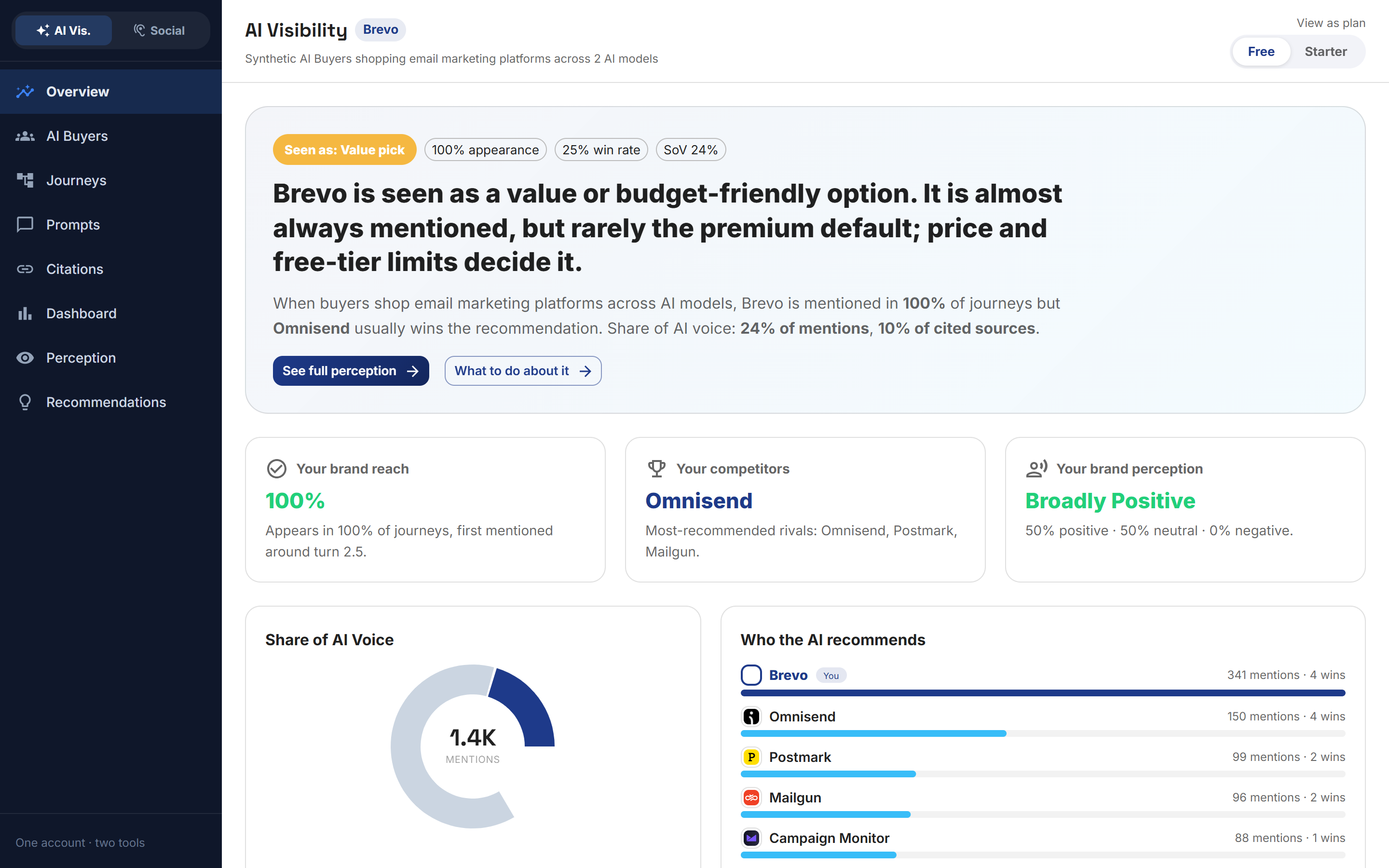
Watching that gap over time, rather than checking it once, is the actual discipline GEO describes: not a one-off content audit, but a running measurement of whether your specific claims are the ones a model chooses to repeat.
Where GEO fits if you're already measuring this
If you're tracking AI search visibility, you don't need a separate "GEO programme" bolted on top, it's the same underlying work, described by a research term rather than a marketing one. Babel42's AI Visibility product runs structured AI Buyer journeys across ChatGPT, Perplexity, Claude, Gemini and Grok, probes Google's AI Overviews and AI Mode alongside them, and tracks appearance rate, share of voice and citation share as they happen, which is the practical, ongoing version of what the original GEO paper was measuring in a lab setting. The free plan runs one AI Buyer across any two of those seven on a weekly cadence, enough to see whether your plainest claims are getting picked up. If you'd rather work from a checklist than a running dashboard first, running a full AI search visibility audit turns the same factors into a one-off scorecard. The audit and the tracking sit side by side on our GEO tools page.
The short version
GEO is a specific term from a specific 2023 research paper, not an industry rebrand of SEO, and its original definition, optimising content so generative engines are more likely to surface and cite it, is narrower and more useful than the buzzword it's become. The practical work looks less like classic SEO and more like disciplined, specific, quotable writing, checked repeatedly against what AI assistants say, not assumed from a one-off audit.
See how Babel42 tracks appearance rate, citations and share of AI voice, read GEO vs SEO: what changes or AEO vs GEO: what's different for the practical comparisons, how to implement GEO, step by step if you're past the definition and want the sequence to follow, or what LLM SEO means if that's the term you actually heard first.