A planning doc lands with a line item for "AEO" and another for "GEO", as if they're two separate workstreams needing two separate budgets. Nobody on the call is quite sure why they're split, and nobody wants to be the one who asks. We've written about what AEO means and what GEO means on their own terms already, so this isn't another pair of definitions. It's the comparison: what genuinely separates them, whether that separation is worth two line items, and which one to prioritise if you can only start with one.
Is there a difference between AEO and GEO?
Yes, but it's narrower than the two acronyms suggest. Answer engine optimisation, in its working definition, is about winning the single direct-answer slot for a literal question: a featured snippet, a "People Also Ask" entry, the one sentence a voice assistant reads back. Generative engine optimisation is about being named, described and recommended inside a full, multi-sentence answer an AI assistant writes for one person, often several turns into a conversation. Both are about being the thing a machine chooses to say. They differ in how big that "thing" is: one fact versus one paragraph of synthesis.
That's a real distinction, but it's a distinction of degree, not of method. The skill underneath both, stating a claim plainly enough that a machine can lift it with confidence, is identical. Some agencies have started arguing publicly that AEO and GEO are effectively the same discipline wearing two names, and it's hard to disagree once you strip the marketing framing off both. The honest answer to "which one do we need" is usually "the same work, described at two different resolutions."
Where the line still matters
The place the distinction earns its keep is scoping a specific piece of content, not scoping a team.
A pricing FAQ answering "does this plan include SSO" is a single-fact question with a single correct answer. Write it as a heading that states the question verbatim, followed by a direct yes-or-no and the detail. This is classic AEO, and it's mechanical enough to checklist: FAQ schema, one question per heading, the answer in the first sentence underneath.
A buyer asking an AI assistant "should a 40-person marketing team use this or a competitor, and what would we be giving up" isn't asking for a fact. They're asking for a synthesis across your pricing, a competitor's pricing, and whatever independent reviews the model has read. There's no schema markup for that. The model is composing a paragraph, not retrieving a snippet, and what earns you a favourable mention is the same plain, specific, quotable writing, just applied to a harder, multi-part question with no single correct answer to optimise for.
Most B2B buying questions live at the second end of that spectrum. We watched this directly across 59 real AI buying journeys: buyers rarely stop at one factual question. They state a constraint, get a shortlist, add a second constraint, and the shortlist changes again. This is GEO territory even when the opening question looked like AEO.
A side-by-side comparison
| AEO | GEO | |
|---|---|---|
| What you're optimising for | One direct-answer slot for a literal question | A full, synthesised answer, often multi-turn |
| Unit of content rewarded | A single, cleanly stated fact | A specific, quotable claim inside a longer narrative |
| Where it shows up | Featured snippets, "People Also Ask", voice answers | ChatGPT, Perplexity, Claude, Gemini conversational answers |
| Technical lever | FAQ schema, literal question-as-heading | Crawlability, off-site mentions, consistent factual claims |
| How you check it's working | Rank tracking still applies in part | No dashboard exists; you have to run the actual conversation and log what comes back |
The last row is the one worth sitting with. Classic AEO still has a rank-tracking cousin, because a featured snippet is a fixed, checkable thing. GEO doesn't: two identical questions asked an hour apart can name different brands, because the answer is regenerated fresh each time rather than pulled from a stored ranking. That's the real operational gap, more than the definitional one.
Which one should a B2B team invest in first?
Start with AEO's checklist items, because they're cheap and finite. Audit your highest-intent pages, pricing, integrations, compliance, security, and confirm every likely single-fact question has a heading that states it verbatim followed by a direct answer in the first sentence. Add FAQ schema where your CMS supports it. It's a week of work, not a quarter, and it picks up the easy wins: the buyer asking "does this handle IR35 compliance" gets a clean, liftable answer.
Then move to GEO, because it's the larger and more open-ended half of the same problem. Read your pricing and comparison pages as if you were the model trying to lift one clean, trustworthy fact to answer a follow-up question you didn't write for. Check whether independent sources, review sites, comparison articles, forum threads, say something a model could plausibly cite alongside your own copy. This part doesn't finish. It's a running discipline, not a one-off audit, because the questions buyers ask keep changing and so do the answers models give.
The order matters because AEO's checklist, done first, makes the GEO work easier: a page that already states its facts plainly for the single-question case gives a model more to work with when it's assembling a longer, comparison-shaped answer. Doing GEO's harder, ongoing work without the AEO groundwork first tends to mean rewriting the same pages twice.
Seeing both play out in one answer
Below is a real journey from Babel42's AI Visibility product. The opening prompt is close to a single-fact question; by the second turn, the buyer has added a constraint that turns it into the comparison-shaped question GEO is built for.
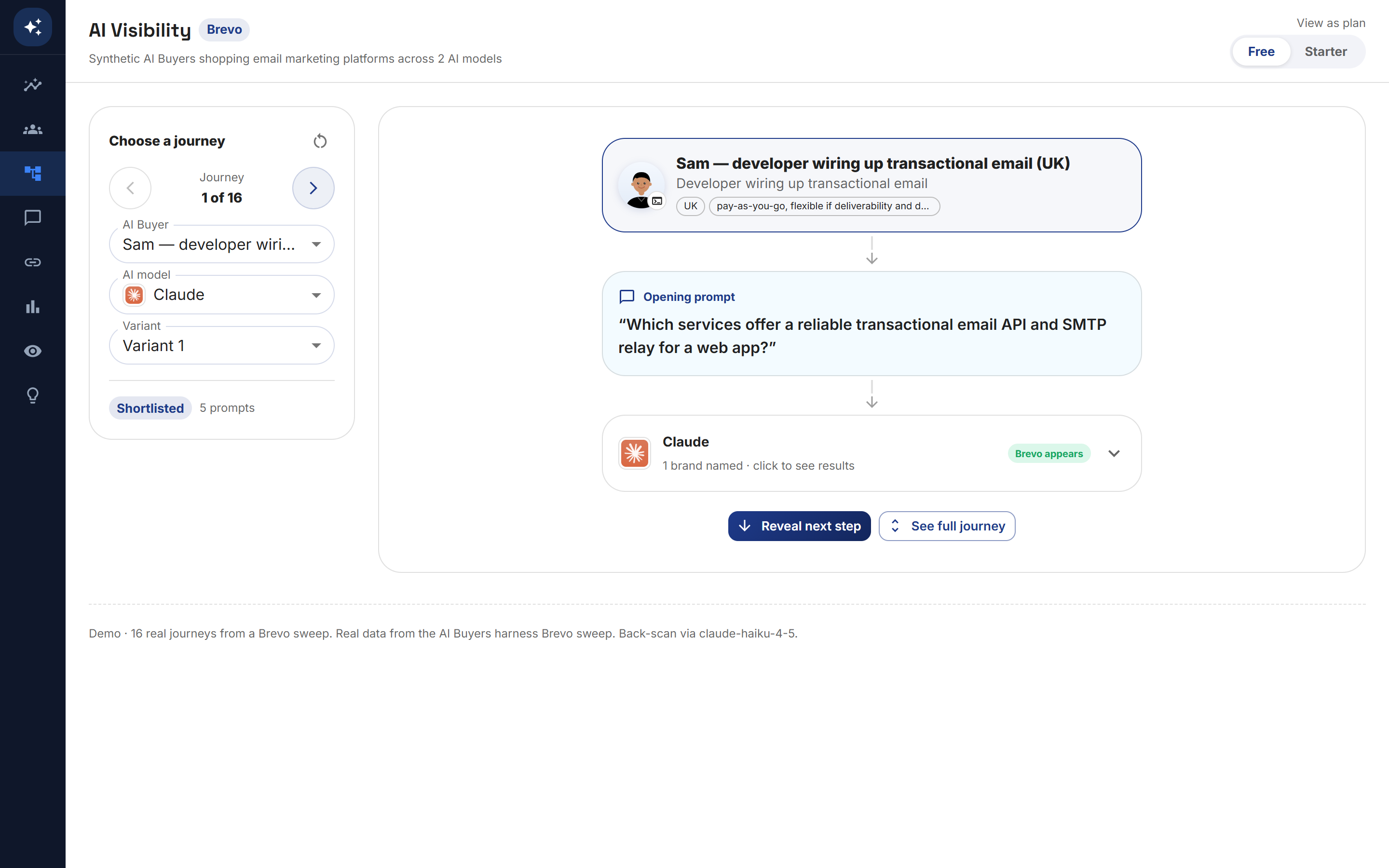
The same underlying signal, whether the model names a brand at all and how it describes it, applies to both the opening single-fact question and the follow-up. That's the practical argument for measuring them together rather than running two separate audits.
Do you need two separate tools or teams for this?
No. Splitting AEO and GEO into two workstreams with two owners mostly just duplicates the research and measurement work, since both draw on the same source material and the same underlying skill. A single small team, or even one person, can run both from the same checklist: state facts plainly, answer the likely follow-up, keep independent sources accurate, and check repeatedly what AI assistants actually say back. The technical half of that checklist is free to run: our free AI SEO audit confirms assistants can reach and read your pages, which both disciplines depend on.
Babel42's AI Visibility product runs structured AI Buyer journeys across ChatGPT, Claude, Perplexity, Gemini and Grok, and tracks appearance rate, share of AI voice, recommendation rate and sentiment for both the single-fact opening question and the multi-turn comparison that usually follows it. You don't need a separate AEO scorecard and a separate GEO scorecard: it's the same conversation, measured end to end. The free plan runs one AI Buyer across any two of the seven assistants it covers on a weekly cadence, enough to see whether your plainest facts are getting picked up before you invest further.
The short version
AEO and GEO differ by scope, not by method: one wins a single direct-answer slot, the other wins a mention inside a longer, synthesised answer, and the underlying skill for both is stating a claim plainly enough for a machine to lift it with confidence. Start with AEO's cheap, finite checklist on your highest-intent pages, then treat GEO as the ongoing discipline it actually is. If you're deciding how to staff this, one team running one checklist against both is enough; the two-line-item budget was never really necessary.