A tool vendor's landing page promises to fix your "LLM SEO". Your own team's roadmap has a line item for "GEO". A consultant on a discovery call keeps saying "AEO", which we keep a standing reference for. Three conversations, three acronyms, and nobody in the room is sure whether that's three separate problems or one problem wearing three costumes. It's the latter. Here's the plain-English version of what LLM SEO means, how it relates to GEO and AEO, and why the same work keeps getting renamed.
What is LLM SEO?
LLM SEO (large language model SEO, also written LLMO) is the practice of structuring content and managing your online presence so that a large language model, ChatGPT, Claude, Gemini and the rest, is more likely to name, cite or recommend your brand when it answers a question. That's the whole definition. Notice it doesn't mention ranking, keywords or backlinks as the goal, only as possible levers toward it. The target is a mention inside an answer the model composes itself, not a blue link on a results page.
If that sounds identical to what we've already written about GEO, that's because it is. LLM SEO isn't a distinct technique with its own playbook. It's the same discipline, described from a different starting point: GEO came out of a research paper studying "generative engines" as a category of system; LLM SEO comes from search practitioners who anchored the term to the technology underneath, the large language model itself, rather than to the shape of the system built on top of it. Different vocabulary, same target.
What is large language model optimisation (LLMO)?
LLMO, large language model optimisation, is the same practice as LLM SEO under a longer name. The two are used interchangeably, and you will see the pair written as "LLMO SEO" or "large language model optimisation (LLMO) SEO" by writers who are not sure which half their reader will recognise. There is no technical distinction between them to learn.
The longer form is worth knowing for one reason: it is the version that tends to appear in job adverts, agency service pages and internal roadmaps, because it reads as a discipline rather than an abbreviation. If a brief lands on your desk asking for an LLMO strategy, it is asking for the work described on this page, and the answer is the same whichever of the two labels the brief used.
Why does one job have four names?
Because each term arrived from a different corner of the industry, at a different time, and nobody agreed to standardise afterwards. SEO is the oldest, decades old, aimed at ranking on a results page. AEO started life even before generative AI existed, describing the older, narrower job of winning a featured snippet or a voice assistant's spoken answer, then got repurposed once chatbots arrived because the goal, "be the answer, not a link in a list," looked similar enough to reuse the acronym; we've covered that history in full in what AEO means. GEO has the most precise origin of the four: it comes from a named 2023 research paper, "GEO: Generative Engine Optimization", which we go through in detail in what GEO means.
LLM SEO is the newest and the least centrally coined of the set. As best we can tell from how the term is used across SEO blogs, agency sites and tool vendors, it emerged organically over the past couple of years as SEO practitioners, people whose whole professional vocabulary was built around "SEO", needed a label for the same shift GEO was describing, and reached for a word their audience already understood rather than adopting the newer academic term. That's our reading of the pattern, not a documented origin story the way GEO's is; take it as informed observation, not fact.
The practical result is a vocabulary problem more than a strategy problem. Whichever term a given person on your team, or a given vendor, or a given article uses usually tells you more about who they are, SEO-background practitioner, academic-adjacent researcher, or B2B marketer, than about a different piece of work.
LLMO vs SEO: what changes and what does not?
The difference is what you are competing for. SEO competes for a position in a list of links that the reader then chooses from. Under LLMO you compete to be the name inside an answer the reader is simply handed. In the first case a person sees ten options and picks one. In the second, a model has already picked, and the reader may never learn what the other nine were.
Three things follow from that, and they are the whole of the practical difference.
There is no position to track. A ranking exists because a search engine stores an ordered list and serves it. A model composes a fresh answer each time, so there is nothing stored to hold a position in. Ask the same question twice and you can get two different sets of brands. That is why LLMO measurement is a rate across repeated questions rather than a number on a given day, and why a single check of what an assistant said about you proves very little.
The unit that competes is the section, not the page. Classic SEO rewards a page that covers a topic thoroughly, because the whole page is the thing being ranked. A model pulls one passage into an answer it is composing, so a long page full of good material can lose to a short one that states the same fact in a form that can be lifted whole. A section that only makes sense after the three above it is a section that cannot travel.
Links matter differently. Backlinks remain one of the strongest signals in classic ranking. In an AI answer, the equivalent currency is being quotable and being cited, and the citation often goes to whoever stated the fact most plainly rather than to whoever has the strongest domain. That is the one place where a smaller site has an opening it does not have in classic search.
What does not change is everything underneath. The page still has to be reachable, still has to load, still has to say something true. Nobody serious treats this as a replacement for SEO, which is the main thing to take from anyone selling the two as alternatives.
LLM SEO, GEO, AEO and SEO side by side
| SEO | AEO | GEO | LLM SEO / LLMO | |
|---|---|---|---|---|
| Goal | A ranked position among links | The single direct-answer slot for a literal question | Being named and described inside a full, synthesised answer | Same as GEO, named for the underlying technology |
| Typical origin | Search-engine ranking, since the 1990s | Featured snippets and voice assistants, pre-dates chatbots | A named 2023 research paper on generative engines | Organic reuse of "SEO" by search practitioners, no single coining |
| Who tends to say it | Classic SEO teams | Snippet- and schema-focused specialists | Researchers, and marketers who picked up the academic term | SEO agencies and tooling vendors |
| What you do | Backlinks, on-page content, technical crawl health | FAQ schema, literal question-as-heading, one-sentence answers | Plain, quotable claims a model can lift into a longer answer | Identical to GEO's practical work |
The first three columns describe different jobs, at least at the edges: SEO and AEO both have something like a rank-tracking equivalent, a snippet either is or isn't yours. GEO and LLM SEO don't. There's no dashboard inside ChatGPT showing your "position", because the model composes a fresh answer each time rather than pulling from a stored ranking. That's the real dividing line in this table, GEO versus AEO versus SEO, not LLM SEO versus GEO, which is a naming choice rather than a methodological one.
Is LLM SEO the same as using an LLM for SEO?
No, and the two get searched for in nearly the same words. Optimising so that a model recommends your brand is one job. Using a model as a tool to do your search work is a different one. The phrases "LLM SEO", "LLM for SEO" and "SEO LLM" are close enough that people land on the wrong article regularly, so it is worth separating them.
Using a model as a tool covers the things you would expect: drafting and rewriting, clustering a keyword list, summarising a competitor's page, generating the first pass of a schema block, checking whether a section actually answers the question its heading asks. That is a productivity question, and the honest answer is that it works well for the mechanical parts and badly for anything that requires knowing something the model cannot check.
The two do meet at one point. Text drafted by a model and published unedited tends to be general, hedged and free of specifics, and specifics are exactly what makes a section quotable. So using a model carelessly to produce content can make you harder for a model to cite, which is the only real overlap between the two meanings and an uncomfortable one.
Does it matter which term you use?
Not for the work itself, no, but it matters for one practical reason: when you're evaluating a tool or a vendor, "LLM SEO" gets used loosely enough that it can mean either of two quite different products. Some tools marketed under that label are, in our experience browsing this space, closer to rank trackers: they check whether your brand's name shows up somewhere in an AI-generated answer and report a percentage. That's a real, useful signal, but it stops at appearance. It doesn't tell you whether the model recommended you over a competitor, or whether you turned up as the winner, a runner-up, or the option a buyer's follow-up question ruled out. Appearing and winning are different outcomes, and a tool's own name won't tell you which one it measures. Read the metric it reports before assuming "LLM SEO tracking" and "AI recommendation tracking" are the same purchase.
That gap, named versus recommended, is the one worth checking for yourself before picking a term or a tool. Below is a real workspace from Babel42's AI Visibility product, tracking a demo brand shopping email marketing platforms across two AI models.
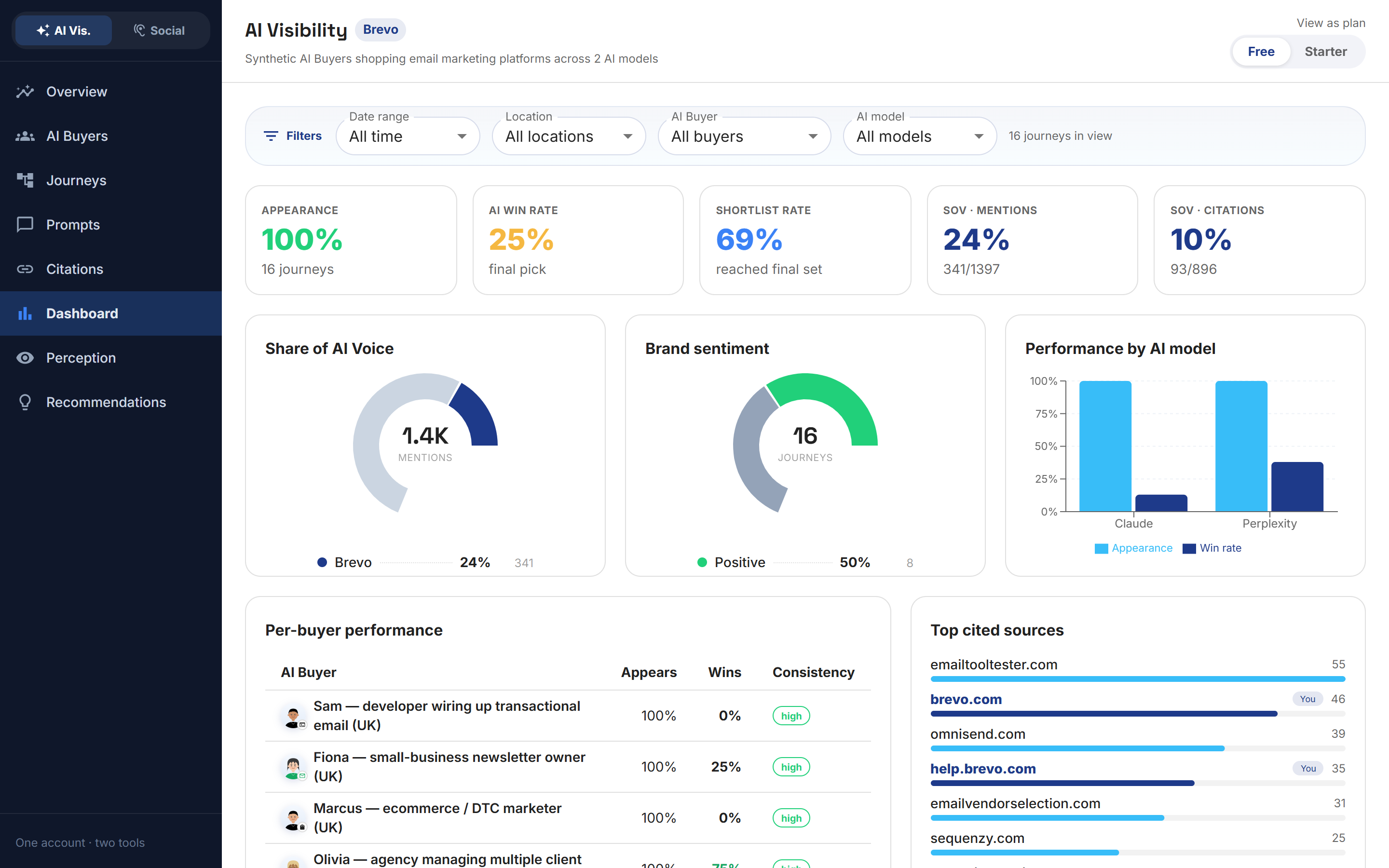
That brand shows up in every single journey, a 100% appearance rate, the number an appearance-only tracker would report as a clean win. Its actual win rate, the share of journeys where the AI Buyer picked it as the final recommendation, is 25%. Its share of citations, how much of what the model quoted came from its own site rather than a competitor's or a review site's, is 10%. Being mentioned and being chosen are two different numbers, and the gap between them is exactly the work LLM SEO, GEO and AEO all describe under different names.
What does Google say about LLM SEO?
Google's position is that there is nothing special to do for its own AI features, because they run on ordinary Search ranking. Its AI features and your website guide states that no new markup, no separate file and no reformatting for AI is required, and that the work is the same people-first content and sound technical health that ordinary Search has always rewarded. If your target is AI Overviews and AI Mode, that is the answer from the engine itself, and it is worth more than any vendor's framework.
Two things stop that being the end of the discussion.
It covers one engine. Google is describing how its own generative features pick from its own index. ChatGPT, Claude and Perplexity are separate systems with their own crawlers, their own rules about what they will fetch, and their own habits about what they quote. Nothing in a Google guide binds any of them, and the practical work of being quotable by them is not something Google has offered a view on.
It is about markup, not about writing. The guidance rules out a technical shortcut. It does not say that how plainly you state a fact makes no difference to whether a model can lift it, which is the part of this discipline that actually moves. Those are different claims, and the guide is regularly quoted as if it settled the second one.
The useful consequence is measurement rather than tactics. Search Console now reports impressions for Google's generative AI features separately from ordinary Search, which it announced in June 2026. That is first-party data on one engine, free, and most teams have never opened it. It will not tell you anything about ChatGPT or Perplexity, so it is half the picture, but it is the half you can check today without buying anything.
Where to start, whatever you call it
If you're starting from zero, the term you use to search for guidance matters less than the sequence you follow. We've written that sequence out in full in how to implement GEO: crawlability first, because it's a binary gate rather than a matter of degree, then plain factual claims a model can lift whole, then a measurement habit that checks real questions against real answers on a repeatable schedule rather than a one-off audit. What earns a citation and how to run an AI search visibility audit cover the two pieces of that sequence in more depth than fits here. Each assistant runs its own crawler under its own name and publishes its own rules for them, OpenAI's are here, so "we allow Googlebot" is not the same as being readable by the rest. The crawlability step is free to check and takes a few seconds: our free AI SEO audit requests your pages as an identified crawler and reports exactly what came back, and the wider AI SEO pillar covers what to do once it comes back clean.
Babel42's AI Visibility product runs structured AI Buyer journeys across seven AI assistants, ChatGPT, Claude, Perplexity, Gemini, Grok, and Google's AI Overviews and AI Mode, and reports appearance rate, win rate and citation share separately, so you're never stuck reading one blended number and guessing which half of it moved. The free plan runs one AI Buyer across any two of those seven on a weekly cadence, enough to see whether appearing and winning look the same for your brand, or don't.
The short version
LLM SEO, LLMO, GEO and AEO name the same discipline from four different corners of the industry, and the practical work is identical: state facts plainly enough for a model to lift them, answer the follow-up question a buyer asks, and check repeatedly what AI assistants say back rather than assuming from a one-off audit. The one thing worth checking before you commit to a term or a tool is what it's actually measuring, appearance or recommendation, because those two numbers can look very different for the same brand.
Read what GEO means or what AEO means for the deeper history of the other two terms, AEO vs GEO for how those two specifically differ in practice, or see how Babel42 separates appearance from winning for the measurement itself.