Share of voice turns up in almost every marketing report: a single percentage next to your brand name, next to a competitor's, implying a clean read on who's winning the conversation. The number itself is simple to produce. What it's built from, and what it leaves out, is where most reports stop asking questions.
This guide covers the formula, a worked example from a live Babel42 dashboard, and two things worth checking before you trust the number: how lopsided the posting behind it usually is, and how the same phrase means something different depending on whether you're counting social mentions or AI citations.
What is share of voice?
Share of voice is your brand's portion of the total conversation in a category, measured against the competitors you name. It's a relative number, not an absolute one: doubling your own mentions doesn't move your share of voice if your competitors' mentions doubled too, and a quiet month can still be a strong one if every competitor had a quieter month. The number only ever tells you how you're doing against the field you picked, over the window you picked.
That relativity is also its main limitation as a summary metric. A rising share of voice can mean you're doing better, or it can mean a competitor is doing worse, and the single percentage doesn't say which. You have to look at the mentions behind it to tell the two apart.
How do you calculate share of voice?
The formula is: your mentions, divided by the total mentions across every brand you're tracking (yours included), times 100.
According to a Babel42 category watch across five project-management tools over a 30-day window, here's what that division produces against real mention counts, 86,420 in total across the five brands:
| Brand | Mentions (30 days) | Share of voice |
|---|---|---|
| Notion | 21,260 | 24.6% |
| Asana | 19,090 | 22.1% |
| Trello | 15,730 | 18.2% |
| Monday.com | 15,560 | 18.0% |
| ClickUp | 14,780 | 17.1% |
| According to that Babel42 dashboard: Notion's 24.6% is 21,260 divided by 86,420, times 100. Nothing more complicated sits behind the number than that division, whichever tool produces it for you. |
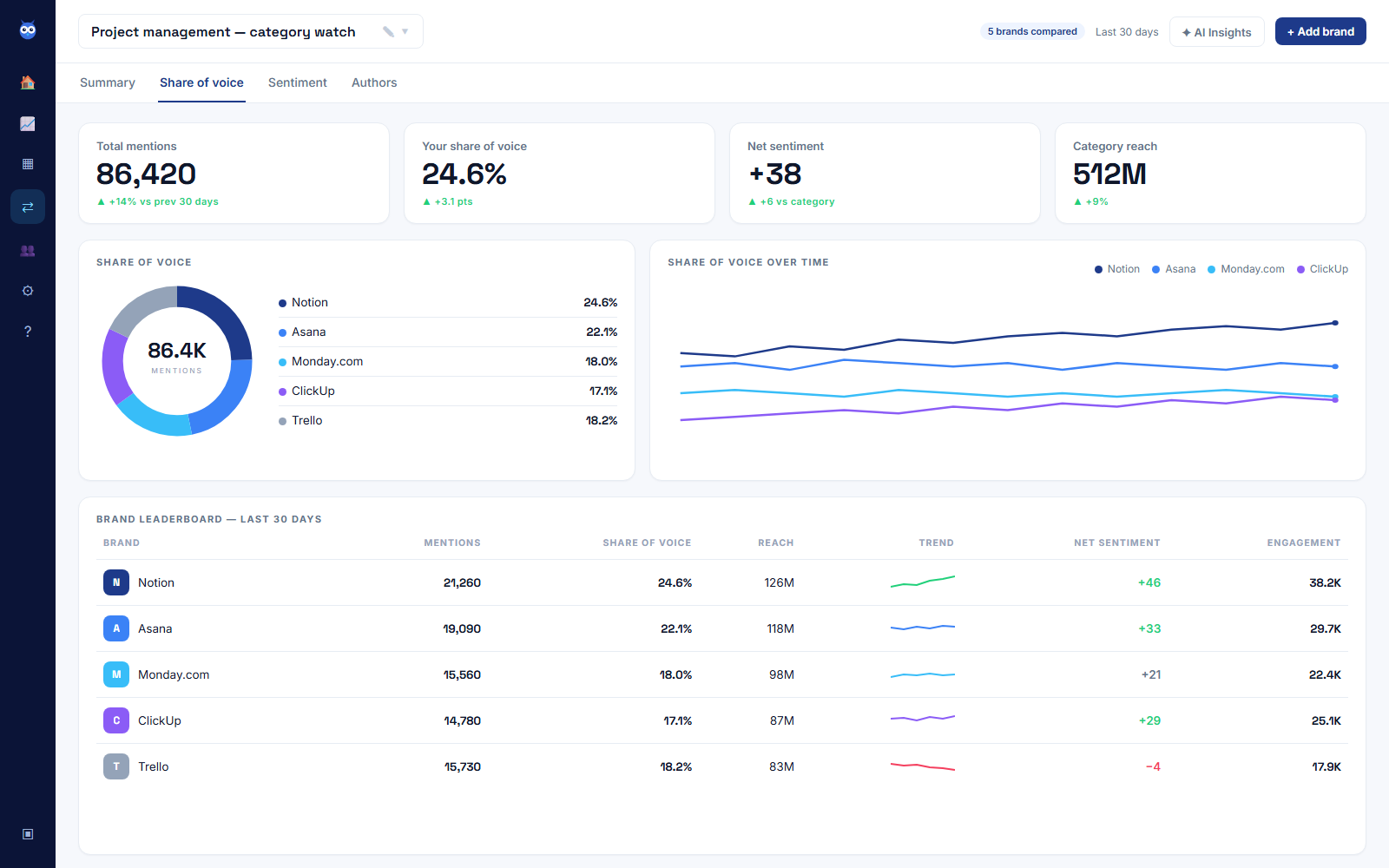
That's a demo category watch, not a live customer account, but the shape is worth learning: the donut and the leaderboard are the same 86,420 mentions, split two ways, and the trend line on the right shows the same split changing week by week. Babel42's share of voice feature works this out for any set of brands you name, across the networks you monitor, and updates it as new mentions come in.
Which competitors belong in the total?
The denominator is a choice, not a fact, and it changes the answer on its own. According to that same dashboard, Notion's share is 24.6% of 86,420 mentions; add a sixth brand to the watch and that share drops even if Notion's own mention count doesn't move a single post, because the same number is now divided by a bigger total. Drop a struggling rival from the list and everyone left standing gets a share bump they didn't earn either.
Two practical rules keep the number honest. First, name the same set of competitors every time you report the figure, and say who's in it: a reader comparing this month's share to last month's is comparing two different competitions if the list changed in between. Second, pick the set a buyer would choose between, not every company that could loosely be called a rival. A five-brand category watch like the one above answers "who's winning this specific fight"; a fifteen-brand version answers a vaguer question and makes every individual share look smaller than it feels, since the same conversation is now split more ways.
One loud account can carry a whole brand's share
A mention count treats every post as equal, and that's rarely true of who's posting. According to Pew Research Center's study of US adult Twitter users, the most active 10% of users produce 80% of all tweets posted by US adults on the platform. If your category's conversation follows anything like that pattern, one prolific account, happy or furious, can move a share of voice number on its own, independent of how the wider market feels.
That's not a reason to distrust the metric. It's a reason to check what's driving a move before you act on it. A share of voice jump worth a slide in a report is usually a lot of people saying a little; a jump worth a closer look first is often a few accounts saying a lot.
Does a mention share and a citation share measure the same thing?
No, and the gap between them is often the more useful number. "Share of voice" gets used for social mentions, but the same idea applies wherever a brand gets compared to competitors, including inside an AI assistant's answer, and counting mentions there answers a different question from counting which sources the assistant actually cited.
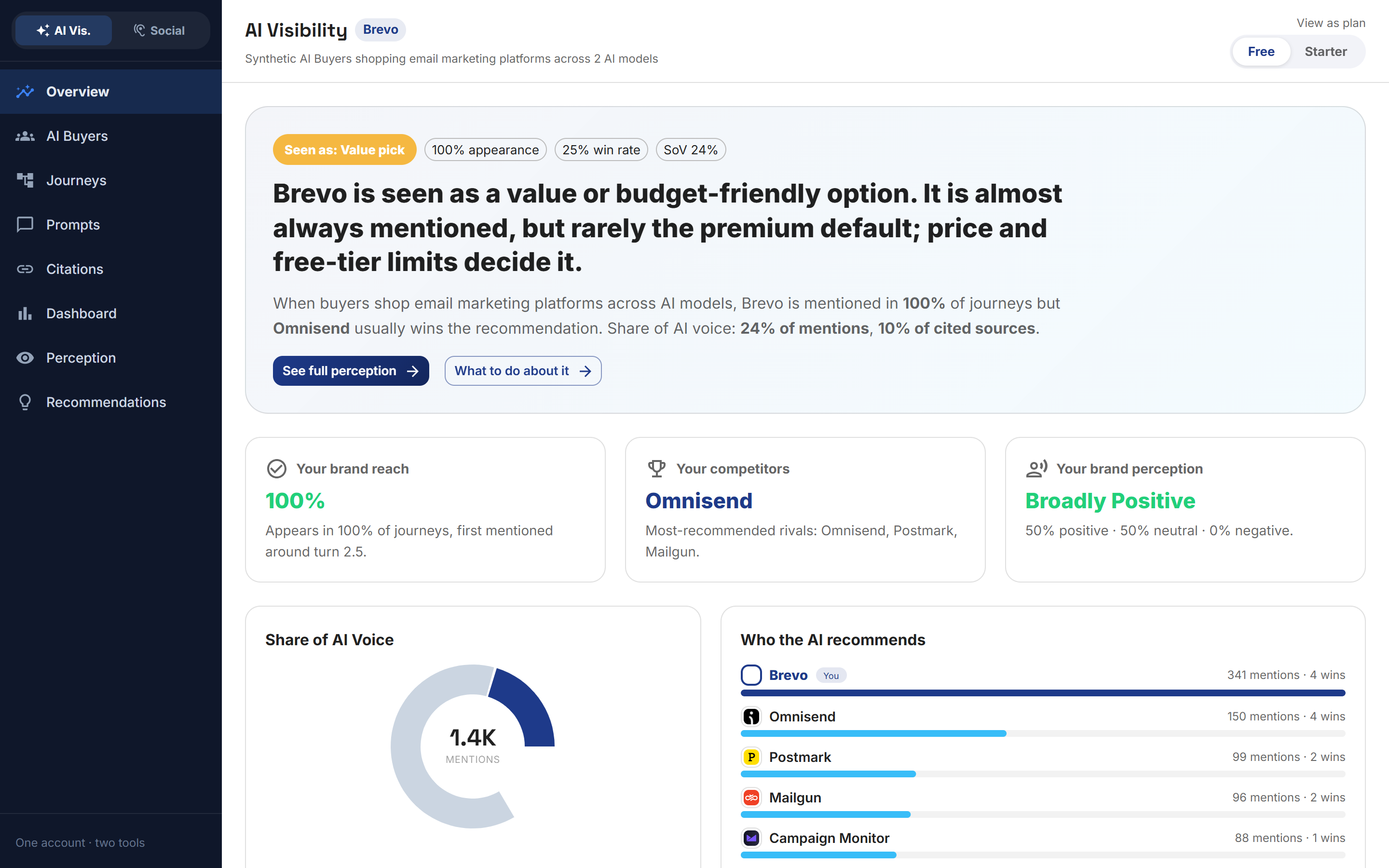
According to that dashboard, the tracked brand is mentioned in every AI buyer journey and comes up in 24% of all brand mentions across the category, its share of voice by that measure. But the same dashboard shows it as the source an assistant actually cited in only 10% of those citations. Being talked about and being the page an AI assistant reads from are two different things, and a brand can lead on one while trailing on the other. Neither number is wrong; they're just answering different questions, the same way a social share of voice and a paid-media share of voice would be.
What to check alongside the percentage
A share of voice number is a starting point, not a verdict. Before reporting one:
- Look at absolute mentions, not just the percentage. A 5-point share swing means something different at 200 total mentions than at 20,000.
- Pair it with net sentiment. A rising share built on complaints is a different story from one built on praise, and the percentage alone can't tell you which.
- Check whether one account is carrying it. If a single post or thread accounts for a big share of the volume behind a move, treat the number as a spike to investigate, not a trend to report yet.
- Ask which conversation it's measuring. Social mentions, AI citations and ad spend all produce a "share of voice", and they don't move together.
None of that means the metric isn't worth reporting. It means reporting the number without the mentions behind it is reporting half the picture.
Babel42's free plan gives you 500 mentions a month, two monitors and one channel across five networks (Bluesky, YouTube, News, Hacker News and DEV.to), with 90 days of history and no card required, enough to set up your brand and one named competitor and see your own share of voice move. The side-by-side comparison view pictured above, with the full leaderboard and trend line across every brand you track, is part of custom dashboards and comparisons, included from the Growth plan.
If you're setting up your first monitor, how to do social listening for free covers that groundwork. For share of voice specifically applied to a named rival, how to monitor competitor activity walks through the weekly routine built around the same dashboard. And if the AI side of this post is new territory, what AI search visibility actually measures covers share of AI voice and the other five headline metrics in full.