Four AI assistants shopped the same category, the same week, for the same brand. Claude shortlisted it. Gemini recommended it outright. Grok never named it. Perplexity picked a rival.
Same product, same buyer question, four different outcomes, and Perplexity landed on the opposite end of the range from Gemini. That spread is the whole reason it's worth asking how to rank on Perplexity specifically, rather than treating "AI search visibility" as one undifferentiated channel.
We've written before about what earns a citation across AI assistants generally and how AI buyers behave once they start shopping. This is the narrower version of that question: what's different about Perplexity, and what would you change if it's the assistant picking rivals over you.
Why does Perplexity treat brands differently from ChatGPT or Gemini?
The most visible difference is one you can watch yourself: Perplexity runs a live web search for every question you ask it and shows the sources it used as numbered citations under the answer. You don't have to take our word for that part, open Perplexity and ask it anything, the citations are right there. ChatGPT and Gemini can also search the live web when browsing is switched on, OpenAI describes its own version here and Anthropic describes Claude's here, but a meaningful share of what they say still leans on what was baked into the model at training time, a snapshot from months or years back. Perplexity's answers are closer to "what does the web say about this right now" by default.
That has a practical consequence. Perplexity publishes no official breakdown of how it weighs one source over another, so anything written about its internals is inference, and we'd rather not guess at internals we haven't verified. Nor does anyone else: Google's "AI features and your website" is the closest thing to an official statement any vendor has made, and all it says is that "there are no additional requirements to appear in AI Overviews or AI Mode, nor other special optimizations necessary". What we can show you is what we've watched happen across real buyer journeys in Babel42's own AI Visibility product: observed pattern, read off actual answers, which is the closest thing to evidence anyone outside Perplexity has.
What gets a brand cited on Perplexity
None of this is exotic. It's the same groundwork that helps across every AI assistant, but it matters more here because Perplexity is reading the live web at the moment of the question rather than falling back on stale training knowledge.
- Say the number, not the adjective. A page that states "$99 a month, 5 AI Buyers, twice-weekly cadence" gives a live search something to quote whole. A page that says "flexible plans for growing teams" gives it nothing to lift, so Perplexity either skips you or quotes whoever did put a number down.
- Make sure the fact is in plain, crawlable text. A price or feature buried behind a "book a demo" form, or rendered client-side in a way a crawler can't parse, might as well not exist for this purpose. We've covered the full crawler-and-citation pipeline, including
PerplexityBotspecifically, in how AI crawlers find and cite your brand. Perplexity publishes its own crawler list too, and it separatesPerplexityBot, which fetches pages so they can be cited, from the agent that fetches a page because a user asked for it. - Keep the page current. Because Perplexity leans on fresh retrieval more than most, a page that hasn't been touched in a year is a weaker candidate than one with a visible recent update, particularly on anything price- or feature-related that changes.
- Don't rely on your own site alone. In what we've watched, Perplexity's citations often point at review sites, comparison posts and forum threads rather than a brand's own pages. If the most quotable, current sentence about you sits on a site you don't control, that's whose link shows up under the answer, not yours.
- Ask Perplexity the actual question a buyer would ask, not a keyword. Open Perplexity yourself and type the full sentence a real buyer would use, constraints and all, rather than a two-word search term. What comes back, and which sources it cites, is a more honest test of where you stand than checking whether a keyword ranks.
None of it is certain. It's what we've seen raise the odds, watching real answers come back, not a formula that fixes any single query.
What it looks like when Perplexity picks a rival
Here's a real example from a Babel42 AI Visibility workspace: a synthetic buyer persona, a UK developer wiring up transactional email, asking "Which services offer a reliable transactional email API and SMTP relay for a web app?" across five assistants.
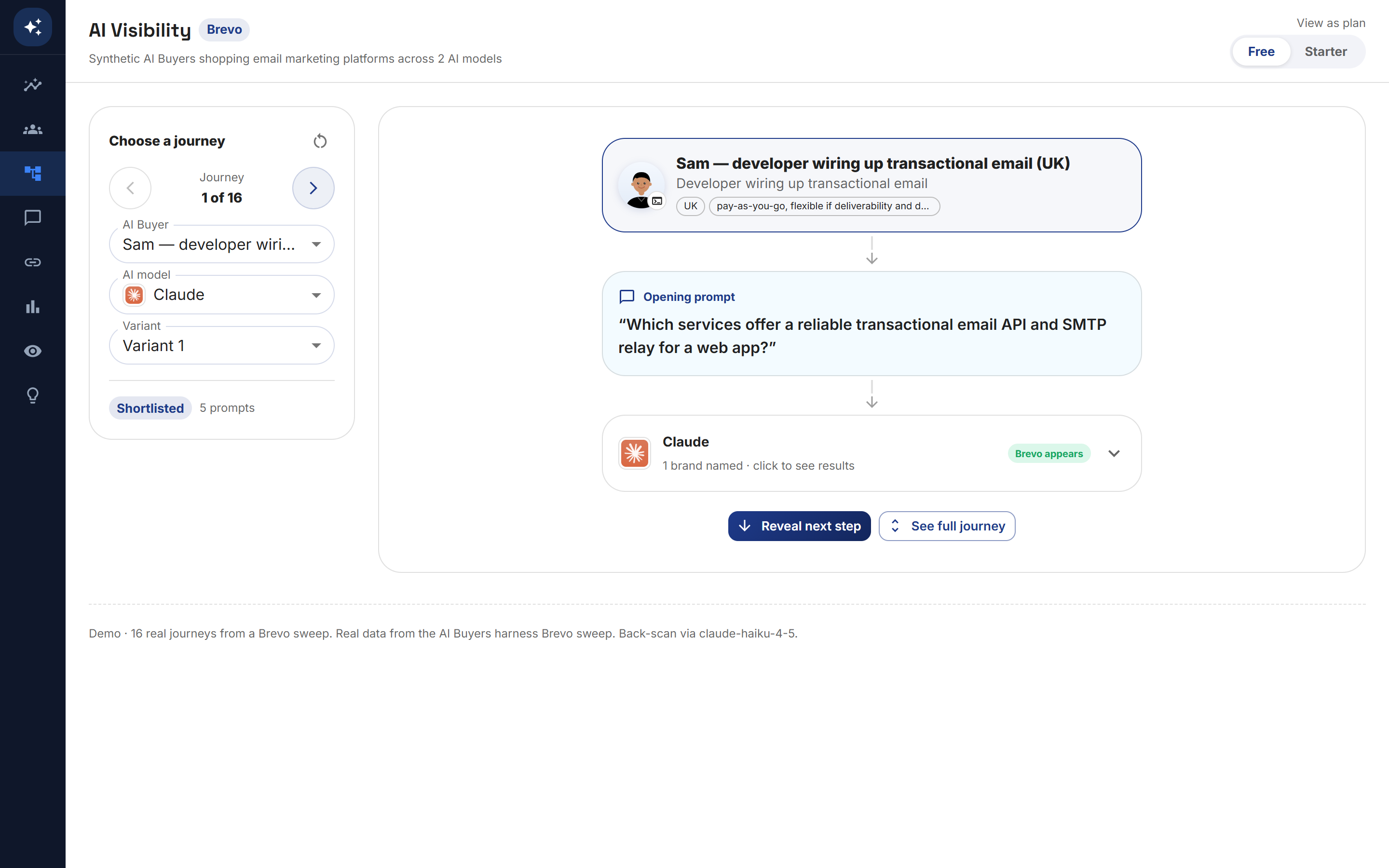
The screenshot above shows the journey with Claude selected: Claude named the brand and, per the dashboard, shortlisted it. Switch that same journey to a different model and the picture changes. Across the five assistants on this one journey, the outcomes read: Claude "Shortlisted you", Gemini "Recommended you", Grok "Didn't name you", and Perplexity "Picked a rival". ChatGPT's turn was still shopping when this was captured.
The workspace's own summary for this buyer, read straight off the Babel42 dashboard, put it plainly: the brand "Won the agency & founder buyers" but "Lost the developer, on reliability", eliminated on turn three by a rival Perplexity preferred. We tracked this buyer's win rate, straight off that same dashboard, at 32% across all five models, against a 100% appearance rate and a 3-of-5 shortlist rate. Named everywhere, recommended by less than a third.
That gap, between showing up and winning, is the pattern we've written about across AI assistants generally in what AI search visibility measures. Perplexity here is simply the assistant where that gap showed up hardest for this particular buyer.
What should you do if Perplexity keeps picking a rival?
Start by checking whether it's a Perplexity-specific problem or a general one. If the same brand is losing to the same rival across every assistant, the issue is upstream of Perplexity, probably a genuine gap the rival covers better, per the objection Perplexity gave here ("on reliability"). If Perplexity alone is the outlier and the others rate you fine, the more likely explanation is retrieval: whatever Perplexity found and read at that moment either wasn't yours or wasn't specific enough to win the comparison.
Either way, the fix starts the same place: read what the AI said, not just whether you appeared. A "Picked a rival" outcome with no reason attached tells you almost nothing. The same outcome with "on reliability" attached, as in the example above, tells you exactly what to go fix, or what to say more clearly on the page a buyer's assistant is likely to read.
Where Perplexity fits in a wider AI visibility check
Perplexity is one of seven AI assistants Babel42's AI Visibility product tracks: ChatGPT, Claude, Perplexity, Gemini and Grok are shopped as full multi-turn buyer journeys through to a decision, while Google's AI Overviews and AI Mode are checked once per question for appearance and citation. Watching Perplexity in isolation tells you something. Watching it next to the other six, on the same question, in the same week, is what tells you whether a lost decision is a Perplexity quirk or a real product gap every assistant agrees on.
The free plan runs one AI Buyer across any two of those seven assistants on a weekly cadence, enough to see whether Perplexity and at least one other model agree on your brand, or don't. If you're starting from nothing, how to run an AI search visibility audit is the structured version of the check this post walked through by hand. If ChatGPT or Gemini is the assistant you're more worried about, how to rank on ChatGPT and how to rank on Gemini cover the same question for those two, and the side-by-side comparison puts all of them on one page.