Someone on your team has started saying "AI search optimisation" in planning meetings. Maybe a vendor pitched it. Maybe a competitor got named by ChatGPT and you did not.
Before anyone writes a single page, two questions matter more than any tactic. How long until this does anything. Do you even need it if your site already ranks well on Google. Here are honest answers to both.
The urgency is real, even if the hype around it is not. A randomised study found Google's AI Mode cuts clicks to outside websites by nearly a fifth, compared with a classic search results page. Fewer of your potential customers reach your site at all, even when you rank well, which is a separate problem from whether the assistant names you once they are there.
What is AI search optimisation?
AI search optimisation means making it more likely that an AI assistant names your brand when someone asks it a buying question. It covers the same ground as GEO, AEO and LLM SEO. Those are four labels the industry uses for one underlying job.
The differences between the four terms matter less than the question underneath them. Can a model find a plain, citable fact about you and repeat it back. What LLM SEO means covers where the four labels came from, if the terminology itself is what is confusing your team.
Do you need it if you already rank well on Google?
Yes, because ranking and being named are different events. A page can hold position one on Google and still never get read by an assistant.
The assistant might answer from a page further down the list. It might answer from no single page at all. We put the same buying question to five assistants at once and found they rarely agreed on which brand to recommend.
Strong Google rankings still help. They usually mean your content already exists and is indexed, which is the raw material an assistant needs. What they do not do is promise the assistant picks that content up, structures it the way a retriever wants, or quotes you over a competitor.
Picture two rivals selling the same kind of software. One holds position two on Google for the category term, with a dense, jargon-heavy comparison page. The other sits at position five, but states its pricing and its three main limits in plain sentences near the top of the page. An assistant retrieving a short, quotable passage is more likely to lift the second page, even though it ranks lower on Google. The ranking measured one thing. The assistant measured another.
How long AI search optimisation takes to show a signal
Expect three different timescales, not one. Do not judge the whole effort by the fastest of them.
| Stage | What you are fixing | Realistic timeframe |
|---|---|---|
| Crawler access | Whether AI bots can fetch your pages at all | Days, once identified |
| Content structure | Answer-first sections a model can lift whole | Two to six weeks to rewrite the pages that matter |
| A measurable shift in answers | Assistants actually naming you more often | One to three months, re-checked on a schedule |
A blocked crawler is the fastest fix, and the easiest one to miss. If a bot cannot fetch the page, nothing you write on it matters until that is corrected first.
Content rewrites take longer, because they are editorial work rather than configuration. Someone has to read the page, find the vague sentence, and replace it with a fact a model can lift whole.
The slowest stage is the one people expect to be instant. Models do not refresh what they know about you the moment you publish. A change needs time, and a re-check, before you can tell whether it worked. Treat the table above as a reasoned expectation, not a promise: no one can fix the exact date an assistant starts naming you.
The timeframe also depends on how crowded your category already is. A niche B2B tool with few competitors can see a shift faster, because there is less competing content for a model to choose between. A category with dozens of established players, each with years of indexed content, takes longer to move in, for the same reason a crowded Google results page is harder to break into. Set your own expectation against your category, not against a generic number.
The mistake that wastes most teams' first month
Teams rewrite content before confirming an AI crawler can reach it. AI crawlers fetch your site separately from Googlebot, under their own names and their own rules. A page that ranks fine on Google can still be invisible to the bot that would have read it for an AI answer.
Checking this takes a few seconds, and it tells you whether the content work is worth doing yet. Our free AI visibility checker requests your pages the way an AI crawler does and reports exactly what came back. That is worth doing before you spend a week rewriting a page nothing can fetch.
A blocked crawler is rarely deliberate. It is usually a firewall rule written for bot traffic in general, a robots.txt line copied from a template years ago, or a content delivery network rejecting anything without a familiar browser signature. None of those were written with AI assistants in mind, because most of them predate AI assistants reading the web at all. Finding and loosening the specific rule is a technical fix, not a content one, and it is worth doing before the writing starts.
A second mistake: optimising for one assistant only
Teams run a few test prompts through ChatGPT, see a weak answer, fix it, and stop there. That tells you about one assistant on one day, not about AI search as a whole.
A single check on a single assistant is not even reliable on its own terms. We asked assistants the same buying question twice, in the same run, and the same assistant named the same winning brand again barely a fifth of the time. One good answer from ChatGPT might just be the result you got that day, not evidence the fix worked. Checking one assistant once and generalising to "AI" is the single most common way a team overstates its own progress.
The fix is not complicated. Run the same handful of buying questions across several assistants before and after a change, not just the one that prompted the project. A spreadsheet works for a first pass; a tool that automates the repeat runs matters once you are doing this every week rather than once.
Where to go once you decide to start
Once crawlability is confirmed, the order to work in is a separate question. We have answered it in full: how to implement generative engine optimisation lays out the step-by-step sequence, from a cold start to a repeating weekly check.
If you want a baseline before changing anything, how to measure your brand in AI answers covers the method. Once you have a baseline, our playbook for improving it covers what to fix first.
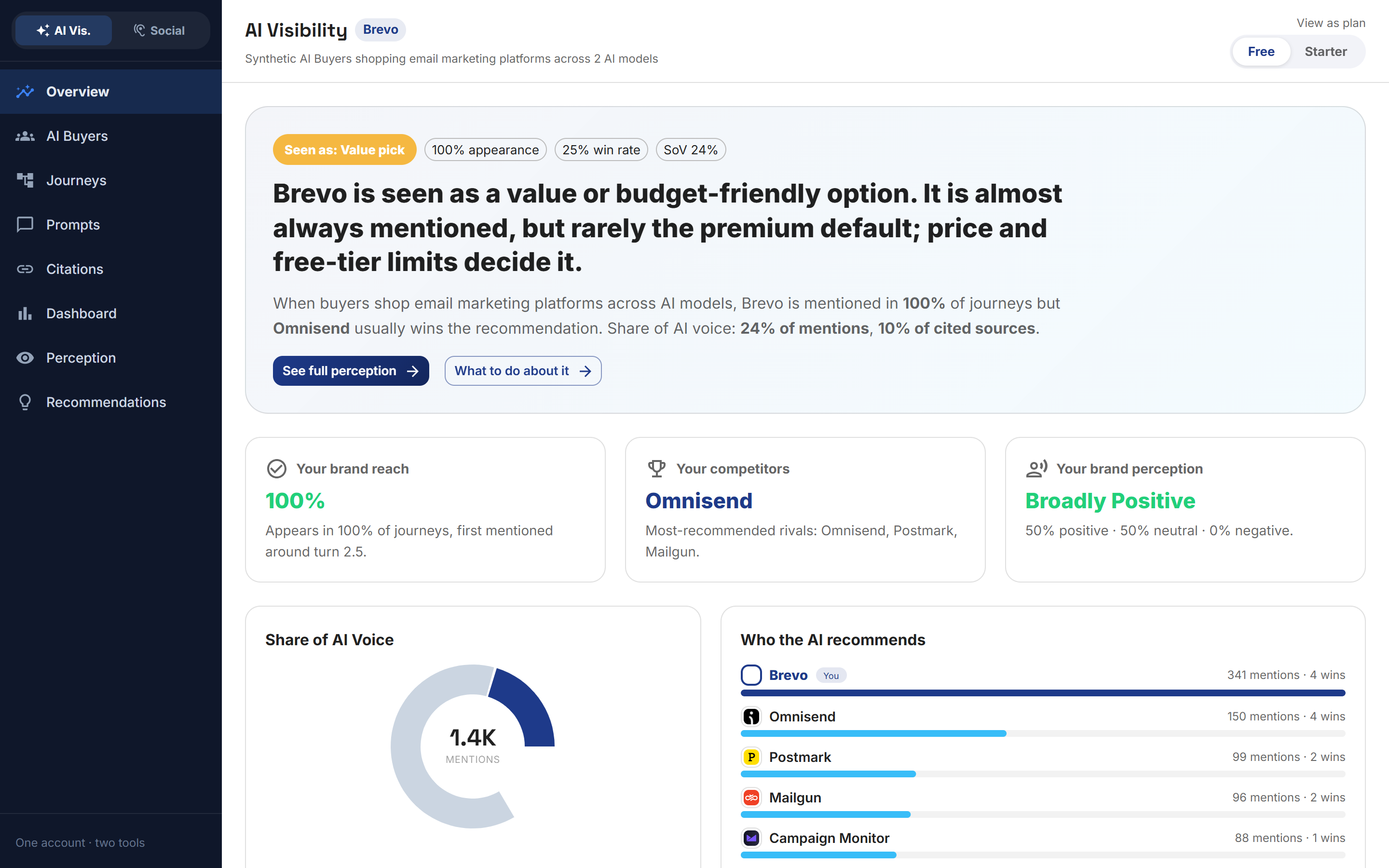
Babel42's AI visibility tool runs this measurement for you on a schedule. It scores appearance rate, win rate and share of AI voice separately, rather than blending them into one number. The free plan runs one AI Buyer across any two of seven AI assistants weekly, no card required, enough to see your starting point before you commit further.
The short version
AI search optimisation is not instant. It is not optional just because you already rank on Google.
Confirm crawler access first. It is the fastest check, and the one gate that blocks everything else. Expect weeks for content work and a month or more before you can judge whether assistants are naming you differently. Re-check on a schedule, not once.