"Build brand awareness" shows up in more marketing plans than it does marketing dashboards. Everyone agrees it matters; few teams can point to a number that moved because of it. Part of the problem is that brand awareness describes two different things, measured two different ways, and most teams have only ever budgeted for one of them, or neither.
This guide covers how to measure brand awareness both ways: the survey methods market researchers have used for decades, and what you can track continuously and for free, using the conversation already happening in public. Neither replaces the other. Used together, you get a reading you can check every month instead of once a year.
What is brand awareness, and how is it different from reputation?
Brand awareness is whether people know your brand exists at all, a separate question from whether they like it once they do. A reputation problem and an awareness problem look nothing alike on a dashboard: a reputation dip shows up as a sentiment line moving against a steady volume of mentions, while an awareness problem shows up as barely any mentions to begin with, regardless of how positive they are. You can have a five-star reputation with twelve people who've heard of you.
If you're already tracking sentiment and mention trends, our guide to brand reputation monitoring covers that side of the dashboard in full. This guide is about the separate, earlier question: whether anyone is talking about you at all.
Unaided and aided awareness: the two things a survey asks
Market researchers split brand awareness into two measurements, and the distinction matters because they capture different things. Unaided awareness asks an open question, something like "which brands come to mind for [category]?", with no options shown, so a brand named back is one that was genuinely top of mind. Aided awareness shows a list of names or logos and asks which ones a respondent recognises, which measures recognition rather than recall. Qualtrics, which runs this kind of research for a living, puts it plainly: unaided awareness is the harder, more valuable number precisely because nobody was prompted.
Both numbers come from the same source: a market research panel, asked the same questions on a schedule, usually annually or twice a year because a representative panel costs real money and time to run each time.
How do you measure brand awareness without commissioning a survey?
You watch for the moments people name your brand without being asked, in public, because that behaves the same way unaided recall does in a survey room. Nobody handed them a list. They said your name anyway, while arguing about a purchase, asking for a recommendation, or comparing notes with someone else in your category. A social listening monitor built around your brand name catches exactly that, continuously, instead of once a year.
The caveat is the one every proxy metric carries: this only counts people who post publicly, which skews toward the more vocal end of your market and away from the people who think about your brand but never write anything down. Treat it as a real, checkable signal that moves between the annual survey rounds, not a population-representative replacement for one. The two are complementary, not competing: a survey samples everyone and asks; a listening monitor counts everyone who spoke up without being asked.
The table below lines up all four methods against the same three questions.
| Method | What it captures | How you get the number | Typical cadence |
|---|---|---|---|
| Unaided recall survey | Spontaneous recall, no prompt | Commission a market research panel | Annual or twice-yearly |
| Aided recognition survey | Recognition once shown a name or logo | Same panel, a second question | Annual or twice-yearly |
| Branded search volume | People deliberately searching your name | A keyword or search console tool | Monthly |
| Unprompted social mentions | People naming you, unasked, in public conversation | A social listening monitor | Continuous |
Build a monitor that only counts the unprompted mentions
A monitor built around your brand name alone will also catch your own marketing: your company account's posts, an ad's replies, a newsletter link people are quoting back at you. None of that is awareness in the sense a survey means it, since the person didn't bring you up, you did. Babel42's query builder turns a plain-English description into a Boolean search you can then narrow by hand with AND, OR and NOT, so you can exclude your own handles and any campaign hashtag you're actively pushing, leaving the mentions that started somewhere else.
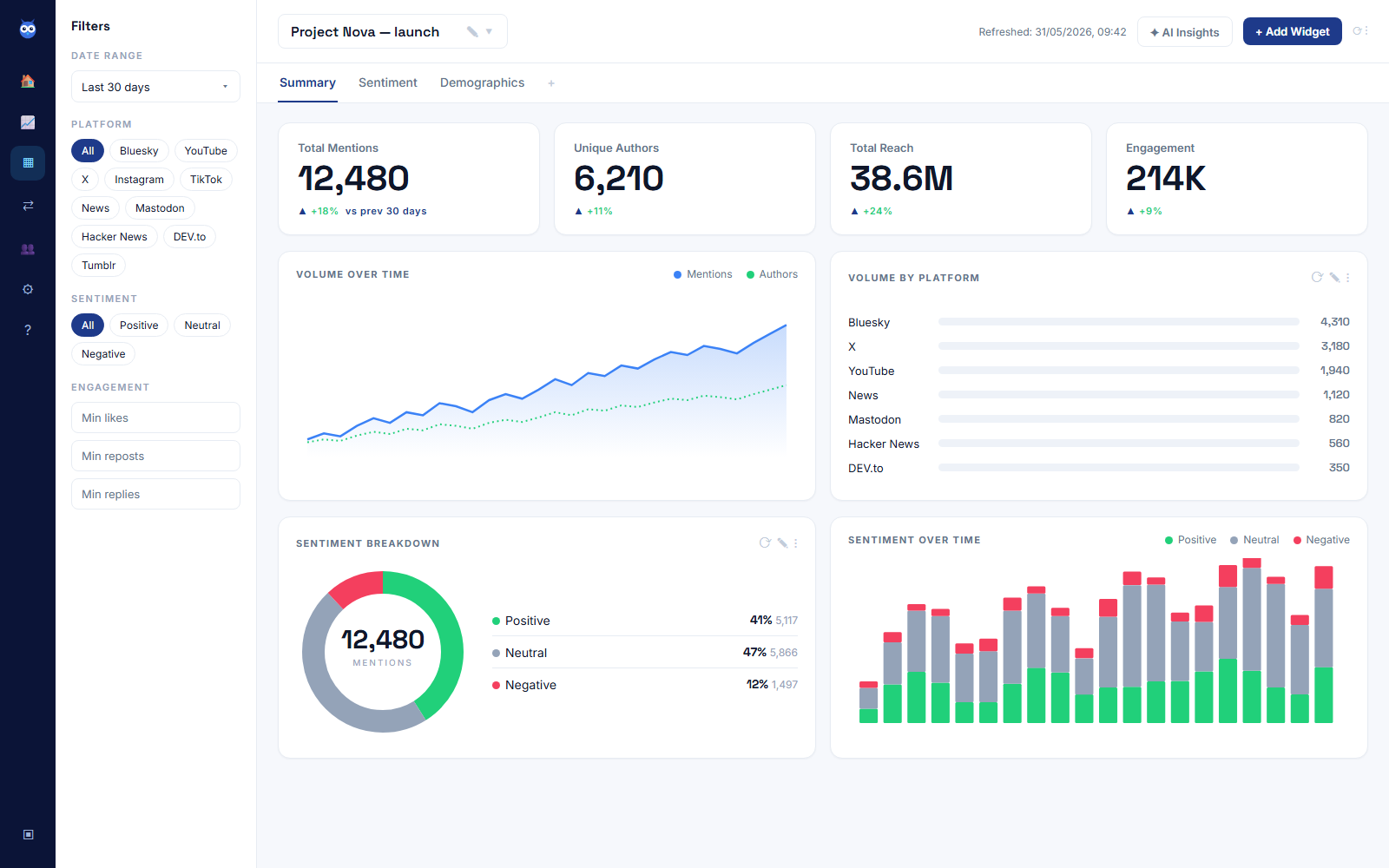
The screenshot above is a demo project, not a real customer's account, but two numbers on it matter more than the rest for awareness specifically: unique authors and total reach. Mention volume can be inflated by one very vocal account repeating itself; a rising count of distinct people bringing you up, across a widening reach, is the closer read on whether more of the market has actually heard of you.
Compare share of voice against named rivals
Share of voice is your brand's mentions as a proportion of every mention in a category, yours and your named competitors' combined. It answers a question a raw mention count can't: whether your volume is climbing because more people know you, or just because the whole category is talking more this month. A monitor for your top two or three competitors, tracked alongside your own, turns that into a side-by-side comparison instead of a guess.
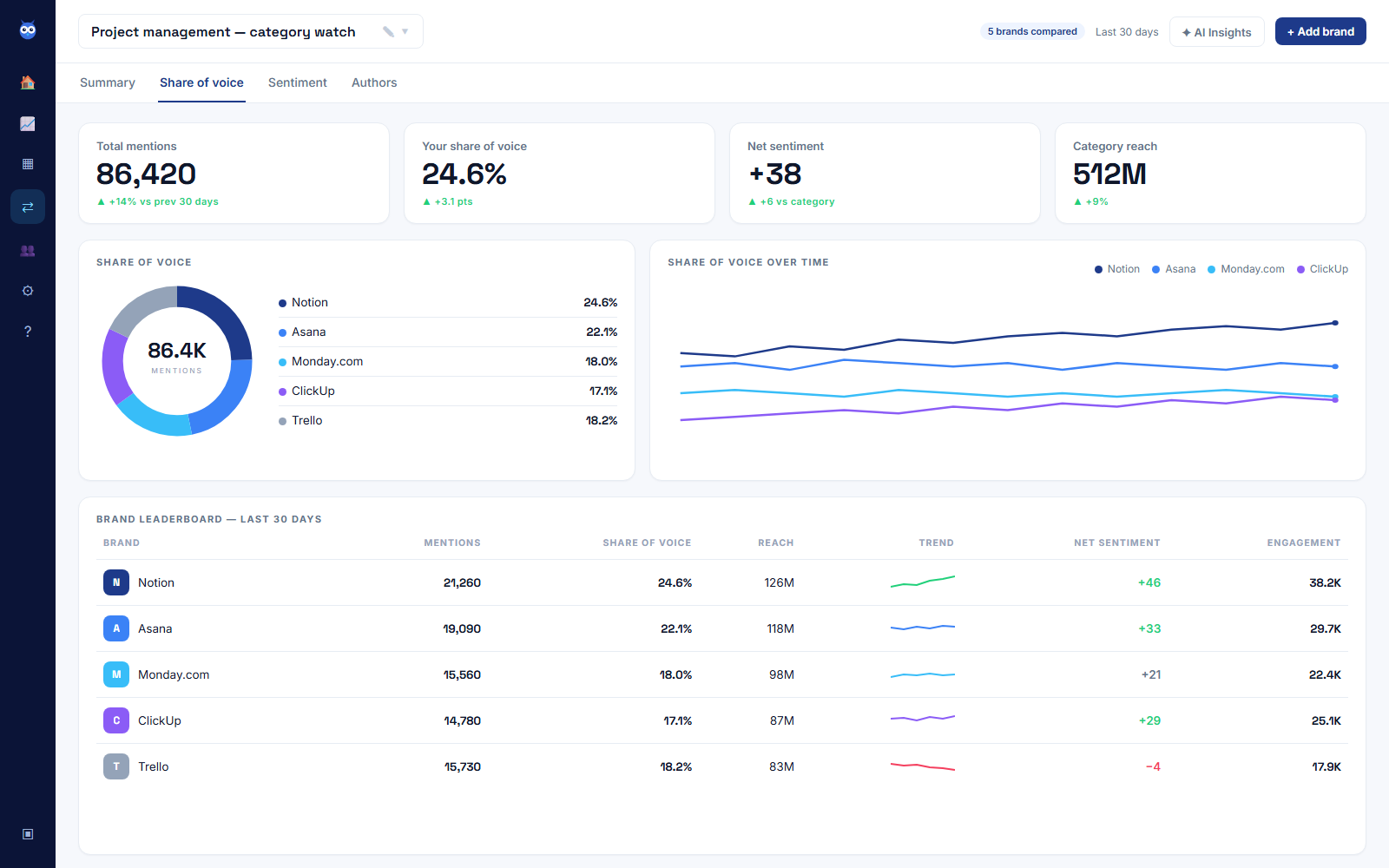
This is the same category-watch demo used elsewhere on this blog, shown here for the awareness angle specifically: a share of voice that's climbing even while total category mentions grow is a genuinely different, stronger signal than your own mention count rising in isolation, because it means you're taking a bigger slice of a conversation everyone in your category is having, not just riding a wider trend along with everyone else.
Set up your first awareness-tracking monitor
- Write the exclusion list first. Before anything else, list your own social handles, your paid campaign hashtags and any co-marketing partner accounts. These go into your monitor with
NOTso your own reach doesn't count as someone else's awareness of you. - Add your brand name, common misspellings and your product name as quoted phrases. Use
ORto catch every variant in one query. - Add a second monitor for two or three named competitors, the set you actually get compared against, for the share of voice view above.
- Let it run for a full month before reading anything into it. A single week of mentions is too noisy to say anything about a trend that moves over months.
- Note the starting numbers: unique authors, total reach and your share of voice against that competitor set. Everything after this is a comparison against that baseline, not an absolute score.
A quarterly routine, because awareness moves slowly
Reputation can turn in a day; awareness rarely does. A monitor showing more distinct people mentioning you this month than last is worth a look, but the real read is the trend over a quarter, not a single week's wobble. A workable routine:
- Monthly, five minutes: glance at unique authors, total reach and share of voice for anything that broke its usual range, positive or negative.
- Quarterly, twenty minutes: compare this quarter's unique authors and share of voice against the same quarter's numbers three months ago, and against your last survey reading if you run one. A listening trend that agrees with the survey confirms both; one that disagrees is worth digging into before you trust either on its own.
- Alongside your next survey round: if you do commission an unaided/aided recall survey, log your listening numbers from the same window next to it. Over a few rounds, you'll learn how closely your own proxy tracks the real thing, which is worth knowing before you lean on it between survey rounds.
Start with the free monitor, add the survey when you can
Babel42's free plan gives you 500 mentions a month, two monitors and one channel across five networks (Bluesky, YouTube, News, Hacker News and DEV.to), with AI sentiment analysis and 90 days of history, no card required. That's enough to run a brand-name monitor and one competitor monitor side by side and start building the baseline this guide describes; a survey is worth commissioning once you want the population-representative number to check that baseline against, not instead of it.
If you haven't set up any listening yet, how to do social listening for free covers the first monitor this guide assumes you already have running. For the sentiment and trust side of the same dashboard, our guide to brand reputation monitoring picks up where this one leaves off, and how to monitor competitor activity goes deeper on watching a specific rival rather than the category as a whole.