Ask a marketing team how they'd find out what their audience thinks about a category, and most reach for the same playbook: a survey, a round of customer interviews, maybe a focus group if the budget stretches that far. All three work. All three also take weeks to plan, run and write up, by which point the conversation has often moved on to something else. Social listening for market research is not a replacement for any of that. It's a faster, always-on complement: instead of asking people what they think, you read what they're already saying, unprompted, in their own words, and you can start today rather than after a six-week fielding window.
This is one of the oldest use cases for listening tools, older than most of the AI-search conversation dominating marketing blogs right now, but it's easy to undersell because it doesn't produce a tidy chart the way brand tracking does. Here's what it's good for, how to set a project up properly, and how to read the findings it produces.
What social listening for market research is good at
A survey and an interview both share the same structural weakness: you have to ask the question before you get an answer, and the act of asking changes what people say. Someone answering "how do you feel about X" in a survey is performing an answer, filtered through what they think a reasonable answer sounds like. Someone complaining about X in a Bluesky thread, three days before you ever thought to ask, is not performing anything. They're just talking.
That difference matters most in three situations: when you don't yet know the right question to ask, when you need the exact words a real audience uses rather than the words a research brief uses, and when you want to catch a shift in opinion while it's happening rather than reconstruct it from memory weeks later. A survey is precise but slow to set up. Social listening is messier but running the moment you start a monitor.
Is social listening a replacement for surveys and interviews?
No, and treating it as one is the most common way a listening-based research project goes wrong. A survey lets you ask a specific person a specific question and get a structured, comparable answer from a sample you chose on purpose. Social listening only shows you people who chose to post, about a topic they chose to bring up, in public. That's an enormous advantage for catching things you didn't think to ask about, and a real limitation for anything that needs a representative, controllable sample. The two methods answer different questions well. Most research programmes that use both end up running listening first, to find out what's worth asking about formally, and then again after, to see whether the survey's findings actually show up in how people talk when nobody's prompting them.
Four things unprompted conversation shows you that a survey struggles to
- The words people actually use for the problem, before you name a product. A monitor on the problem itself, not your brand or category label, catches the phrasing real people reach for. That phrasing is worth more in a landing page or an ad than anything a focus group moderator's summary can give you, because it's proof the words already resonate rather than a guess at what might.
- Complaints and requests nobody had to be prompted to make. A survey respondent answers the questions on the page. Someone posting "why doesn't X just do Y" is telling you their actual priority, unranked and unfiltered by a list of options you wrote in advance.
- How opinion moves in the days after something happens, a price change, a controversy, a competitor's launch, rather than how someone remembers feeling about it a fortnight later when you finally get the survey out. Recall is unreliable in ways that are well documented, and measurably so: Fallesen et al., "Long-Term Recall Error in Retrospective Family Surveys", in the European Journal of Population, matched what people remembered against the register record and found recall quality decaying "in a linear fashion by 0.5 to 0.6% points per year on average over a 20-year period". A post written on the day decays at nought per cent per year.
- How a niche audience talks amongst itself. Developer communities, hobbyist forums and industry-specific corners of the internet each have their own shorthand and their own concerns, and reading real threads there tells you things a generic panel-recruited survey respondent, who may not be a genuine member of that niche at all, simply can't.
Setting up a listening project as a research exercise
The mechanics are the same as any Babel42 monitor, but a research project benefits from a bit more discipline up front than a brand-monitoring one does. Start by writing down the actual question you're trying to answer, not just a topic. "What do people think about our pricing" is a topic. "Do people compare us on price or on features when they mention us alongside a competitor" is a question you can build a query around and answer directly.
From there, build the monitor with Babel42's plain-English query builder, which turns a description into the underlying Boolean search, and refine it with AND, OR and NOT once you can see what's coming through. A query like "the problem you solve" AND (price OR expensive OR cheap) narrows a broad topic monitor down to the specific angle your research question is about, without you having to read every mention that isn't relevant.
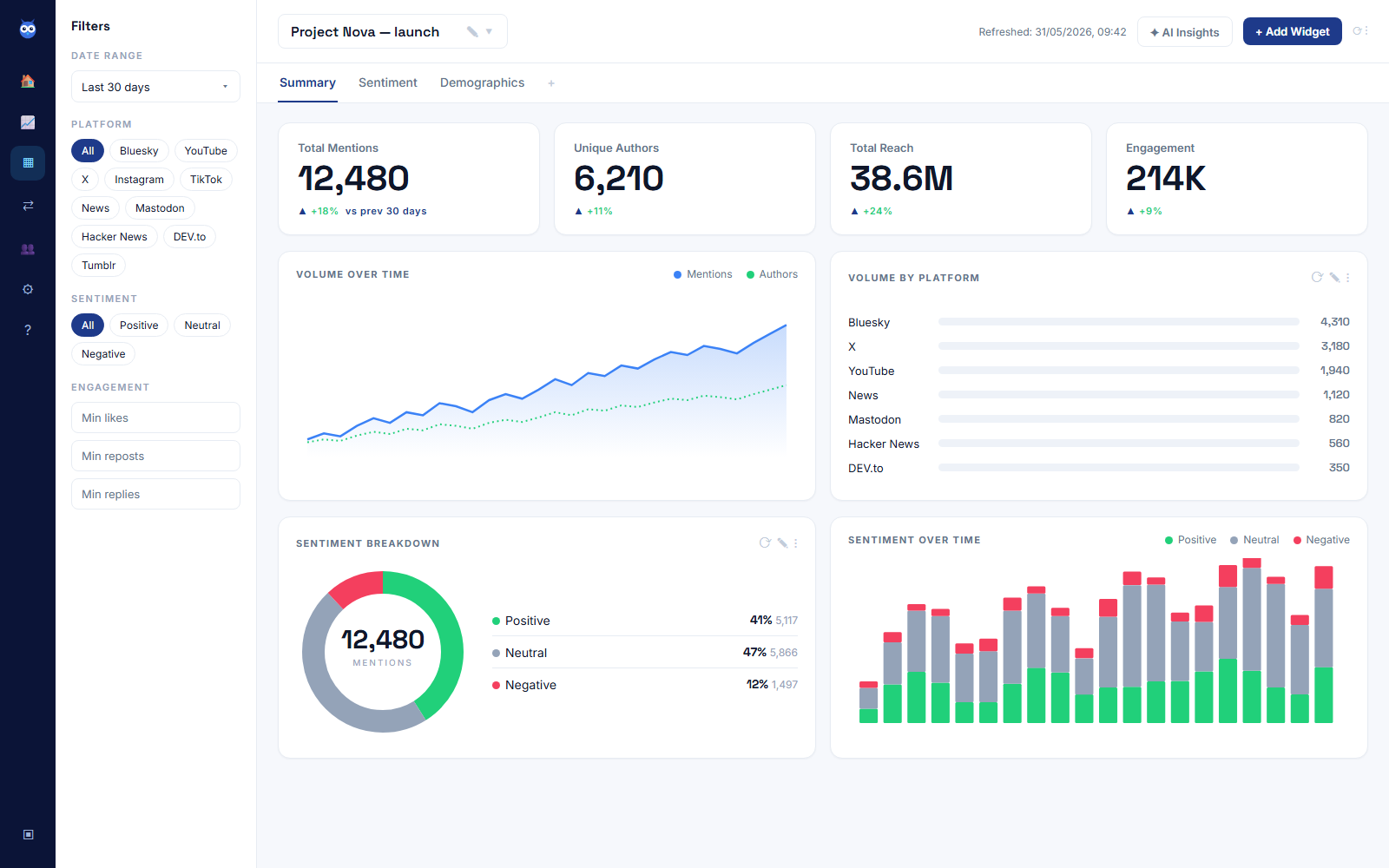
Once the monitor's running, resist the urge to just watch the top-line sentiment number. That figure, produced by Babel42's AI like all automated sentiment scoring, is a useful directional signal rather than a verdict, and the real research value sits one level down: read the individual mentions behind a spike, not just the fact that one happened. The AI Insights panel (from the Starter plan up) summarises the recurring themes and surfaces the mentions worth reading first, which is a faster way into a large monitor than scrolling the raw feed, but the underlying posts are still where the actual research findings live.
Keeping more than one research question running at once
A real research programme rarely has just one question. Keyword lists let you group mentions by the different things you're trying to learn, your own product lines, named competitors, a specific campaign, or a running list of feature requests, and then slice the same monitor's data by whichever one you're currently writing up.
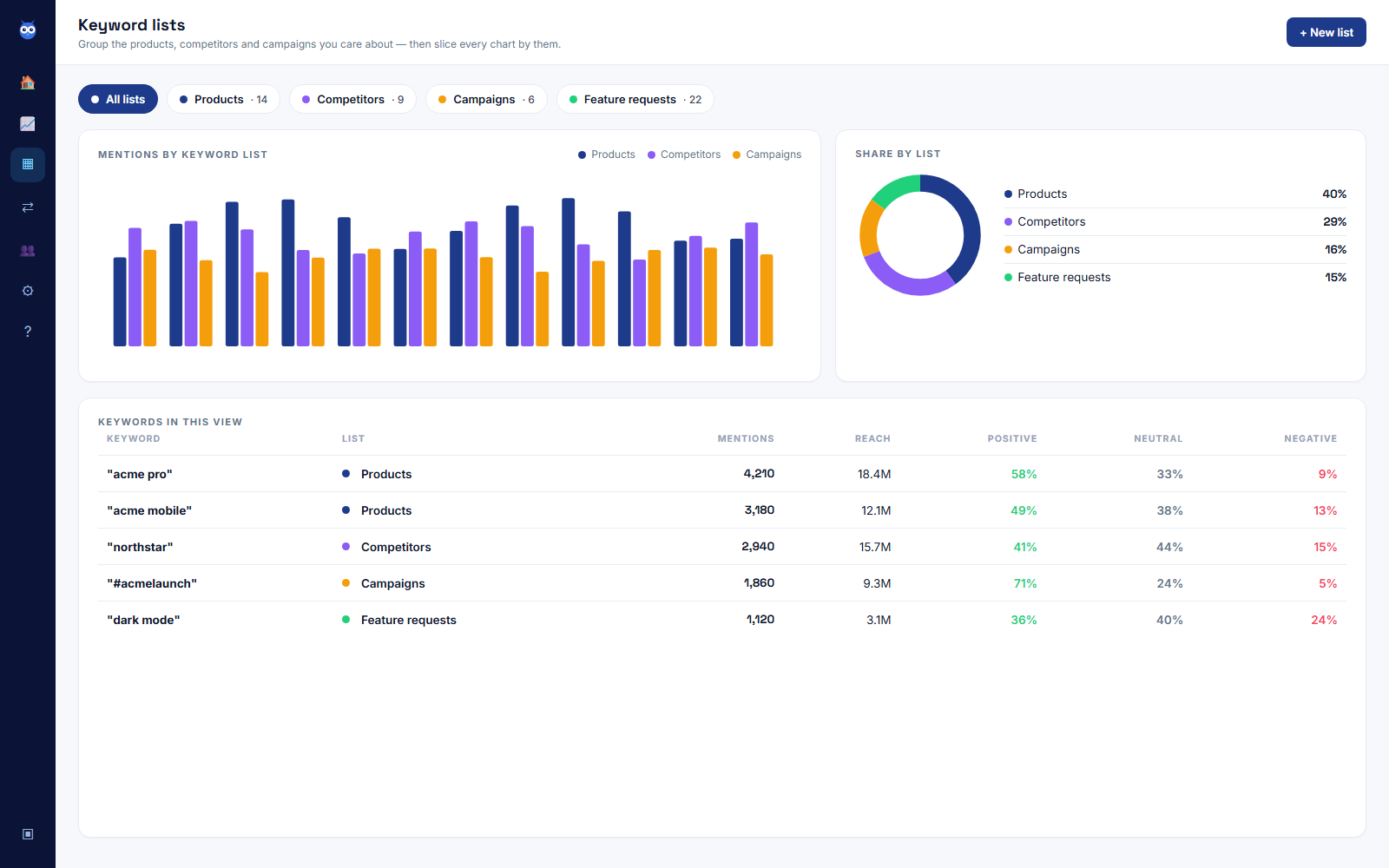
That grouping is also what stops a broad category monitor turning into an unreadable firehose. A single "your industry" query might return hundreds of mentions a week, most of them irrelevant to any one research question. Splitting them by list means the competitor-comparison question and the feature-request question each get their own clean view, rather than competing for attention in one undifferentiated stream.
How to read a listening finding
Read a listening-based finding for what it is, because one presented as if it came from a representative survey is worse than no finding at all. The people who post about a topic are not a random sample of your market; they skew toward people who feel strongly enough to say something publicly, which overrepresents both the enthusiastic and the furious and underrepresents everyone quietly satisfied or quietly indifferent. It is worse than it sounds. According to Pew Research Center's "Contending with the 80/20 rule when studying online behavior", "the most active 10% of Twitter users produce 80% of all tweets from U.S. adults", so a listening sample is weighted towards a small group of heavy posters before you have read a word of it. You also can't ask a follow-up question. A survey respondent who gives a confusing answer can be probed; someone's three-year-old forum post cannot.
Reading the results still needs a human who understands the context. Sarcasm, in-jokes and industry-specific shorthand trip up automated sentiment scoring in ways a careful reader catches immediately, which is exactly why the individual mentions behind a number matter more than the number on its own.
The best measurement of how hard this is comes from Van Hee et al., "SemEval-2018 Task 3: Irony Detection in English Tweets", where dozens of research teams competed on nothing harder than deciding whether a tweet was ironic and the winner reached an F1 of 0.71. None of that makes the signal worthless, it just means treating it as one input alongside, not instead of, methods built for a controllable sample.
A simple way to run this alongside formal research
The most useful pattern we've seen is running a listening project before and after, rather than as a one-off. Before commissioning a survey, a couple of weeks watching the unprompted conversation sharpens which questions are worth asking, and in what language your respondents will recognise. After the survey ships, the same monitor becomes a quiet check on whether the findings hold up in how people talk when nobody's asking them directly, and an early warning if opinion shifts again before your next formal research wave.
Between waves, a light-touch version of the same monitor catches the shift itself: a new complaint pattern, a competitor move that's changing how people describe the category, or a feature request that keeps recurring in slightly different words from different people, which is usually a stronger signal than the same request from one person repeated.
Start with a monitor, not a whole research programme
You don't need a formal research budget to try this. Babel42's social listening product covers 500 mentions a month across five networks on the free plan, with AI sentiment analysis, two monitors and 90 days of history, enough to run a real problem-space monitor and see whether the conversation backs up what you think you already know. If you haven't set up a monitor at all yet, our plain-English guide to what social listening is covers the basics, and how a social listening tool works under the hood walks through how the mentions get from a raw post to a sentiment score in the first place. If your research question is closer to "who should we be talking to" than "what does the market think", our playbook on generating leads from social listening covers that adjacent use of the same monitors.
Some research questions extend beyond what people say about you directly, into what AI assistants say about you when someone asks them instead of searching. That's a related but different kind of measurement, closer to a mystery-shopping exercise than a listening one; our guide to what AI search visibility means explains how that side works if it's relevant to the research you're running.