Search for brand monitoring and you get three different answers: a cybersecurity glossary about fake domains, a market-research firm selling annual surveys, and a social media tool selling mention alerts. They are not the same job. This guide covers the one marketing teams usually mean: tracking what is said about a brand in public, and turning it into something you can act on.
What is brand monitoring?
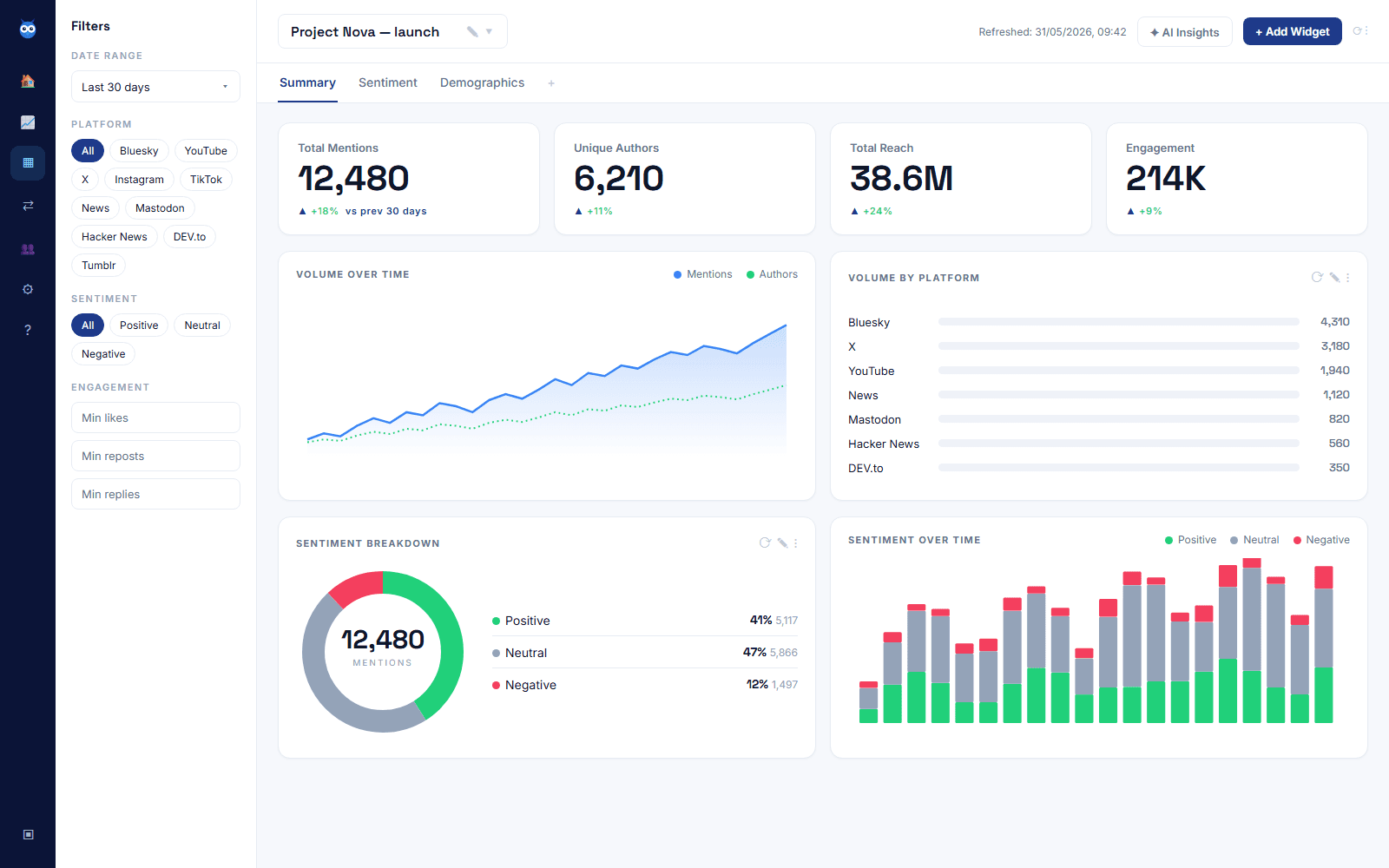
Brand monitoring is the ongoing collection of public mentions of a brand, so a team can see what is being said and respond before it becomes a bigger problem. Three parts make it work: collecting mentions from the places people talk (social media, reviews, news and forums), scoring what each one says, usually positive, neutral or negative, and alerting someone when a number moves enough to matter.
Drop any one of the three and the practice falls apart. Collection without scoring is a pile of posts nobody has time to read. Scoring without an alert means a crisis gets found a week late, once someone happens to check.
Brand monitoring vs social listening
The two terms overlap enough that most people use them interchangeably, and in Babel42 they share one product. Where a line exists, it is in what each one is built to answer.
| Brand monitoring | Social listening | |
|---|---|---|
| Question it answers | Is anyone talking about us right now? | What does the conversation mean, and where is it heading? |
| Typical trigger | A mention, a review, a spike in volume | A theme across weeks of mentions |
| Output | An alert on one post or one number | Sentiment trends, share of voice, audience insight |
A social listening tool does both jobs from the same collected data: the alert when something needs eyes today, and the dashboard that explains the month. Monitoring without listening catches the fire; listening without monitoring explains fires after they are already out. For the fuller version of this distinction, including the strategy and metrics around it, see what social listening is and how it works.
Brand monitoring vs brand tracking
A third term causes most of the confusion: brand tracking. It sounds like the same job, but it is market research, not mention collection. A panel of people answers a survey on a schedule, saying whether they recognise or recall a brand, which is a question put to people who were never going to post about it either way.
The mention-based version only ever sees the people who spoke up in public without being asked. That is a real signal, not a lesser one, but it is a different sample from a survey panel, and the two answer different questions. Our guide to measuring brand awareness covers both methods side by side, including when a survey is worth commissioning and when the continuous version covers the question on its own.
What a brand monitoring tool tracks
A mention is not just a tweet. The sources that matter split into four groups: social media posts, customer reviews, news articles, and forum or community threads. A tool that only watches one of these misses whole categories of conversation, most commonly reviews and forums, which is also where the most detailed complaints and feature requests tend to sit.
Each source answers a different question. Social media shows reach and speed, how far a mention travelled and how fast. Reviews show the specific complaint behind a star rating, in the customer's own words. News shows how a story is being framed by people who were not there. Forums and technical communities show the most candid version, since nobody there is writing with the brand as the intended audience.
Coverage varies by plan rather than by promise. The free plan on Babel42's social listening tool collects 500 mentions a month across five networks, with two monitors and 90 days of history, no card required. Bluesky mentions are matched within seconds of posting; everything else is checked on a schedule set by your plan. Reddit is not collected by any plan, because Reddit's own terms require a separate commercial agreement for that kind of access, so it stays a manual search alongside whatever a tool collects automatically.
Why does brand monitoring matter?
It matters because the alternative is finding out from a customer, a journalist or a competitor, usually after the moment to respond well has passed. A reputation problem is rarely a single bad post. It is a pattern: the same complaint from three different people in a week, a review score drifting down, a competitor's launch pulling the conversation their way. None of those show up if nobody is watching between the weekly report and the next one.
The same collected data answers more than one question. Setting up reputation monitoring uses it to catch a drift before it becomes a headline. Watching what a competitor does and says points the same kind of feed at a rival instead of your own name.
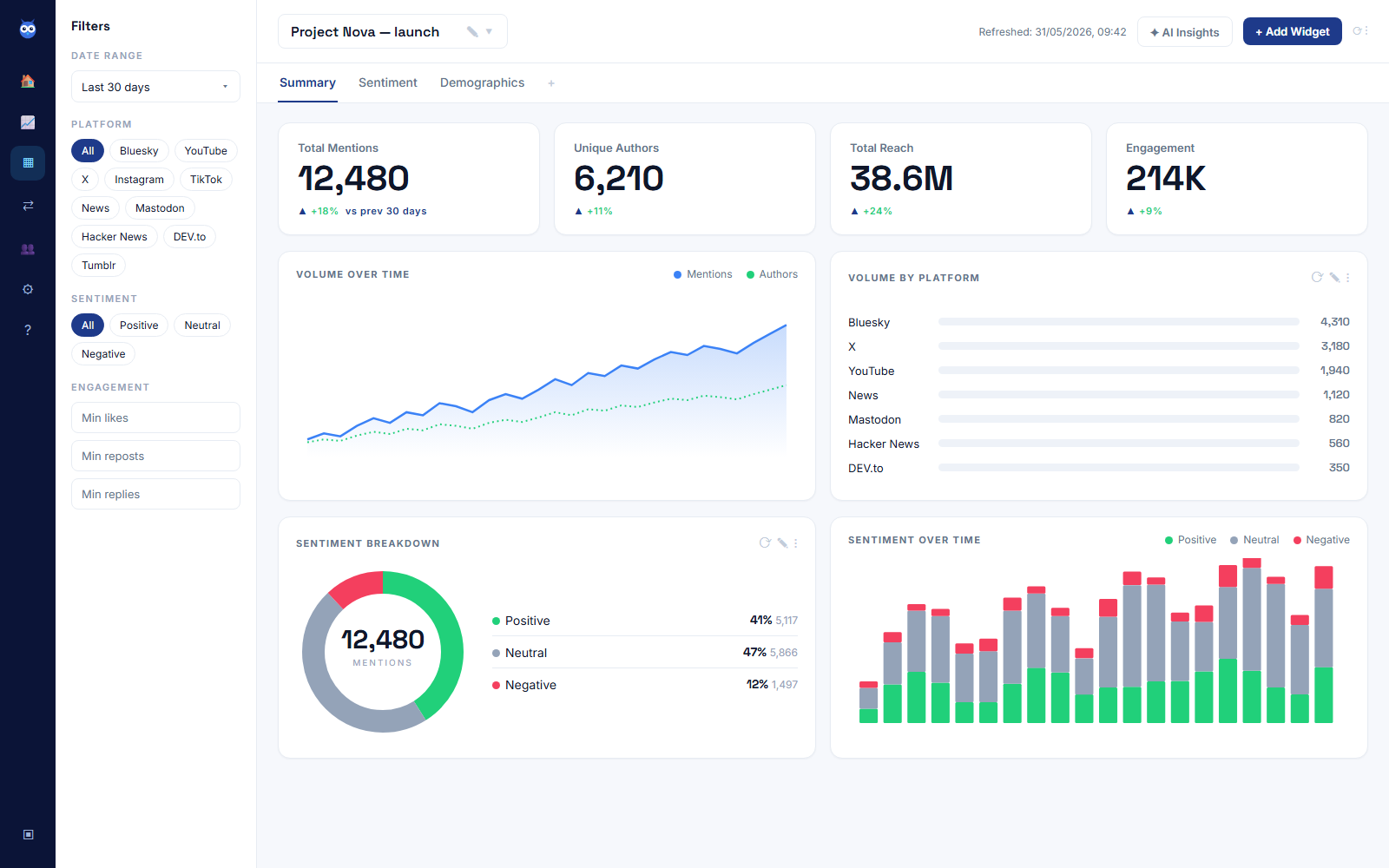
A single tracked launch shows why one overall number is not enough. We tracked 1,587 mentions of the SpaceX IPO and sentiment split almost evenly: 30% positive, 31% negative, read overall. Split by network instead, it told four different stories, which the overall figure had hidden. The full write-up has the network-by-network breakdown.
Common brand monitoring mistakes
Four mistakes show up often enough to name. Each one makes the whole practice look useless, when the fix is usually small.
Watching one platform. A query on X alone misses every review, every forum thread and every news mention, which is often where the most specific complaints sit. Pick the sources your audience actually uses, not the one that is easiest to search by hand.
Reading volume as good news. A spike in mentions can mean a launch landed, or that a complaint is spreading. Check the sentiment behind a spike before deciding which one it is.
No named owner for the response. An alert nobody is responsible for answering is the same as no alert. Decide who replies to a complaint and who hears about a feature request before the first one arrives.
Treating every mention as a true signal. A handful of loud accounts can dominate a small sample. Check who is driving a number, not just the number itself, before reporting it upward.
How to start brand monitoring
Four steps cover a sensible first setup, with no budget and no data team required.
- Write one query. Your brand name plus the obvious variants and misspellings. Use
NOTto drop unrelated results that share the same words. - Pick the sources that matter to your audience. A consumer brand needs social media and reviews; a developer tool needs forums and technical communities more than either.
- Set one alert. A volume spike or a sentiment dip, whichever would need you to act fastest. Everything else can wait for a weekly read.
- Decide who acts on what, before anything happens. Monitoring without an owner for the response is just reading.
Babel42's social listening tool runs this on a free plan, no card required, so the setup above takes an afternoon rather than a procurement cycle.
For the fuller strategy, including how to read the sentiment and share-of-voice numbers once mentions start arriving, see what social listening is, and how to build a strategy around it. For the reputation-specific version, with the thresholds worth alerting on, see how to set up brand reputation monitoring. And for turning the same feed into a lead instead of an alert, see how to generate leads using social listening.